




Manas Dasgupta
NEW DELHI, July 28: With the logjam between the treasury and the opposition benches over, at least over the crucial anti-paper leak bill, the Lok Sabha on Tuesday began normal business taking up the “Public Examinations (Prevention of Unfair Means) Amendment Bill, 2026,” after the government conceded the opposition demand to extend the time for the discussions on the bill to up to 10 hours from six hours originally scheduled, even as the Rajya Sabha was adjourned for the day amidst continued opposition din.
Ahead of the crucial discussion, both the ruling NDA and the Opposition I.N.D.I.A bloc held separate strategy meetings to chart out their respective moves. While the Prime Minister Narendra Modi chaired the NDA’s ‘Mangal Milan’ meeting, leaders of the INDIA bloc also met in the Parliament complex to finalise their floor strategy for the debate.
The anti-paper leak amendment bill, however, is unlikely to be passed on Tuesday itself as the discussion on the measure is expected to continue until around 10 pm, but still remain incomplete to be resumed on Wednesday when its passage is also likely to take place.
Earlier after the speaker Om Birla called for taking up the discussion on the bill, the Union Parliamentary Affairs Minister Kiren Rijiju said the government was willing to extend the time of the anti-paper leak debate in the Lok Sabha to up to 10 hours as the House resumed at 2 pm.
As the proceedings commenced to discuss the exam Bill, Congress MP KC Venugopal objected to Prime Minister Narendra Modi and Home Minister Amit Shah not being present in the House during the discussion on “a very important” Bill. The Opposition also demanded an extension in the discussion time.
Union Parliamentary Affairs Minister Kiren Rijiju clarified that the government has no objection to extending the duration of the debate up to 10 hours. “All political parties had first agreed to six hours of discussion on the anti-paper leak Bill, then it was increased to eight hours. Now, if the Opposition wants more time, we are willing to take it up for 10 hours,” Rijiju said.
The Public Examinations (Prevention of Unfair Means) Amendment Bill, 2026, was introduced in the Lok Sabha by the Minister of State for Personnel Jitendra Singh on Monday. This Bill seeks to amend the Public Examinations (Prevention of Unfair Means) Act, 2024, providing for stricter punishment for indulging in leaking question papers of public examinations. It provides for up to 10 years in jail and Rs 50 lakh fine for individuals and fine of up to Rs 10 crores in case of organised crime. The bill was introduced amidst protests and sloganeering by the opposition, which has been demanding a response from the government over the police crackdown on students during the Cockroach Janta Party (CJP)-led July 20 protest march to Parliament and in other parts of the country.
Piloting the bill, Mr Singh said the amendment in paper leak bill has been brought to make law more stringent. Saying that the incidents of paper leaks have taken place in various states ruled by different parties, Jitendra Singh said the Modi government finished unaccomplished task to bring law to prevent examination malpractices in 2024, which he said was the first legislation of its kind in independent India.
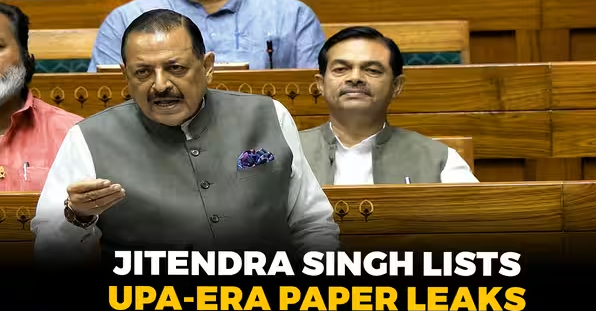
Mr Singh said examination paper leaks were not a new phenomenon and had occurred under previous governments as well. He cited alleged instances from 2009, 2010, 2011, 2012 and 2013, claiming that the railway recruitment examination paper leaked during the UPA government’s tenure in 2009 and that another paper leak occurred in Maharashtra in 2013. Singh said the Centre had brought the legislation to establish a nationwide legal framework to curb paper leaks and protect the integrity of public examinations.
He said the amendment reaffirms the Centre’s commitment to protecting students’ interests and ensuring the integrity of public examinations. “And at the same time, it is also a reiteration of Prime Minister Modi’s resolve- not to allow anyone to compromise with the future of the children of Mother India. Therefore, this bill can be described, in a way, as a milestone legislation in the history of Indian Parliament,” he added.
Mr Singh listed the incidents of paper leaks during the UPA and said”…In 2009- Railway Recruitment Board; 2011- All India Engineering Entrance Examination; 2012- AIIMS New Delhi entrance paper leak; 2013- Maharashtra Secondary Certificate Examination. If I keep listing them, I won’t be able to discuss the Bill itself… 2010- B.Ed. Entrance Examination, Uttar Pradesh; 2012- Tamil Nadu Public Service Commission. 2009- West Bengal Joint Entrance Exam.
“Therefore, this government realised the need for dedicated legislation… There are four major recruitment agencies under the Government of India- UPSC, Staff Selection Commission, Railway Recruitment Board, and the Institute of Banking Personnel; and similarly, for higher education admissions, the National Testing Agency. NTA was also constituted in 2017 by this very government.
“In 1992—for the first time—a recommendation was made to the Government of India, led by the Congress party to establish a common national testing agency. Then, in 2010, during the UPA’s tenure, a committee suggested the same thing; I do not know why it was not given due consideration, for whatever reasons or vested interests. So, I think you must compliment Prime Minister Modi and this government. It has completed a task—an unfinished task—that you should have accomplished yourselves.”
On the Public Examinations (Prevention of Unfair Means) Amendment Bill, 2026, Jitiendra Singh said, “This bill, which was introduced yesterday, is, in fact, an amendment to the earlier bill- Public Examinations Prevention of Unfair Means Act 2024, which was also brought by this government. And not only brought, it was perhaps the first of its kind in the history of independent India.
“The earlier Bill and the amendment today are, in a way, reaffirmation of this government’s deep commitment to safeguard the welfare of the students and the youth of this country. And at the same time, it is also a reiteration of Prime Minister Modi’s resolve- not to allow anyone to compromise with the future of the children of Mother India. Therefore, this bill can be described, in a way, as a milestone legislation in the history of Indian Parliament…”