




Manas Dasgupta
NEW DELHI, May 19: In sharp contrast to India shedding off Mughal and colonial era names of streets and places replacing them with the names of the national heroes, Pakistan nearly 80 years after its creation through partition is reverting back to the old Hindu, Sikh, Jain and colonial names of the streets, alleys, roads and places of Lahore shedding off their Islamised identity.
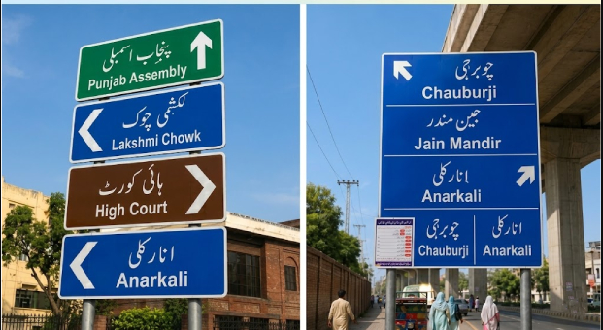
Many of these names had earlier been renamed after Islamic, Pakistani or local figures. Now, the official signboards of Islampura read Krishan Nagar, Babri Masjid Chowk has reverted to Jain Mandir Chowk, Sunnat Nagar is now Sant Nagar, Mustafaabad has become Dharampura and Rehman Gali is back to being called Ram Gali. Over the past two months, at least nine locations have already been renamed, and many others are ready to go back to their “old glory.”
The renaming is part of Pakistan’s Punjab government’s effort to bring back Lahore’s pre-Partition heritage that many believe were slowly erased over the decades. “The Punjab Cabinet meeting, chaired by Chief Minister Maryam Nawaz, a few days ago had approved a plan to restore the original and historical names of various streets and roads in Lahore and its neighbourhood,” a Punjab government official had said.
History bears witness that, ever since the partition, the plight of minorities in Pakistan– particularly Hindus and Sikhs — has been a matter of grave concern. Incidents involving their oppression, forced conversions, encroachment upon their properties, and the demolition of historical temples have surfaced with alarming regularity. However, surprisingly, the name change drive has unfolded with almost no organised opposition in a country shaped by decades of Islamisation.
By restoring old names, Pakistan seeks to demonstrate to the global community, particularly Western nations, that it was shedding its “radical image” to evolve into a tolerant, inclusive, and multicultural nation, thereby facilitating access to diplomatic and economic assistance.
List Of Locality Names Being Restored
| Islamic Name | Restored Name |
| Sunnat Nagar | Sant Nagar |
| Maulana Zafar Ali Khan Chowk | Lakshmi Chowk |
| Mustafaabad | Dharampura |
| Sir Aga Khan Chowk | Davis Road |
| Allama Iqbal Road | Jail Road |
| Fatima Jinnah Road | Queens Road |
| Bagh-e-Jinnah | Lawrence Gardens |
| Islampura | Krishan Nagar |
| Hameed Nizami Road | Temple Street |
| Nishtar Road | Brandreth Road |
| Rehman Gali | Ram Gali |
| Babri Masjid Chowk | Jain Mandir Road |
| Ghaziabad | Kumharpura |
| Jeelani Road | Outfall Road |
| Shahrah-i-Abdul Hameed bin Badees | Empress Road |
For Lahoris, however, these names never disappeared. “The people still call them by the old names,” Kamran Lashari, former director-general of the Walled City of Lahore and secretary of LAHR, said. He said the restoration effort deliberately embraces Lahore’s layered identity — Muslim, Sikh, Hindu, Christian and colonial at the same time. “Whether it is Christian, Sikh, Hindu or Parsi, it doesn’t matter,” he said.
The renaming campaign is part of a much larger ‘Lahore Heritage Area Revival’ (LHAR) project of Pakistan’s Punjab government, which aims to revive the country’s cultural capital to its pre-partition heritage. It is former Pakistan Prime Minister Nawaz Sharif’s ambitious dream project, worth 50 billion PKR, to restore the city’s architectural and cultural fabric after decades of neglect, haphazard urbanisation and ideological rewriting.
It was started by Sharif and his daughter, the current chief minister of Punjab province, Maryam Nawaz, in 2025. The government argues that, like European nations, Pakistan, too, should preserve the historical heritage of its cities rather than erase it. A major objective behind this initiative is to promote heritage tourism, thereby generating revenue for the government.
Sharif has also proposed the restoration of three cricket grounds and a traditional ‘akhara’ (wrestling arena) at Minto Park (Greater Iqbal Park) — which is being widely perceived as a damage control strategy. Sharif’s brother, Pakistan’s Prime Minister Shehbaz Sharif, during his tenure as the chief minister of Punjab in 2015, faced heavy criticism for demolishing three historical cricket grounds, areas under cricket clubs and a wrestling arena as part of an urban development programme.
Several cricketers, like former Pakistan skipper Inzamam-ul-Haq, were trained in these cricket clubs in Minto Park. Before the Partition, Indian cricketer Lala Amarnath also went for training in these clubs. When Amarnath visited Lahore with the Indian cricket team in 1978, he went to Minto Park and spent time with the players of the Crescent Cricket Club, for which he used to play till the Partition happened.
The demolished wrestling arena in Minto Park once witnessed bouts by veterans such as Goonga Pehalwan, Imam Bakhsh and Gama Pehalwan. Before Partition, Hindus would celebrate the festival of Dussehra in Minto Park.
Pakistan has long attracted international scrutiny over allegations of terror financing, costing its economy billions of dollars. By restoring colonial-era names in a major cultural hub like Lahore, Pakistan seeks to construct a narrative suggesting that it is leaving extremism behind, a move aimed at preventing the Financial Action Task Force (FATF) or other global institutions from reimposing stringent sanctions upon it.
Islamabad is also entirely dependent on an International Monetary Fund (IMF) bailout package for survival. The IMF does not merely scrutinise economic data but also keeps a watchful eye on a country’s political stability and social climate. This charade of renaming also reassures foreign investors and the IMF that the country was becoming a safe and liberal destination for investment.
Lahore has long lived in the memory of the subcontinent in a way few cities have. Barely 50 kilometres from Amritsar, it was once a common cultural home for Punjabis across faiths and communities. Its crowded bazaars, old colleges, gardens, akharas, temples, gurdwaras and shrines belonged to a Punjab that existed before Partition tore the region into two countries in 1947.
Partition changed Lahore forever. Majority of Hindu and Sikh families fled or were forced out during the violence of 1947. In the decades that followed, many streets, localities and landmarks once linked to Hindu, Sikh or British history were gradually renamed with Islamic or nationalist identities. Krishan Nagar became Islampura. Dharampura became Mustafaabad. Jain Mandir Road turned into Babri Masjid Chowk.
Yet old Lahore resisted complete erasure. On Lahore’s streets, the old names never completely disappeared. Tea sellers, shopkeepers, rickshaw drivers and residents kept using them in everyday conversations. For many Lahoris, Lakshmi Chowk was always Lakshmi Chowk, no matter what the signboards or official files said.
Lahore is home to more than 100 recognised heritage structures. Restoration work is currently underway on dozens of colonial-era sites.
The revival drive also includes restoration work on churches and Sikh-era structures linked to Maharaja Ranjit Singh’s empire. At Lahore Fort, authorities have restored a painting of Princess Bamba Sutherland, the last descendant of the Sikh royal family. Kamran Lashari said earlier attempts to install a statue of Maharaja Ranjit Singh in Lahore had faced vandalism. But he said the atmosphere in recent years has become more open and inclusive.