



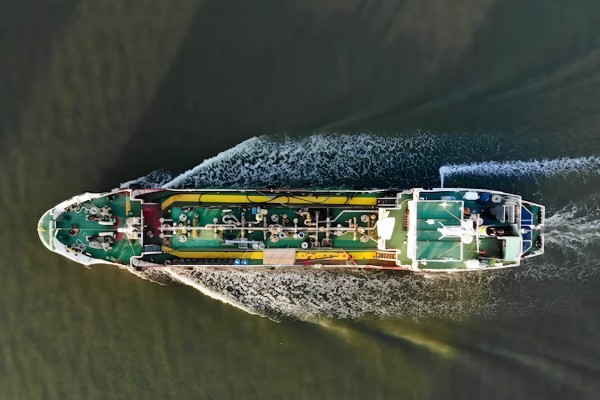

New Delhi: Iran on Wednesday seized two ships in the Strait of Hormuz, tightening control over the strategic waterway a day after U.S. President Donald Trump announced he was indefinitely pausing attacks, with no clear sign of peace talks resuming.
The status of a two-week-old ceasefire, due to expire earlier this week, remained unclear. In a sharp about-face hours after threatening renewed violence, Trump made what appeared to be a unilateral announcement on Tuesday that the U.S. would extend a ceasefire until it had discussed an Iranian proposal in peace talks to end the two-month-old war.
Bur Iranian officials did not say they had agreed to any extension of the truce, and criticised Trump’s decision to maintain the U.S. Navy blockade of Iran’s trade by sea, itself considered by Iran an act of war.
Parliament speaker and lead noegotiator Mohammad Baqer Qalibaf said a full ceasefire would only be possible if the blockade was lifted, adding that reopening the Strait of Hormuz—through which a fifth of global oil trade once passed—was impossible with such a “flagrant breach of the ceasefire,” Qalibaf said on social media.
“You did not achieve your goals through military aggression and you will not achieve them by bullying either,” he wrote in his first response to Trump’s announcement. “The only way is recognizing the Iranian people’s rights.”
Despite repeated threats, Trump stopped short of authorising strikes on Iranian power plants and civilian infrastructure, actions widely warned against under international humanitarian law.
The conflict, which began with joint U.S.-Israeli strikes on Iran on February 28, remains unresolved, leaving both sides in a prolonged standoff. The continued disruption in the Strait of Hormuz has strained global markets, with oil flows severely impacted.
According to statements from shipping firms and Iran’s semi-official Tasnim news agency, the Islamic Revolutionary Guard Corps (IRGC) seized the vessels over alleged maritime violations and escorted them to Iranian shores—the first such seizures since the conflict began.
The IRGC also warned that any disruption to order in the strait would cross a “red line.”
Meanwhile, global oil prices have surged, with the Brent crude, the international crude oil benchmark, closed above $100 per barrel for the first time in two weeks, as the blockade continues to disrupt supply chains and pressure major economies.
No New Deadline for Ceasefire
In his announcement on Tuesday, President Trump said the U.S. had agreed to a request from Pakistan “to hold our Attack on the Country of Iran until such time as their leaders and representatives can come up with a unified proposal … and discussions are concluded, one way or the other.”
White House press secretary Karoline Leavitt said no deadline had been set for the proposal or negotiations.
Pakistan, acting as a mediator, has been attempting to bring both sides together after they failed to attend scheduled talks in Islamabad on Tuesday before the two-week-old ceasefire was due to expire.
Both Iran and the U.S.-Israel alliance have continued to claim progress in the conflict. Iran showcased ballistic missiles during a public parade, with state media images showing crowds waving Iranian flags and a banner in the background with a fist choking off the strait.
Captions read: “Indefinitely under Iran’s Control” and “Trump could not do a damn thing”, referring to the strait, which Iran has effectively shut to ships other than its own and lately attacking vessels that attempt to transit without its permission.
Meanwhile, the Islamic Revolutionary Guard Corps said it had seized two container ships—the Liberia-flagged Epaminondas and the Panama-flagged MSC Francesca—for alleged maritime violations, including operating without permits and tampering with navigation systems.
Greece’s Technomar Shipping confirmed its vessel Epaminondas was seized after reporting it had been fired upon about 20 nautical miles northwest of Oman, sustaining damage to its bridge but with no injuries reported. Shipping giant MSC did not immediately comment.
Maritime security sources also reported that a third, Liberia-flagged vessel was fired upon in the same area but was not damaged and later resumed its journey.
Leavitt said in an interview with Fox News that the seizures did not violate the ceasefire as the vessels were neither U.S. nor Israeli, describing the actions as “piracy.” She added that the use of small gunboats indicated Iran’s naval capabilities had been significantly weakened and that it did not fully control the strait.
Before the war, around 130 vessels passed through the Strait of Hormuz daily. That number has now dropped sharply to only a handful.
The US military said it had redirected at least 29 vessels as part of its blockade, and has also intercepted multiple Iranian-flagged tankers in Asian waters, including near India, Malaysia, and Sri Lanka, diverting them from their routes.
U.S.-Iranian Differences Remain
A first session of peace talks between Iran and the U.S. in Islamabad 11 days ago produced no agreement.
Trump wants Iran to give up highly enriched uranium and forgo further enrichment to prevent it building a nuclear weapon. Iran says it has only a peaceful civilian nuclear programme, and wants the lifting of sanctions, reparations for damage and recognition of its control over the strait.
Iran has also made a ceasefire between Israel and Lebanon’s Hezbollah militant group a condition of truce talks. On Wednesday, Israeli air strikes on Lebanon killed at least five people, including the Lebanese journalist Amal Khalil.
It was the deadliest day since a 10-day ceasefire was announced on April 16 between Israel and Lebanon.
(DD News)