



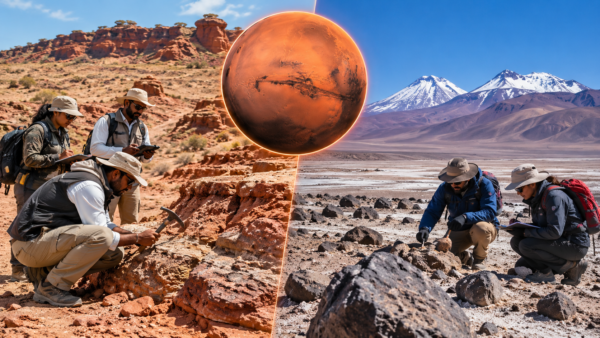

Kerala: Indian researchers have identified geological sites in Tamil Nadu and Chile’s Atacama Desert that share mineralogical and environmental characteristics with Mars, offering new insights into the planet’s history of water activity and potential habitability.
A research team from the University of Kerala identified two hydrous sulphate minerals — melanterite and gypsum — at locations with geological, chemical and physical similarities to the Martian environment.
Melanterite was detected in Neyveli, Tamil Nadu, while gypsum was identified in the Atacama Desert in Chile and the Tiruchirappalli Badlands, a semi-arid geological and palaeoclimatic region in Tamil Nadu.
According to the Department of Science and Technology (DST), the findings could help scientists better understand past water-related processes on Mars and identify environments that may once have supported life.
The research was led by Dr Sajin Kumar K.S., Project Coordinator of the DST-FIST programme at the University of Kerala’s Department of Geology.
The team used an advanced laser Raman spectrometer, supported by the DST’s Fund for Improvement of S&T Infrastructure (FIST) programme, to identify the minerals through their distinctive spectral signatures.
Both melanterite and gypsum are hydrous sulphates that provide evidence of interactions between water and rocks, making them valuable indicators for studying the geological history of Mars.
While gypsum preserves evidence of past aqueous environments, melanterite forms under temporary wet, acidic and oxidising conditions, similar to processes believed to have occurred on Mars.
Researchers said melanterite, formed through the oxidation of sulphide minerals, provides evidence of short-lived wet conditions relevant to understanding sulphate formation on the Red Planet.
Gypsum, meanwhile, records past water activity and can preserve potential biosignatures within its mineral structure, making it significant for astrobiological investigations.
The findings highlight the importance of studying terrestrial analogue sites, particularly as orbital observations alone cannot fully characterise the mineral composition and geological processes of Mars.
High-precision analytical instruments, including Raman spectroscopy, are therefore essential for confirming mineral identities and examining processes that may have shaped the Martian surface.
The research findings have been published in two papers in the Journal of Geophysical Research: Planets, a scientific journal focusing on planetary research.
The team is now expanding its investigations to rare terrestrial analogue sites in extreme environments across the world to better understand conditions associated with primitive life and their relevance to astrobiology.
According to the researchers, identifying minerals that record past water activity and preserve potential biosignatures could help guide future planetary exploration missions towards locations with a greater likelihood of retaining evidence of ancient life.
The DST said advanced research facilities supported under the FIST programme could play an important role in strengthening planetary science and improving scientific understanding of potentially habitable environments on Mars and other planetary bodies.
[DD news]