



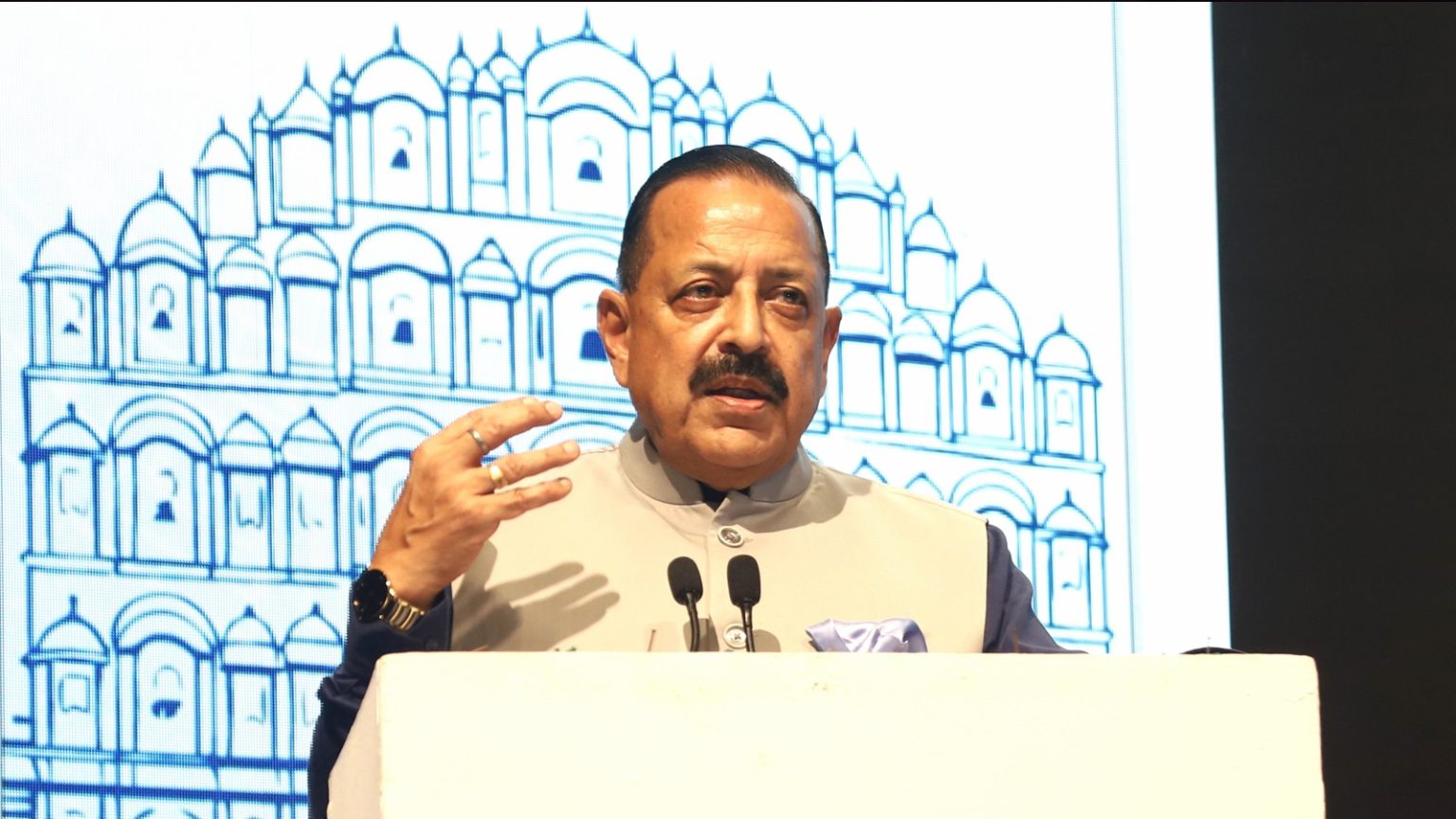

New Delhi: Emphasising that technology must remain accountable to people, Union Minister of State (Independent Charge) for Science & Technology Dr. Jitendra Singh on Thursday said that human-led artificial intelligence (AI) will be the defining force behind India’s journey towards Viksit Bharat 2047, asserting that AI should strengthen governance rather than replace human judgment.
Addressing the valedictory session of the 29th National Conference on e-Governance (NCeG) in Jaipur, the Minister said artificial intelligence is no longer a matter of choice but an essential component of modern governance. However, he stressed that its success would depend on governments deploying it responsibly while keeping citizens at the centre of every technological intervention.
“Technology can accelerate governance, but only human wisdom can give it direction. Human-led artificial intelligence is the pathway through which India will realise the vision of Viksit Bharat 2047,” Singh said.
The two-day conference concluded with the adoption of the Jaipur Declaration on e-Governance 2026, which outlines a roadmap for advancing AI-enabled, data-driven, secure and citizen-centric digital governance aligned with the vision of Viksit Bharat 2047. The Minister also presented the National e-Governance Awards 2026 to 17 outstanding digital governance initiatives, including 10 Gold Awards, six Silver Awards and one Jury Award across seven categories.
AI Should Empower Governance, Not Replace Human Accountability
Singh said India’s digital transformation is driven by the objective of empowering public institutions through technology rather than replacing human decision-making with machines. He noted that governance of the future must combine the speed and analytical capabilities of AI with human judgment, constitutional values and democratic accountability.
“The real question is not artificial intelligence alone; the question is how intelligent we are in using artificial intelligence,” he said, adding that technology should enhance transparency, accountability, efficiency and citizen-centric service delivery while preserving public trust.
He said India’s approach towards AI differs from a purely technology-driven model, with the government committed to deploying Artificial Intelligence in a manner that complements human intelligence instead of substituting it.
AI Central to India’s Governance Reforms
Organised jointly by the Department of Administrative Reforms and Public Grievances (DARPG), the Ministry of Electronics and Information Technology (MeitY) and the Government of Rajasthan, the conference was held under the theme “Viksit Bharat 2047: AI-enabled, Data-driven and Secure Digital Governance.”
The event brought together policymakers, senior administrators, technology experts, researchers, innovators, industry leaders and representatives of local governments to deliberate on the future of digital governance in India.
Singh said the conference demonstrated that India’s digital governance journey has moved beyond simple digitisation of services and entered a new phase driven by artificial intelligence, digital public infrastructure, secure digital ecosystems and data-driven decision-making.
He said governance reforms over the past decade have been guided by Prime Minister Narendra Modi’s vision of “Maximum Governance, Minimum Government,” with technology enabling greater transparency, faster service delivery and enhanced public accountability.
Preparing Governance for 2047
The Minister urged policymakers to design governance systems with a long-term perspective rather than focusing only on present-day challenges.
Highlighting the rapid pace of technological change, he said many innovations considered indispensable today could become obsolete within a short span of time. Therefore, governance systems, public institutions and the role of civil servants must evolve continuously to remain future-ready.
Singh said preparing governance for 2047 requires anticipating change rather than merely responding to it.
Digital Governance Initiatives Highlighted
Singh cited several flagship initiatives that are transforming governance across the country.
He highlighted the expansion of the Centralized Public Grievance Redress and Monitoring System (CPGRAMS), which has emerged as one of the world’s largest technology-enabled grievance redress platforms, significantly reducing grievance disposal time while improving accessibility.
He also pointed to SAMADHAN DIDI, an AI-powered multilingual voice chatbot developed in collaboration with BHASHINI, as an example of how Artificial Intelligence can make governance more inclusive by enabling citizens to interact with government services in their own languages.
The Minister also referred to the National e-Governance Service Delivery Assessment (NeSDA), the IndiaAI Mission, Digital Public Infrastructure, Mission Karmayogi and Special Campaign 5.0, saying these initiatives are helping build a more efficient, transparent, secure and citizen-centric administrative system.
Rajasthan’s Digital Governance Praised
Congratulating the Government of Rajasthan for successfully hosting the conference, Singh praised the state’s progress in digital governance, particularly the Raj-Kaj integrated administrative platform, which has improved administrative efficiency through paperless and technology-enabled governance across departments.
He said the conference reflected a true “Whole-of-Government” approach by bringing together the Centre, States, academia, industry and civil society to shape governance reforms for the future.
Jaipur Declaration Charts Future Roadmap
The conference concluded with the adoption of the Jaipur Declaration on e-Governance 2026, reaffirming the commitment of governments to build AI-enabled, secure, transparent and citizen-centric governance systems.
Calling upon participants to implement the ideas and best practices discussed during the conference, Singh said India’s aspiration to become a developed nation by 2047 would depend not only on technological advancement but also on preserving human judgment, institutional integrity and democratic accountability.
“Artificial Intelligence must remain an instrument that empowers people rather than replacing them,” the Minister said, expressing confidence that India’s model of responsible, citizen-centric digital governance would continue to serve as a global benchmark in the years ahead.
(DD News)