



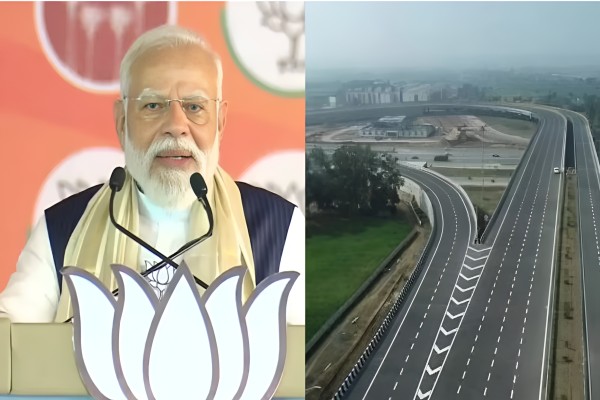

New Delhi: Prime Minister Narendra Modi will inaugurate the long-awaited Delhi-Dehradun Expressway on Tuesday. The project, also called the Delhi-Dehradun economic corridor, will reduce the travel time from Delhi to Dehradun by almost half.
The Prime Minister held a roadshow in Dehradun ahead of the inauguration of the Delhi-Dehradun Economic Corridor, a major infrastructure project aimed at enhancing regional connectivity.
Several people had congregated to greet the Prime Minister along his route through the roadshow. Prior to this, he had conducted a roadshow in Saharanpur, Uttar Pradesh.
The journey between the two cities was completed within six hours previously; however, with the opening of the Delhi-Dehradun expressway, this journey will take only 2.5 hours.
The inauguration will take place as part of the Prime Minister’s tour to Uttarakhand, where he will inaugurate the expressway that spans 213 kilometres. The expressway has been constructed at an estimated cost of more than ₹12,000 crore.
The expressway passes through Delhi, Uttar Pradesh and Uttarakhand.
The commencement of the Delhi-Dehradun expressway reflects the Centre’s commitment toward initiating high-speed connectivity projects despite the grand inauguration requiring significant traffic control operations, impacting commuters across multiple routes in Uttarakhand and Western Uttar Pradesh.
Ahead of the Prime Minister’s visit, local authorities have issued a detailed traffic advisory, implementing route diversion plans.
Vehicles travelling from Muzaffarnagar toward Dehradun will be diverted from Rampur Tiraha via Purkazi, Manglaur, Roorkee, and Haridwar. Likewise, vehicles moving towards Dehradun from Deoband-Nangal will be redirected via Gagalheri, Bhagwanpur, Roorkee and Haridwar.
Traffic moving from Saharanpur are being redirected through Gagalheri Tiraha and Bhagwanpur Tiraha for movement to Dehradun, which further leads to Roorkee and Haridwar.
Those from Behat moving through Chhutmalpur are being diverted through Badkalan underpass to Bhagwanpur and further to Roorkee and Haridwar.
In Dehradun, certain routes, including the elevated road from Mohand, have been temporarily sealed, and traffic has been diverted through designated alternative routes to avoid disruptions during the Prime Minister’s convoy movement.
Furthermore, restrictions have been imposed from April 12 evening to April 14 afternoon on key areas, particularly the Delhi-Saharanpur-Dehradun highway, to control congestion and maintain security during the high-profile event.
The expressway, spanning Delhi, Uttar Pradesh, and Uttarakhand, is characterized by many modern features such as wildlife corridors, underpasses, and a sophisticated traffic system, making it an essential part of India’s growing highway network.
The expressway includes features that allow free wildlife movement, such as a 12-kilometre-long elevated passage—among the longest in Asia—that runs through the ecologically fragile Rajaji National Park in the Shivalik hills.
Other provisions include eight animal crossings, two 200-metre-long elephant underpasses, and a 370-metre-long tunnel near the Dat Kali temple.
In terms of planning, the corridor has been structured into four phases.
The initial phase covers a 31.6 kilometre stretch from Akshardham to Khekra, which falls close to the Eastern Peripheral Expressway, where the existing lane has been developed into a six-lane elevated road with service lanes.
In the second phase, the 120 kilometres long project has been built as a greenfield project from the EPE interchange at Baghpat till the Saharanpur bypass. The third phase, extending over 42 kilometres from the Saharanpur bypass to Ganeshpur in Uttarakhand, is already complete.
The final stage covers 20 kilometres, where a section of 4.6 kilometres has been upgraded and the rest has been newly built.
Traffic officials have advised commuters to plan beforehand and adhere to the diversion rules to avoid delays. Additionally, the project is anticipated to make it easier for visitors to access significant places of worship and tourism destinations, including Haridwar.
The inauguration has generated much political interest as well, with the project being touted as an important step towards developing the region, even as opposition parties raise questions over infrastructure readiness and execution timelines.
(DD News)