



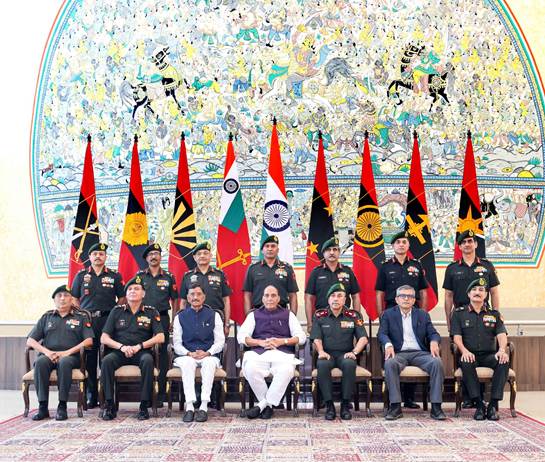

New Delhi: New thinking and better coordination with modern weapons played an important role in ‘Operation Sindoor’. Defense Minister Rajnath Singh said this at the Army Commanders’ Conference on Friday. He also released the ‘Land Warfare Doctrine’ here. The Raksha Mantri said that the Indian Army will have to be fully prepared to deal with the present and emerging challenges while preparing for the next 20 to 30 years for the challenges of future wars.
The ‘Land War Doctrine’ will provide a comprehensive framework to prepare the Indian Army to face the challenges arising out of the changing warfare and future conflicts. The aim is to orient the Army’s readiness to suit future combat requirements. Amidst changing technology, operational conditions and security challenges, this doctrine will serve as the guiding framework for developing the Army’s future capabilities.
Defence Minister Rajnath Singh has called upon the top leadership of the Army to keep a close watch on the evolving geo-political and regional developments and adjust their tactics according to the situation. He said that the Army’s strategy should be based on long-term thinking, but it should also be flexible enough to make timely changes if needed. In the changing security scenario, both future preparedness and the ability to respond to immediate challenges are essential.
The Raksha Mantri lauded the Armed Forces for adapting themselves to the changing operational scenarios. He said that new thinking, better coordination and strong coordination played an important role in the success of ‘Operation Sindoor’. Modern weapons also increased the effectiveness of this campaign. According to the defence minister, the operation sent a clear message that India will not shy away from taking necessary steps to protect its national interests. He also appreciated the organisational changes being made within the Army.
Stressing on the use of drones, in particular, and modern technologies, he said the Army should constantly assess its capabilities and improve them as per the requirement. He called for intensification of work in areas such as AI, automated systems, data analytics, cyber security and secure communication networks. These technologies aim to strengthen the operational capability of the military and better prepare it for future wars.
The Raksha Mantri said that the challenges in the air, maritime, space and cyber domains are constantly increasing. Despite this, the role of the army on land war and on the ground will remain indispensable. Given the needs of modern warfare, it is necessary to integrate the capabilities of all sectors. He stressed that success in future operations will not depend on any one military capability alone. This will require developed capabilities in various domains and seamless coordination during joint operations.
According to the Defense Minister, India’s defence production reached a record Rs 1.78 lakh crore in the financial year 2025-26. At the same time, defence exports also reached an all-time high of about Rs 38,000 crore. He made it clear that reforms should not be limited to policies and schemes alone, but their benefits should be reflected in the actual operational capability of the Army. For this, it is necessary that there should be regular review of the changes made and corrective steps should be taken where necessary.
Raksha Mantri Shri Rajnath Singh lauded the courage, discipline, preparedness and restraint of the Armed Forces, saying the dynamic leadership and diplomatic efforts of Prime Minister Narendra Modi have also contributed to strengthening India’s standing on the global stage. On the occasion, the Raksha Mantri also unveiled the annual journal related to the United Nations. He also felicitated the personnel of the Indian Army for their outstanding contribution in UN peacekeeping operations.
[DD news]