Agriculture: India overtakes China, becomes the world’s largest rice producer







Virendra Pandit
New Delhi: Union Agriculture Minister Shivraj Singh Chouhan said India has become the world’s largest rice producer, beating China, with a total output of 150.18 million tonnes, the media reported on Monday.
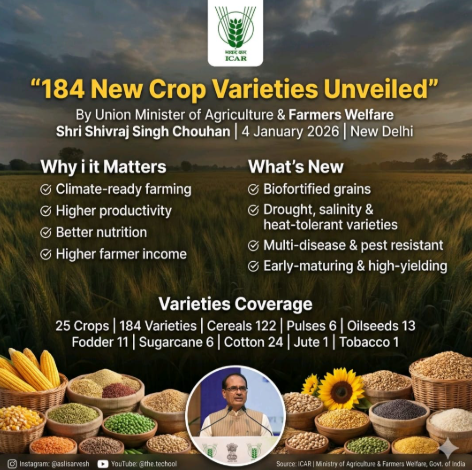
He said this while unveiling 184 improved varieties of 25 field crops developed by the Indian Council of Agricultural Research (ICAR) at an event in New Delhi.
These new high-yielding seed varieties would boost crop production and enhance farmers’ income, he said, and directed officials to ensure these varieties reach farmers quickly.
Chouhan said India has achieved great success in the development of high-yielding seeds. Since 1969, a total of 7,205 crop varieties have been notified, including rice, wheat, sorghum, maize, pulses, oilseeds, and fibre crops, among others.
He informed that 3,236 high-yielding varieties have been approved by the Narendra Modi-led government since 2014, as compared to 3,969 varieties notified between 1969 and 2014.
India has transformed from being a food-deficient country into a global food provider.
“India has surpassed China in rice production and has become the world’s largest producer,” he said.
India’s rice production has reached 150.18 million tonnes, compared to China’s 145.28 million tonnes, he said, describing it as an unprecedented achievement. India is now supplying rice in overseas markets.
India has abundant foodgrain stocks, thereby ensuring its food security.
Elaborating on 184 advanced varieties released on Sunday, Chouhan said that farmers will be benefited with higher yields and better quality of produce.
He also asked farm scientists to focus on increasing the production of pulses and oilseeds to make India self-sufficient.
Chouhan said India has entered a new era of agricultural revolution on the strength of the development of high-yielding and climate-resilient seeds.
This achievement is the result of the collective efforts of the ICAR’s All India Coordinated Projects on crops, state and central agricultural universities, and private seed companies.
The 184 recently released varieties include 122 cereals, 6 pulses, 13 oilseeds, 11 fodder crops, 6 sugarcane, 24 cotton (including 22 Bt cotton), and one each of jute and tobacco.
These varieties, developed by ICAR institutes, state/central agricultural universities, and private seed companies, are climate-resilient, high-yielding, and resistant to major pests and diseases.
“These newly-released varieties have been developed to address challenges such as climate change, soil salinity, drought, and other biotic and abiotic stresses, while also supporting natural and organic farming practices.”
Agriculture Secretary Devesh Chaturvedi noted that seed multiplication rates have been increased by 1.5 to 2 times to strengthen seed availability.
National and state seed corporations are ensuring quality seeds at affordable prices, he added.