




Virendra Pandit
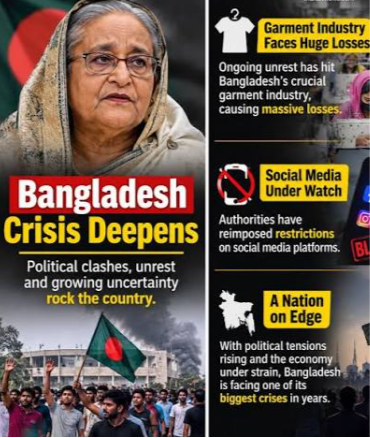
New Delhi: As Bangladesh prepares for a violent showdown with the likely return of former Prime Minister Sheikh Hasina Wazed and her re-energised Awami League next month, global textile brands have shifted hundreds of millions of orders from the Islamic country, which is going the Pakistan way, to India.
Many global fashion retailers, including Zara and H&M, shifted nearly a tenth of their monthly orders from Bangladesh to other Asian manufacturing hubs in the first half of November, as labour and political unrest disrupted production and rising costs eroded the country’s competitive edge in the textile business, the media reported on Friday.
Between November 1 and 18, major brands diverted about USD 254 million worth of orders from Bangladesh, with most moving to neighbouring India in a shift that represents a major blow to a key pillar of Bangladesh’s economy and could extend beyond the current unrest.
Rising wages, energy shortages and political uncertainty have weakened the low-cost advantage that, during the 15 years of business-friendly Hasina regime, helped make Bangladesh the world’s second-largest apparel exporter after China, prompting global brands to diversify sourcing.
The fresh economic protests have caused more than USD 400 million in production losses, according to the Bangladesh Garment Manufacturers and Exporters Association (BGMEA), in an industry that accounts for more than 80 per cent of Bangladesh’s export earnings and nearly 40 per cent of its manufacturing jobs.
Business shift
India has emerged as the biggest beneficiary of the order diversions, while buyers are also looking to Vietnam, Cambodia and Indonesia to reduce supply-chain risks and improve delivery reliability, the reports said.
Those pressures intensified on Wednesday when Bangladesh approved a 36 per cent increase in the minimum wage for garment workers, although the rise was the smallest in four decades.
The increase fell well short of workers’ demands to more than double wages, triggering fresh clashes with police even as Abdur Rahman Tarafder, secretary of the Ministry of Labour and Employment, said the wage increase was “satisfactory” and that he hoped all garment workers would resume work from Saturday.
The ongoing unrest had prompted Zara, H&M, Marks & Spencer, Celio and other global brands to divert orders, with India receiving the bulk of the business.
Manufacturers said the bigger concern was that orders already diverted could be followed by the loss of future business as buyers reassessed where to source garments.
Persistent energy shortages, exacerbated by the Middle East crisis, have added to production disruptions and forced some factories to rely on more expensive alternative power sources, and increasingly prioritise delivery times over price when choosing suppliers.
India can offer buyers a delivery advantage of about a week, while Vietnam and Cambodia can cut lead times by as much as 15 days.
Rival sourcing hubs can typically complete production and delivery within 60 to 90 days, compared with about 120 days in Bangladesh.
The disruptions have also created production backlogs, with manufacturers around Dhaka losing an estimated 20 to 25 production days. Some are considering overtime and costly air freight to meet delivery commitments.
Political tensions
Political tensions surrounding former Prime Minister Sheikh Hasina’s possible return from India in December have added to concerns about further disruption.
Restoring stability and uninterrupted production would be critical to retaining international buyers. Orders shifted elsewhere during periods of instability might not return even after conditions improved.
The challenge is restoring buyers’ confidence before temporary shifts become long-term sourcing decisions. Since brands have options, they will not wait instability persists.