


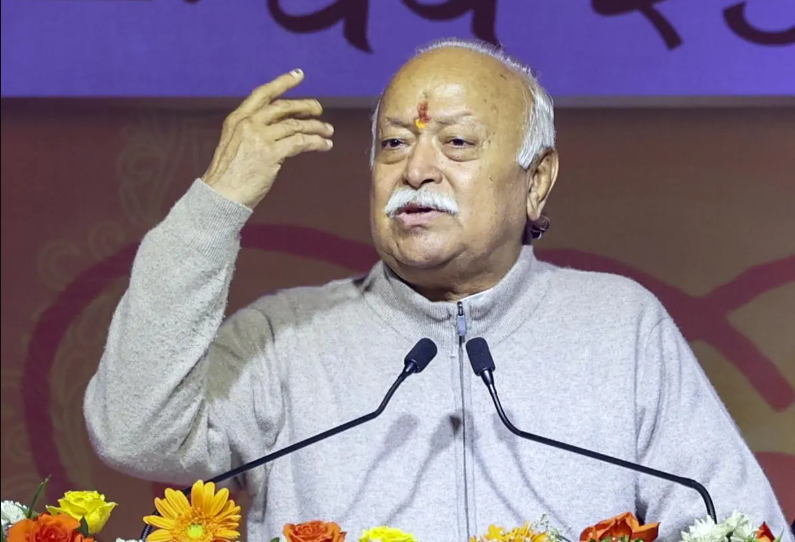

NEW DELHI, Nov 12: The Rashtriya Swayamsevak Sangh (RSS) chief Mohan Bhagwat on Thursday said the world was increasingly looking towards India for solutions to vexed problems.
Addressing the gathering after inauguration of a veterinary and agriculture college of the Datta Meghe Foundation in Nagpur, Bhagwat said, “India could draw upon its traditional knowledge and experience to provide a new development model to the world, which was increasingly looking towards the country for solution.”
“Biodiversity, ecology, animal health and environmental conservation are essential for human well-being, Bhagwat said, stressing the need for a lifestyle that ensures the well-being of all rather than only oneself. “Our vision of life should be such that it is not merely about my life, but about everyone’s life,” he said.
“In English, this is referred to as “One Health.” This term and the concept behind it have emerged in the modern world over the last 20–30 years. However, in India, this idea has existed for centuries—not through an English term, but rather through our ancient lifestyle and traditions,” he said.
“If the environment is not healthy, we cannot remain healthy either. Similarly, when the health of animals deteriorates, it does not merely affect their productivity; diseases can also spread from animals to humans. In science, this process is known as ‘zoonosis.’ If humans themselves are not healthy—and fail to grasp the importance of the environment and the animal kingdom—the entire creation could be placed in jeopardy. While the modern world is coming to realize this truth through its own experiences, this understanding has existed in India since ancient times.”
“That is why our traditions and festivals also reflect respect for nature and animals. We recently celebrated Diwali, which begins with Govatsa Dwadashi—a day dedicated to the worship of the cow. Cow dung also holds significance during Govardhan Puja. Today, the world, too, has begun to recognize the utility and importance of cow dung,” he said.
India’s perspective has always been holistic and integral. Our nation is ancient, and the experience of life here is equally old. Long ago, our ancestors—having learned from the very challenges and experiences that the world is navigating today—developed a way of life. Now, the world is gradually beginning to understand the significance of that way of life.
“The ‘One Health’ concept is one such example. Until now, the prevailing global perspective was that humans are the masters and owners of nature, and could therefore utilize it as they pleased. However, an understanding is now emerging that we are not the masters of nature, but rather a part of this very creation and universe. We are all dependent on nature and on one another,” he added.
(Manas Dasgupta)