



Manas Dasgupta
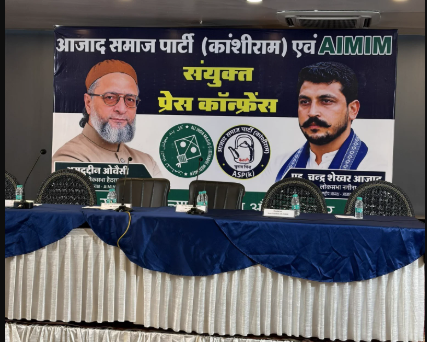
NEW DELHI, Nov 12: To the massive advantage of the ruling BJP, Asaduddin Owaisi’s All India Majlis-e-Ittehadul Muslimeen (AIMIM) and Chandrashekhar Azad’s Azad Samaj Party (Kanshiram) announced the formation of a new alliance, the “Samajik Parivartan Morcha,” creating a third front ahead of the one of the most crucial Uttar Pradesh Assembly polls scheduled early next year.
Announcing the formation of the new alliance at a joint press conference in Lucknow on Thursday, Mr Owaisi said, “We have decided to form Samajik Parivartan Morcha. I can say with confidence that this will be a strong Morcha to stop the BJP from coming to power in UP for the third time.”
“If SP, Congress or any other party wants to join us to stop BJP from coming to power, we are open to it,” the Nagina MP Mr Azad said. Mr Owaisi announced that Mr Azad would be SPM coalition’s Chief Ministerial face for the 2027 State election. “I am happy to announce that our brother Chandrashekhar Azad will be the chief president of the SPM and its chief ministerial candidate in Uttar Pradesh,” Mr Owaisi said.
The AIMIM chief said the alliance would focus on issues concerning backward and Dalit communities, the oppressed and marginalised sections, irrespective of their caste, alleging that these communities had so far been used merely as vote banks by political parties. He said the morcha would raise issues such as the deteriorating condition of education, unemployment among the State’s youth and problems faced by farmers.
Mr Azad, however, said the new alliance was not the third front. “This is not a third front, but a front for social change. Our alliance is strong on the ground, and it will grow even stronger. It is the alliance of deprived, downtrodden, marginalised, oppressed and exploited people and groups, our promised is to eradicate poverty and helplessness, to put an end to the caste-based violence and oppression inflicted upon us, in Uttar Pradesh.”
He said, those who spoke of uplifting the poor, marginalised social groups, of bringing them into the mainstream, went on to become MLAs, MPs, Chief Ministers, and even Prime Ministers. “Yet, these marginalised community remains exactly where it has always been. The truth is that governments kept changing, announcements kept being made, and even today, the Bahujan community remains deprived of basic amenities, in Uttar Pradesh these communities face injustice through bulldozer raj.”
The alliance between the two parties could pave the way for the first declared non-Bharatiya Janata Party (BJP), non-Congress political front in Uttar Pradesh, with both parties considered marginal players eyeing to consolidate Scheduled Caste (SC) and minority voters in the politically crucial state.
With Owaisi by his side, Azad made health, education and jobs as the big pitch for the alliance agenda. He promised free education up to class 12, better hospitals and jobs for the youth as the alliance’s priority areas.
While the Samajwadi Party-led Opposition is seeking to dislodge the BJP government, which has been in power for a decade, the AIMIM-Azad Samaj Party alliance is looking to chip away at a section of the Muslim and Dalit vote. This could potentially disrupt the Opposition’s electoral arithmetic, which also depends heavily on the support of these two voter blocs. Muslims account for around 20% of Uttar Pradesh’s population, while Dalits constitute approximately 21%.
Owaisi had, for months, sought space in the Opposition alliance, even issuing ultimatums to the SP and the Congress. However, his overtures failed to find takers. The Samajwadi Party and the Congress, which are currently engaged in seat-sharing negotiations, have given Owaisi’s overtures a cold shoulder and have also played down the significance of the AIMIM-Azad Samaj Party alliance.
The Samajwadi Party and the Congress leaders in the state reacting to the new alliance have said political parties were free to enter into alliances and that each party would decide its own course. “In a democracy, everyone is free to form alliances. They can do what they want; we’ll decide our own course. In politics, these things don’t matter much at this stage. Everything is taken into consideration,” he said.
The BJP, meanwhile, dismissed the Owaisi-Azad alliance as lacking an agenda and expressed confidence that it would benefit the party in the Uttar Pradesh elections. The party is hopeful that at least in 58 constituencies in the state where the BJP lost by narrow margins, in most of the cases by less than even 1,000 votes, in the last Assembly elections, the new alliance cutting into the minority and Dalit votes would largely benefit the saffron party.
In addition, the political landscape during the 2022 Assembly elections was markedly different from the present situation. At the time, Jayant Chaudhary’s Rashtriya Lok Dal (RLD) and Om Prakash Rajbhar’s Suheldev Bharatiya Samaj Party (SBSP) were part of the Samajwadi Party-led alliance. Both parties are now aligned with the BJP.
In western Uttar Pradesh, Jayant Chaudhary’s party has a significant support base, while Om Prakash Rajbhar’s SBSP wields influence among the Rajbhar community and in either situation, the saffron party stands to gain on the path of winning the third successive mandate in the 2027 elections.