



Manas Dasgupta
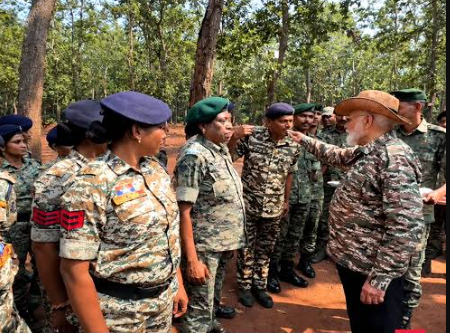
NEW DELHI, Nov 8: Keeping his tradition of celebrating Diwali with the jawans, the Prime Minister Narendra Modi this year spend the Diwali day on Sunday with the security personnel at a Central Reserve Police Force (CRPF) camp in once Naxal-infested Bastar, Chhattisgarh, but his target of attack remained the opposition parties whom he called “Dimagi Naxals.”
Addressing the personnel, Mr Modi said the armed Maoists had been eliminated, but “dimagi Naxals” (ideological supporters) had infiltrated several political parties and organisations and were instigating people against the Constitution and democracy. “We must identify and defeat such elements and secure the country,” Mr Modi said, reminding the people that the government declared the country free of Naxalism on March 31, 2026.
Describing the occasion as particularly significant as it marked the first Diwali after India’s victory in its decades-long fight against Naxalism and Maoist extremism, Mr Modi praised their courage and sacrifice, saying the country had achieved a major milestone in its internal security efforts.
He said the festival was especially meaningful because every district in the country was now free from Naxalism, and millions of people had been freed from the fear associated with the insurgency.
“This is the first Diwali after achieving victory in the decades-long fight against Naxalism and Maoist terror. This is the first Diwali when every district of the country is free from Naxalism. This is the first Diwali when crores of Indians have been freed from the fear of Naxalism,” he said.
“Amid the successes, we must remember one more thing. Naxalites have been eliminated, but the threat is not over yet. Armed Naxalites have disappeared from the forests, but ‘dimagi Naxals’ have taken control of several organisations,” he said.
“Even today, they are instigating people against the country’s Constitution and democracy. They have infiltrated several political parties and different organisations. We must identify and defeat them and secure the country,” he added. The government, he said, took decisions that “dealt very big blows to the funding of Naxals and secessionists.” On Independence Day in August 2026, Mr Modi had also referred to “dimagi Naxals” saying the country had succeeded in removing armed Naxalism but its ideological supporters were seeking opportunities to promote violence.
Recalling the fight against Naxalism in Bastar, Mr Modi said it had not been easy, as at one point over 230 districts across nearly 20 States were affected by Left-Wing Extremism. After sunset, life would come to a standstill, thousands of villages and crores of people were affected, and there were around 2,000 Naxalite attacks annually, he said.
“This land had become soaked in the blood of our brave personnel, but not a single sigh of grief was heard from any of the ‘naamdaar’ (powerful people) living in palaces. Not a single tear rolled down their eyes. Such attacks continued to take place somewhere or the other almost every day,” he said, targeting previous governments. Between 2004 and 2013, more security personnel were killed every year than the number of Naxalites eliminated, he said.
“Unfortunately, the governments of that time treated Naxalism as an incurable disease and left it unaddressed. No country can function with such an approach towards its enemies… The lack of political will that the country faced was addressed in 2014, when you gave this Pradhan Sevak the opportunity to serve Mother India,” he said.
The morale of security forces began changing after 2014, Mr Modi said, adding that for the first time in 47 years, not a single CRPF personnel lost his life while on duty over the past year. “This is a victory of the country’s right policies and strong political will. This is a victory of your valour, courage and restraint,” he said.
The Prime Minister said the government had taken tough decisions to strengthen national security, including measures not widely known. “These decisions and efforts dealt a major blow to the funding networks of Naxalites and secessionists. The fake currency nexus was destroyed. This not only broke their financial backbone but also choked their entire supply lines. As a result, the supply of weapons was stopped, and the recruitment of Naxalites was curbed,” he said.
Mr Modi alleged that previous governments tied the hands of security forces during ground operations and denied them the freedom to retaliate effectively against Maoist attacks. “We gave security forces the freedom to take every necessary decision. We also worked to stop the support that Left-Wing Extremism received from certain people within the government and the system,” he said.
The government’s objective, he said, was to ensure that no mother lost her child, no family was pushed into devastation, no child took up arms, and no youth’s future was destroyed. “Without publicity or showmanship, we worked with sensitivity and broke the backbone of Maoist terrorists. We transformed the lives of people in Naxal-affected areas through a spirit of service, which led those suffering from Naxalism to stand firmly with the government and security forces,” he said.
Over the past 12 years, the country had not only won the battle against Naxalism and secessionists, but also achieved a major victory in its fight against poverty, Mr Modi said, citing a World Bank report that 50 crore people had come out of extreme poverty in India. “What decades of ‘garibi hatao’ slogans could not achieve, the country accomplished in just 12 years,” he said.
He said India had the capability to fulfil its resolutions, citing the abrogation of Article 370, the construction of household toilets, and the expansion of vaccination coverage. “When we speak of eliminating poverty, building a drug-free India, creating a developed India and making India self-reliant, the country will achieve these goals as well,” he added.
The Prime Minister underlined the importance of internal security, saying a strong security framework was essential to protect the country from external threats. “When internal security is strong, external enemies cannot do anything. It is only when internal security becomes weak that external enemies gain the upper hand,” Mr Modi said.
Earlier in the day, the Prime Minister had announced his visit to Bastar in a post on X, saying he was going to celebrate Diwali with the country’s brave security forces. He described the region as an area where Naxalism once held sway but where development was now progressing.