




Manas Dasgupta
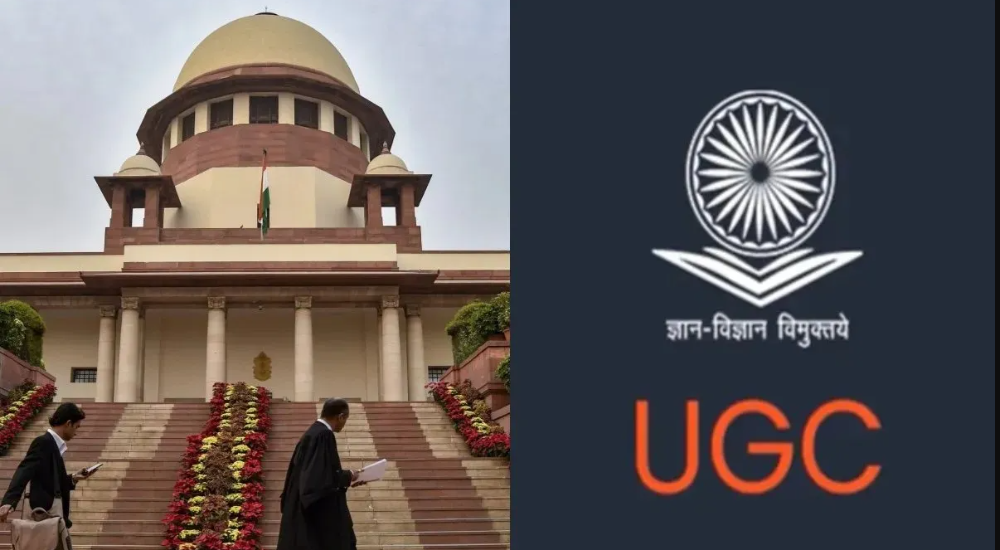
NEW DELHI, Nov 5: The Centre is considering to appoint a committee to re-visit the controversial regulations of the University Grants Commission (UGC) in keeping with the objective of ensuring unity in the society that progress together without discrimination or divisions, the Supreme Court was informed on Thursday.
The “University Grants Commission (Promotion of Equity in Higher Education Institutions) Regulations, 2026,” to address caste-based discriminations in higher educational institutions were stayed by the court earlier this year after petitions questioned their neutrality.
“The government is contemplating appointing a committee to reconsider the UGC regulations,” Solicitor General Tushar Mehta told a three-judge bench presided by Chief Justice of India Surya Kant. The solicitor general said this after the bench also comprising Justices Joymalya Bagchi and V Mohana told the government to consider taking a relook at the provisions. “Why don’t you revisit these regulations so that the next generation is taken care of? They should protect the interest of every student,” the CJI said.
The Chief Justice emphasised that the objective should be to ensure that society progresses together without discrimination or divisions. Mr Mehta assured the court that the interests of students belonging to all communities would be protected and that no section should feel threatened, dissatisfied or discriminated against.
Notified on January 13 this year, the UGC (Promotion of Equity in Higher Education Institutions) Regulations, 2026, had snowballed into a political issue after drawing objections from both general category groups and sections of Dalit and OBC communities. In the eye of the storm was regulation 3(1)(c), which defines caste-based discrimination as discrimination on the basis of caste or tribe against members of the Scheduled Castes, Scheduled Tribes and Other Backward Classes.
Petitioners who challenged it argued that this excludes general category students and faculty from specific protection against caste-based discrimination. At the same time, the regulations’ broader definition of “discrimination” covers unfair or differential treatment on the ground of caste against any stakeholder.
The regulations stem from a 2019 petition filed in the Supreme Court by the mothers of Payal Tadvi and Rohith Vemula, who committed suicide over alleged caste-based discrimination in 2019 and 2016, respectively. They had sought the enforcement of robust anti-discrimination mechanisms across higher education institutions.
The bench heard a batch of petitions challenging the regulations and raised concerns over their potential interpretation and implementation. During the hearing, the CJI also emphasised that the interests of every student must be safeguarded while framing such regulations, adding that the country’s young generation should be kept in mind.
The petitioners have argued that the new rules were discriminatory, exclusionary and violate constitutional principles by allegedly failing to provide equal protection to students belonging to the general category.
During the proceedings, advocate Vishnu Shankar Jain questioned the definition of caste-based discrimination provided under the new UGC regulations. He argued that the law should not presume that discrimination could take place only against a particular section of society. “I am seeking a stay on this definition of caste-based discrimination. The law cannot presume that discrimination will take place only against a particular category. It cannot be assumed that discrimination occurs only against one section,” Jain submitted before the bench.
Responding to his arguments, CJI Surya Kant raised a hypothetical situation involving students from different parts of the country. He asked what would happen if a student from South India took admission at a university in North India, or a student from North India enrolled at an institution in the South, and faced insulting or sarcastic remarks despite the two sides not knowing each other’s caste.
Jain also pointed out that the new definition did not specifically include the term ‘ragging’. Another lawyer appearing in the matter argued that universities were effectively being divided along caste lines under the new regulatory framework.
During the hearing, the Chief Justice raised broader concerns about the possibility of creating divisions within educational institutions and society. “After 75 years, whatever we have achieved towards becoming a casteless society, are we now moving towards becoming a regressive society?” CJI Surya Kant asked.
He also highlighted the problems faced by students who come to universities from different cultural and geographical backgrounds, particularly those from southern and north-eastern parts of the country.
The Chief Justice observed that students often carry their cultural identities with them when they move to other regions for education. Those unfamiliar with their traditions sometimes make remarks that can be hurtful or offensive.
He also expressed reservations about the suggestion of having separate hostels based on caste. “For God’s sake, there are inter-caste marriages as well. We have also lived in hostels where everyone stayed together,” the CJI remarked.
During the proceedings, CJI Surya Kant indicated that the court did not want to pass an order immediately but stressed that the judiciary needed to be taken into confidence over the concerns surrounding the regulations. “We want the entire society to progress,” the Chief Justice observed. He asked Solicitor General Tushar Mehta to consider the possibility of constituting a committee comprising some eminent personalities to examine the concerns surrounding the rules.
During the hearing, senior advocate Indira Jaising pointed out that a petition challenging the 2012 UGC regulations had been pending before the Supreme Court since 2019. She submitted that the earlier regulations were now being replaced by the new 2026 framework and argued that the pending matter should also be considered.
Responding to her submission, CJI Surya Kant said the court could not go further back while examining the 2012 regulations. The Chief Justice also reiterated that there should be no segregation on university campuses.
Staying the January 13 notification, the Supreme Court on January 29 had put forward a set of questions:
* Whether Clause 3 (1) (c) “bears a reasonable and rational nexus to subserve the object and purpose of the 2026 UGC Regulations, particularly in light of the fact that no distinct or special procedural mechanism has been prescribed to address caste-based discrimination, as opposed to the exhaustive and inclusive definition of “Discrimination” provided under Clause 3(e)”.
* Would the introduction of the term “caste-based discrimination… have any bearing on the existing constitutional and statutory sub-classification of the Most Backward Castes within the Scheduled Castes, Scheduled Tribes, and Other Backward Classes, and whether the (new rules) provide adequate and effective protection and safeguards to such Extremely Backward Castes against discrimination and structural disadvantage”.
* Whether the inclusion of the expression “segregation… in the context of allocation of hostels, classrooms, mentorship groups, or similar academic or residential arrangements, albeit on transparent and non-discriminatory criteria, would amount to a “separate yet equal” classification, thereby infringing the constitutional guarantees of equality and fraternity under Articles 14, 15 as well as the Preamble to the Constitution.”
* Whether the omission of the term “Ragging” as a specific form of discrimination constitutes “a regressive and exclusionary legislative omission? If so, whether such omission is violative of unequal treatment of victims of discrimination by creating an asymmetry in access to justice and thus falls foul of Articles 14 and 21 of the Constitution.”