




Virendra Pandit
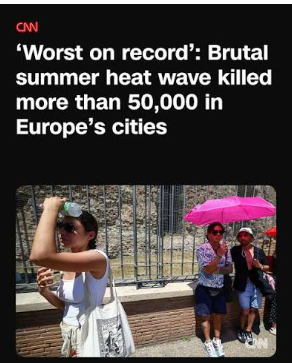
New Delhi: Unprecedented temperatures in Europe’s summer this year claimed approximately 50,000 lives and shaved off its GDP to the tune of USD 18.9 billion, the media reported on Friday.
According to a Bloomberg report, Europe’s summer of extreme heat caused an estimated 50,000 deaths in cities across the region — the highest number on record — and wiped roughly 0.17 per cent from European Union’s GDP from April through September, or close to €17 billion (USD 18.9 billion).
These findings, from two separate studies, reveal the extent of Europe’s vulnerability to rising temperatures in what’s likely to be one of the hottest years in modern history.
The mortality toll came from a study released on Friday, led by scientists at Imperial College London, which determined that almost two-thirds of the deaths linked to high summer temperatures would not have happened without climate change. A recent study from Bloomberg Economics, meanwhile, measured the hit to Europe’s GDP at two-and-a-half times the average loss for the period over the previous decade.
The overall mortality level, triggered by a series of record-breaking heat waves, was far higher than those in the next most deadly years. The figure compares to about 29,000 heat-related deaths in cities in 2022 and about 28,000 in 2003, according to the research, which is due to be published in Nature Health next week.
“We had these repeated heat events that — even without the extra heat from anthropogenic warming — would’ve been dangerous, but with that extra boost from anthropogenic warming became really, really dangerous,” said Clair Barnes, extreme weather and climate change researcher at Imperial and the study’s lead author.
European countries experienced extreme temperatures throughout the summer. Heat waves began in May and continued into September, with temperature records broken by significant margins in many countries. Average temperatures in Western Europe were nearly 3 degrees C higher than the summer average between 1991 and 2020, with some days as much as 12 degrees C higher.
Across the continent, vital infrastructure suffered. Wildfires destroyed homes, hospitals overheated, transport broke down and cooling systems in fridges and air conditioners failed.
French GDP was 0.2 per cent smaller in the second quarter due to extreme heat. Germany’s economy was 0.1 per cent smaller over the same period, while Spain saw a 0.05 per cent heat-related GDP dent.
The study by Imperial and the London School of Hygiene & Tropical Medicine covered 854 cities in 30 countries across the EU, UK, Switzerland and Norway, accounting for about 40 per cent of the countries’ total population.
The number of heat-related deaths linked to climate change has risen over time, the study found, as fossil-fuel emissions have pushed temperatures higher. Climate change accounted for nearly two-thirds of this summer’s excess mortality toll, up from about 40 per cent in 2003.
Calculating heat deaths is challenging because people rarely die directly from heat exposure. Instead, high temperatures typically put extra stress on the body and exacerbate existing conditions, especially those affecting the heart or respiratory systems. Measuring a person’s core temperature accurately can also be difficult outside of hospital settings. If someone has died alone at home, it’s not always clear how or if heat played a role. As a result, heat-related deaths aren’t always recorded as such.
“We often see elderly patients become confused or have strokes or have cardiac-type events where heat may have made a significant contributing factor to the death,” said Andrew Hartle, an intensive-care consultant at Imperial College Healthcare NHS Trust, in a press briefing on Wednesday. “A postmortem won’t tell you whether somebody was hot or not.”
The Imperial study combines temperature records with previous findings that calculate the impact of heat levels on mortality, to estimate a death toll linked to the heat. This method has previously been consistent with official statistics, many of which have not yet been released by government health authorities for the full 2026 summer season, the authors said.
“Clearly we need to support those most at risk, including the elderly, the unwell and those from poorer backgrounds, and to act to prevent the collapse of infrastructure that keeps vulnerable people safe in the heat,” said Toby Perkins, chair of the UK’s Environmental Audit Committee.
Next year is expected to be even hotter than 2026. Global warming is now virtually guaranteed to exceed 1.5 degrees C versus pre-industrial levels and the world must now focus on minimizing its overshoot, the United Nations said Wednesday.