




New Delhi: In the Uttarakhand town of Muni Ki Reti, limited land posed a challenge for sewage treatment. The site had to accommodate wastewater infrastructure near three sewage drains and a stormwater drain, upstream of Rishikesh’s Triveni Ghat. The solution was to build upwards.
The resulting four-storey sewage treatment plant, built under the Namami Gange Programme, treats 7.5 million litres a day while occupying approximately 900 square metres. Its vertical design illustrates a central feature of the programme’s approach: treatment systems must respond to the geography, sewage flows and infrastructure of the places they serve.
In Bithoor, Uttar Pradesh, a different challenge produced a different solution. For the town of approximately 20,000 people, conventional sewerage infrastructure was costly and suitable land for a treatment plant was scarce. Six constructed wetlands were developed directly on drains to treat approximately two million litres of wastewater daily.
According to the programme’s figures, biochemical oxygen demand—a measure of organic pollution—fell from around 75 milligrams per litre at the inlet to below 10 milligrams per litre in the treated discharge.
These projects show how wastewater treatment across the Ganga basin is moving beyond a single infrastructure model. Large cities need extensive sewer networks and treatment plants, while smaller settlements, hilly towns and areas dependent on septic tanks require other arrangements.
Launched in 2014, Namami Gange combines pollution abatement with the conservation and rejuvenation of the Ganga. Sewage treatment infrastructure forms a major part of this effort, alongside river-surface cleaning, biodiversity conservation, afforestation and industrial effluent monitoring.
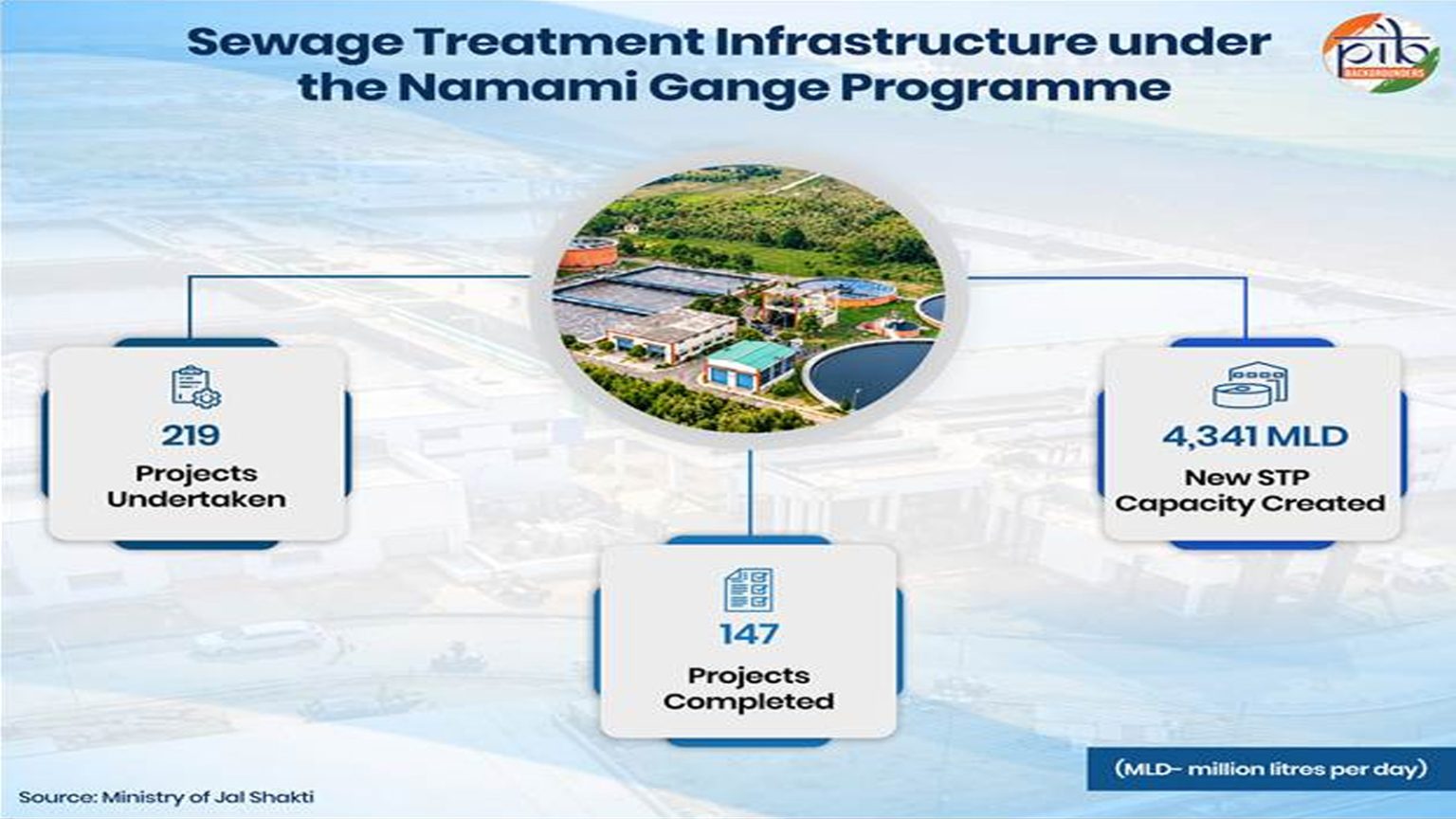
The programme has undertaken 219 sewage infrastructure projects with an estimated value of ₹35,664 crore, of which 147 have been completed. Across ten Ganga basin states, its interventions cover the development of 6,603 million litres per day (MLD) of sewage treatment capacity, with 4,341 MLD created so far.
Its technology-neutral approach allows treatment processes to be selected according to sewage characteristics, land availability, discharge standards and local operating conditions.
Conventional biological systems remain part of this framework. These use microorganisms to break down organic matter in wastewater. Alongside them, the programme has introduced technologies designed to reduce land requirements, energy consumption or construction needs.
One example is the Food Chain Reactor, which incorporates fixed artificial media and plant roots into biological treatment. The technology offers a smaller footprint, lower power consumption and nutrient removal. Five plants using the system are operational—two in Bhatpara, West Bengal, and three in Prayagraj, Uttar Pradesh—while another is under construction in Bhagalpur, Bihar.
In Uttarakhand, electrocoagulation and electro-oxidation provide options for cold, hilly and difficult-to-access locations. Electrocoagulation uses an electric current and a metal anode to help separate pollutants from wastewater.
The programme records 17 installations using these systems in the state, including locations such as Badrinath and Chamoli. Their use extends treatment options to places where conventional infrastructure can be difficult to build and operate.
Treating wastewater closer to its source is another area of experimentation. At Varanasi’s Assi Drain, an Advanced Oxidation Process-based pilot was designed to treat excess wastewater on site, reducing the need for long interception and diversion sewer lines.
The pilot also uses a different payment arrangement. With no upfront capital payment, remuneration is linked to the volume of water treated and the achievement of specified performance indicators. The arrangement connects payment to treatment results while allowing flexibility in system design.
For smaller settlements, decentralised systems can help bridge gaps left by incomplete sewer networks.
Johkasou, a prefabricated treatment system, brings several treatment stages together in a compact unit. It can serve locations with low sewage flows, limited space or difficult construction conditions, including sites where equipment can be installed underground. Six installations are recorded in Uttarakhand.
At Devprayag, a 1.2 MLD plant uses Soil Biotechnology, which combines sedimentation and infiltration with biochemical treatment. Mineral media, native microorganisms and plants help remove pollutants, while limited use of moving equipment makes the system easier to operate.
Larger installations are also adopting processes that use less space and energy. At Pahadi in Patna, a 60 MLD plant uses NEREDA technology, in which bacteria form compact granules with good settling properties.
Its bioreactor occupies approximately 1,900 square metres, compared with the cited requirement of 5,400 square metres for a Sequential Batch Reactor. The technology has demonstrated power savings of about 50 per cent compared with the conventional Activated Sludge Process and 20 per cent compared with Sequential Batch Reactors.
Wastewater management must also account for households that are not connected to sewers. In Chunar, Uttar Pradesh, where septic tanks and soak pits were common and conventional sewerage infrastructure was considered too costly, a 10-kilolitre-per-day faecal sludge treatment pilot was sanctioned at a construction cost of ₹2.70 crore.
Such facilities handle material periodically collected from on-site sanitation systems. They serve a different function from sewage treatment plants, which receive regular wastewater flows. Co-processing offers another option by allowing collected septage to be received and treated alongside city sewage.
Beyond removing pollutants, the programme is exploring how treatment plants can recover energy and reduce their operating requirements.
At Varanasi’s 140 MLD Dinapur plant, biogas generated through anaerobic digestion of sludge produces around 2.2 lakh to three lakh units of electricity a month. Against reported monthly consumption of 4.2 lakh units, this meets approximately 52 to 72 per cent of the plant’s power needs.
At the 80 MLD Naini plant in Prayagraj, biogas accounts for around half of daily electricity consumption. Solar generation contributes approximately 1,400 units a day, while biogas supplies another 4,500 units against a total daily requirement of about 8,900 units.
A separate 42 MLD Naini plant has a 1,000-kilowatt solar installation generating approximately 3,850 units daily against a requirement of 5,700 units.
The programme also identifies a proposed 220 MLD plant at Meerut for green operations, with full solar power envisaged for the plant and associated facilities. A 10 MW off-site solar installation was being considered to support that arrangement.
Handling the sludge left after treatment presents another operational challenge. At the 50 MLD Ramana plant, a compact Volute Press was introduced to remove water from sludge while meeting energy and land requirements.
At Muni Ki Reti, limited disposal space prompted a sludge-incineration pilot. The process dries dewatered sludge and thermally treats it to reduce its volume and stabilise the residue. The resulting ash is not bio-manure, though stabilised ash can be considered for use in fire bricks or concrete.
New technologies, however, cannot compensate for damaged sewers or poorly maintained plants. Rehabilitation therefore forms another part of the programme.
Upgrades at the Naini plant in Prayagraj and Jajmau plant in Kanpur include work on equipment, biogas power systems and monitoring infrastructure. Ageing trunk sewers are also being rehabilitated to address siltation, damage and leaks.
In Varanasi, a seven-kilometre brick trunk sewer was taken up for rehabilitation using a glass-reinforced pipe liner. In Kanpur, machine-wound spiral lining was used for 9.3 kilometres of old brick trunk sewer.
To support continued operation, the programme uses public-private partnerships under the Hybrid Annuity Model and the One City/Cluster–One Operator approach. These combine construction-linked payments with performance-linked payments over 15 years.
Under this framework, 31 projects covering 1,955 MLD have been taken up. Eleven projects covering 454 MLD have been completed, while six covering 235 MLD are at an advanced stage of completion.
[DD News]