




Virendra Pandit
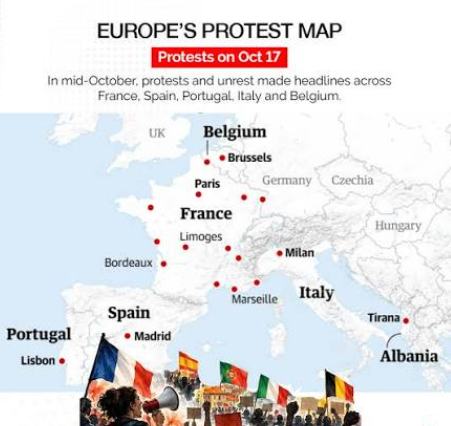
New Delhi: Several countries in Europe—France, Italy, Belgium, Albania, Spain, and Portugal—witnessed hundreds of thousands of people hitting the roads over the weekend, looting markets, and unleashing a reign of terror, the media reported.
As in India recently, the students’ protests in Europe were quickly hijacked by politicians, infiltrators, anarchists and criminals.
Protests over rising living costs turned violent in these countries over the weekend of October 17-18, with shops looted, fires set and clashes with police reported mainly in France, Italy and Belgium. In Portugal, tens of thousands marched in Lisbon against low wages and rising housing costs.
On Tuesday, anti-government protesters in Tirana, Albania, set fire to offices and parts of the Supreme Court building and hurled petrol bombs at the parliament, the reports said.
In France, over 2,500 rioters were arrested after they destroyed a 140-year-old landmark town hall, besides more than 1,500 shops and retail establishments across around 20 cities, including outlets of Louis Vuitton, Apple and Hugo Boss, Le Monde reported. The violent protests, which started with demands for school reforms, quickly descended into chaos as many others, mostly illegal immigrants, joined the ranks.
The protesters also unfurled a Palestinian flag atop the Eiffel Tower, according to some reports.
A historic city hall in Limoges was set on fire, while public buildings in other cities were vandalised. Over 1,000 officers were injured.
President Emmanuel Macron urged calm and said peaceful grievances would be heard while those causing damage would be held accountable, as he also warned of local curfews if violence continued.
In Italy, rioters looted shops and set fires in Central Milan, injuring at least two police officers. Prime Minister Giorgia Meloni condemned the violence and called for a security meeting.
In Belgium, police used tear gas and water cannon to disperse demonstrators in Brussels and Liège.
Rising inflation
The unrest comes as euro area inflation has accelerated again. Eurostat’s September 2026 estimate put annual inflation at 3.8 per cent, up from 3.2 per cent in August, with energy prices rising by 18.8 per cent over the year.
Across Europe, household incomes are struggling to keep pace with the cost of living. According to a Le Monde report, the latest increase in inflation is adding to a price shock that began several years ago.
Russia’s invasion of Ukraine in February 2022 has since disrupted energy markets, pushing up the cost of gas, electricity and fuel. Higher transport and production costs also fed into food prices. Inflation subsequently slowed in many countries, but the prices did not return to their earlier levels. Instead, they continued to rise slowly.
The cumulative increase has been substantial. Eurostat data analysed by Euronews Business show that prices of food and non-alcoholic beverages across the European Union rose by 34 per cent between August 2021 and August 2026.
Low wages
Income has also not kept pace with the rising inflation. Al Jazeera‘s analysis of Organisation for Economic Co-operation and Development’s (OECD’s) wage data, adjusted for inflation using Eurostat’s price index, found that average full-time real wages between 2000 and 2025 fell by almost 5 per cent in Italy, while rising by 7 per cent in Spain, 11 per cent in France and 20 per cent in Portugal.
Eurostat data show that EU households spent an average of 19 per cent of their disposable income on housing in 2024. For people at risk of poverty, the share was 37 per cent.
Housing
Housing has become another major source of discontent, particularly among younger people and renters in large cities.
The OECD price-to-income data found that Spain’s house-price-to-income ratio was 56 per cent higher in 2026 than in 2000, Al Jazeera reported. France’s ratio was 39 per cent higher and Italy’s was 5 per cent higher. In Portugal, the ratio rose by 67 per cent between 2015 and 2026.
The ratio compares house prices with household incomes.
In Portugal, housing-rights groups have linked their demands to rising rents, mortgage costs and everyday expenses. Spain has also seen housing affordability become a prominent public concern.
The grievances
The protests share economic themes, but the immediate triggers vary.
In France, students raised concerns about overcrowded classrooms and teacher shortages. The demonstrations widened into opposition to living costs and pressure on public services. Then the illegal immigrants, mostly Muslims, also joined protests and set afire to shops and establishments selectively, sparing those owned by Muslims.
In Italy, the unrest came as annual inflation rose to 4.2 per cent in September from 3.3 per cent in August.
In Portugal, trade unions and housing-rights groups called for higher wages, better pensions, improved public services and action on housing affordability.
In Belgium, students protested in recent weeks against rising education costs, bringing concerns about access to education into the wider debate over living standards.
In Spain, the inflation rate measured using the harmonised European Union index reached 5 per cent in September, its highest level since February 2023, according to Reuters’ report on data from the national statistics agency INE. Housing affordability remains another source of public concern.