


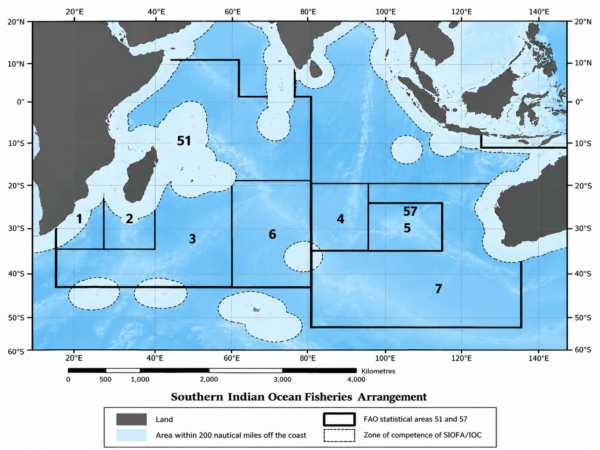

New Delhi: The Central Government has approved India’s accession to the Southern Indian Ocean Fisheries Agreement (SIOFA), a move aimed at strengthening the country’s presence in high seas fisheries, expanding access to high-value marine resources and enhancing its participation in global fisheries governance.
The decision is expected to provide a regional framework for expanding India’s fishing operations into international waters, in line with the Guidelines for High Seas Fisheries issued by the Government in December 2025. It will also help safeguard India’s strategic interests, create new economic opportunities and promote the sustainable harvesting of marine resources.
Following its accession, Indian-flagged fishing vessels and enterprises will be able to undertake authorised fishing of species such as squid, toothfish, alfonsino and other non-highly migratory fish stocks within the SIOFA area, subject to applicable conservation measures and fishing authorisations.
India’s membership will also enable it to work more closely with other participating countries on scientific research, resource assessments and the sustainable management of high seas fisheries. It will strengthen efforts to prevent illegal, unreported and unregulated (IUU) fishing and promote responsible fishing practices in the region.
The accession is also expected to strengthen India’s role in regional maritime cooperation and coastal security through active participation in the High Seas Boarding and Inspection (HSBI) Scheme adopted under SIOFA.
India has been a Cooperating Non-Contracting Party (CNCP) to SIOFA since 2022. This status has limited its participation in decision-making processes, including the organisation’s Scientific Committee and Compliance Committee. Accession as a Contracting Party will enable India to participate fully in these bodies and improve access to scientific data, research programmes and fish-stock assessments.
The move is expected to open up additional fishing opportunities for Indian fishers and entrepreneurs while supporting the long-term sustainability of marine resources and the livelihoods of fishing communities.
The high seas account for approximately 65 per cent of the global ocean and are an important source of marine resources. The Indian Ocean has two major Regional Fisheries Management Organisations: the Indian Ocean Tuna Commission (IOTC) and SIOFA.
India has been a Contracting Party to the IOTC since 1996. While the IOTC manages highly migratory tuna and tuna-like species, SIOFA covers other fishery resources, including fish, molluscs, crustaceans and certain sedentary species within its area of competence, subject to the exclusions specified under the Agreement and the United Nations Convention on the Law of the Sea (UNCLOS).
At present, Indian fishing vessels operate largely within 60 to 80 nautical miles of the country’s coast. Expanding fishing capacity into suitable high seas areas, alongside access arrangements in the exclusive economic zones of other countries, is part of India’s broader effort to develop its fisheries sector and increase its contribution to the national economy.
[DD news]