




Virendra Pandit
New Delhi: Contrary to the Opposition’s claims of a downturn in the country’s economy, the fourth-largest economy in the world continued to receive endorsements from global institutions about a positive outlook for 2026-27, the latest being from the Asian Development Bank (ADB).
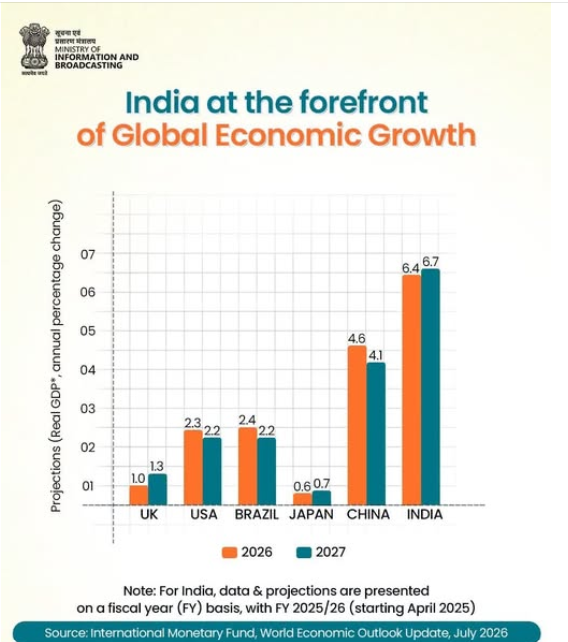
In recent days, the IMF and Moody’s have projected a positive picture for the current financial year, based on the performance in the first quarter (Q1FY27).
On Tuesday, the ADB raised its forecast for India’s economic growth in FY27 to 7 per cent from 6.6 per cent earlier, citing stronger investment demand and resilient services exports, the media reported.
The multilateral lender also lowered its growth estimate for FY28 to 7.1 per cent from 7.3 per cent earlier. ADB said the downgrade for FY28 largely reflects the higher growth base in FY27. The revised projections were released in ADB’s September 2026 Asian Development Outlook on Wednesday.
“The Indian economy remains resilient despite heightened geopolitical tensions and high commodity prices,” ADB said.
Strong Q1 growth
The upward revision comes after India recorded stronger-than-expected growth in the first quarter of FY27. Its GDP grew 7.8 per cent year-on-year during the first quarter of the current fiscal.
Services remained a major driver of growth, expanding 10 per cent. Financial, real estate and professional services grew 12.1 per cent. Manufacturing also recorded strong growth of 9.2 per cent, helped by electronics, textiles, and rubber and plastics.
Investment and exports also supported economic activity. Gross fixed capital formation rose 11.9 per cent in the first quarter, its fastest growth in four years, backed by both public and private investment. Exports of goods and services increased 12 per cent.
Despite global tensions, consumption remained resilient, supported by rural and urban demand, lower tax rates, higher subsidies and limited pass-through of higher input costs to consumers. Agriculture grew 3.6 per cent despite a below-normal monsoon.
Investment, services exports
ADB expects investment to remain firm, supported by relatively low interest rates, higher public capital spending and healthy corporate balance sheets. The Reserve Bank of India (RBI) cut the repo rate by 125 basis points between February and December 2025. The weighted average lending rate on fresh rupee loans fell by 80 basis points between February 2025 and June 2026, while the rate on outstanding rupee loans declined by 91 basis points.
Private investment is also expected to stay strong in sectors such as data centres and energy, where project pipelines remain robust. ADB said government measures to make private investment more attractive, including support for logistics infrastructure and regulatory strengthening, should also support corporate investment. The Central government’s capital expenditure is on track to meet the FY2026 budget target of 11.5 per cent growth.
Exports are likely to provide additional support despite uncertainty in global trade. ADB expects electronics exports to remain healthy, while services exports could grow faster than imports as the development of artificial intelligence (AI) increases demand for technology services.
The lender also expects India’s trade agreements with the United Kingdom and the European Union to support net exports in FY28.
ADB expects net exports to contribute to GDP growth in both FY27 and FY28. Goods imports are also likely to rise rapidly, driven by stronger domestic demand for capital and intermediate goods.
Cuts FY27 inflation forecast
ADB has lowered its inflation forecast for FY27 to 5 per cent from 5.2 per cent estimated in July 2026. The revision reflects lower-than-expected transmission of higher global energy prices to retail consumers.
The FY28 inflation forecast has been retained at 4 per cent. Assuming a normal monsoon, it expects energy prices to ease and agricultural supplies to recover.
However, price pressures could increase in the second half of the current fiscal year as the impact of earlier GST rate cuts fades and higher input costs pass through to retail prices.
West Asia, El Nino pose risks
ADB said the outlook faces risks from geopolitical tensions, particularly in West Asia, as well as greater weather volatility linked to El Nino.
The risks are already visible in monsoon conditions. Rainfall was 14.7 per cent below normal as of September 13, with larger deficits in central and southern India. The shortfall could affect kharif crops such as rice, pulses and oilseeds.
A delayed withdrawal of the monsoon and higher temperatures could lead to post-harvest losses and affect rabi crop yields. The risks are higher as reservoir levels are currently below those recorded a year earlier.
ADB also said rising input costs could weigh on industrial growth, particularly in the second half of FY27.
S&P raises forecast to 7%
S&P Global Ratings also on Wednesday raised India’s GDP growth projections for the current fiscal to 7 per cent, citing robust economic activity and forecasting that the RBI could hike interest rates by 25 basis points in FY27.
In its Economic Activity for Asia Pacific report, S&P estimates consumer inflation to average 5.1 per cent in FY27, the media reported.
The Indian economy grew higher than expected at 7.8 per cent in the April-June 2026 quarter. S&P said factors like robust industrial activity, healthy consumption, strong goods exports, and accelerating government investment have driven the growth.
“We have consequently upgraded our GDP growth forecast for the current fiscal year, ending March 31, 2027, to 7 per cent, from 6.6 per cent previously,” S&P said, adding growth could ease in the second half of the fiscal year as the tailwinds from GST rationalisation and income tax cuts diminish.
Weather-related risks warrant close monitoring. Cumulative rainfall was 15 per cent below normal till September 9, 2026, in the current monsoon season. Agricultural output and food inflation therefore remain key variables to watch, it said.
“We expect the balance of considerations to shift toward higher interest rates. Factors supporting this shift include solid growth, persistent inflationary pressures, an unresolved conflict in West Asia, and weather-related risks. We expect consumer inflation to average 5.1 per cent and the Reserve Bank of India to raise its policy rate by 25 bps in the current fiscal year,” S&P added.
Last week, another global rating agency, Moody’s too, had raised India’s GDP growth forecast for the fiscal to 7 per cent — the fastest growth rate among all G20 economies.
The 7 per cent FY27 GDP growth estimate compares with 6.7 per cent projected by the RBI and 6.4 per cent by Fitch Ratings.
The Indian economy grew at 7.8 per cent in the previous fiscal (2025-26).