



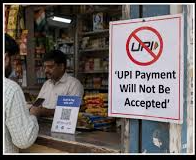

NEW DELHI, Sept 19: Posters have started coming up outside the shops in Ghaziabad saying that “UPI Payment will Not be Accepted” from October 15 in protest against the proposed Merchant Discount Rate (MDR) on selected UPI transactions above Rs 2,000 from that date.
The notices have appeared at shops as traders voice concerns over the proposed 0.4 per cent charge. They say that although the government has said the MDR would be charged to merchants, the additional cost could eventually affect customers.
Traders are advising customers to carry cash when making purchases from October 15, particularly for transactions above Rs 2,000. They argue that merchants may not be willing to absorb the additional cost and could instead ask customers to pay in cash for larger purchases.
The proposed MDR has become a major point of discussion among traders and shopkeepers in Ghaziabad, with many opposing the move. The traders’ notices are effectively a warning to customers that UPI may not be accepted for certain higher-value purchases once the proposed charge comes into effect.
Under the new framework, a 0.4 per cent MDR will apply to specified person-to-merchant UPI transactions above Rs 2,000. The charge will be paid by the merchant, not the customer. It will be capped at Rs 300 for transactions of Rs 75,000 and above. UPI payments between individuals will remain free.
Most everyday UPI payments will also remain outside the new charge. Person-to-merchant (P2M) transactions up to Rs 2,000 account for more than 95 per cent of P2M transaction volume and will continue to attract zero MDR.
This means someone buying a Rs 1,500 item from a shop through UPI will not suddenly face a new UPI fee. The bigger change will be felt in higher-value merchant payments. The government’s concern is simple. If merchants start adding a separate “UPI charge” to bills, customers could feel that UPI is no longer free. That could undermine one of the biggest advantages of digital payments.
The Centre has, therefore, started discussions with payment aggregators and other platforms to ensure the MDR is not passed on to consumers. Banks have also been advised to ensure that merchants do not transfer the cost. The government has not, however, publicly detailed exactly how this daily monitoring will work.
The government does not expect the new MDR to push people back towards cash. Officials estimate that only around 4 per cent of UPI transaction volume will be affected by the new levy. That is because the overwhelming majority of UPI payments are small-value transactions.
NPCI data shows that in August, 86 per cent of P2M UPI transactions were below Rs 500 and another 10 per cent were between Rs 501 and Rs 2,000. So the new MDR is primarily aimed at a relatively small portion of higher-value merchant transactions. RuPay debit card payments will also remain free irrespective of the transaction amount, giving merchants and consumers another digital payment option.
(Manas Dasgupta)