



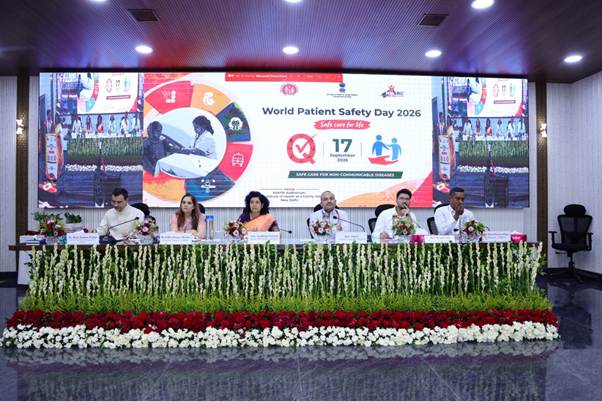

New Delhi: Union Ministry of Health & Family Welfare, Government of India, commemorated World Patient Safety Day 2026 at the NIHFW Auditorium, New Delhi, with the theme “Safe Care for Noncommunicable Diseases (NCDs)”. The national observance focused on strengthening patient safety and quality of care across the continuum of NCD care and brought together policymakers, healthcare leaders, public health experts, clinicians, quality managers, development partners and representatives from States and Union Territories.
Addressing the gathering, Smt. Aradhana Patnaik, Additional Secretary & Mission Director (NHM), Ministry of Health & Family Welfare, reiterated the Government of India’s commitment to strengthening patient safety, improving quality of care and building safer health systems across the country. She emphasized that patient safety cannot be the responsibility of a single programme or department and needs to be embedded across the health system, particularly in the prevention, diagnosis, treatment and long-term management of noncommunicable diseases.
Highlighting the growing burden of NCDs, Smt. Patnaik noted that nearly 63 per cent of all deaths in India are attributed to NCDs, making patient safety an important component of healthcare delivery. Referring to recent achievements in public healthcare, she highlighted that 96 per cent of immunizations and 90.6 per cent of institutional deliveries, as reported under NFHS-6, are being conducted through public health facilities. She stressed the need to further strengthen quality and safety practices within healthcare institutions, particularly in patient referrals and continuity of care, to ensure timely access to appropriate services and improved health outcomes.
Calling upon States and Union Territories to accelerate quality improvement efforts, Smt. Patnaik emphasized the need for a clear roadmap and action plan to achieve 100 per cent NQAS certification of Ayushman Aarogya Mandir–Sub Health Centres (AAM-SHCs) by March 2027, followed by certification of Ayushman Aarogya Mandir–Primary Health Centres (AAM-PHCs). She underscored that a structured and time-bound approach to quality assurance would be critical for institutionalising a culture of patient safety across all levels of care.
The inaugural session concluded with the administration of the National Patient Safety Pledge, reaffirming the collective commitment of healthcare stakeholders towards ensuring safer care and strengthening the quality of healthcare delivery across the country.
The technical programme thereafter featured a dedicated seminar on “Safe Care for Noncommunicable Diseases (NCDs)”, bringing together eminent experts to deliberate on key patient safety challenges and approaches across the continuum of NCD care. The discussions covered the burden of harm in NCD care, strengthening patient safety in NCD services, leveraging digital health for patient safety, ensuring safe NCD care across clinical pathways with a focus on co-morbidities, and promoting medication safety in NCD care.
The programme subsequently focused on translating policy into practice through discussions on patient safety implementation and quality improvement initiatives across States. Participants shared State-led innovations and best practices, including Jharkhand’s model for comprehensive geriatric diabetic and hypertensive screening, Kerala’s Hridhyaragam initiative for prevention and control of NCDs, and Rajasthan’s SETU online referral application. These experiences highlighted the importance of context-specific approaches, knowledge sharing and adoption of effective practices to strengthen patient safety at different levels of healthcare delivery.
India has also been strengthening the institutional framework for quality and patient safety through initiatives such as the National Quality Assurance Standards (NQAS) and the National Patient Safety Implementation Framework. Against this backdrop, the observance of World Patient Safety Day 2026 provided an important platform for bringing together stakeholders, sharing experiences and best practices, and reinforcing a culture of patient safety across all levels of healthcare delivery.
The national observance reflected the Government of India’s continued commitment to improving quality of care and advancing patient safety as an integral component of Universal Health Coverage. Through dialogue, knowledge sharing and collective action, the event contributed to strengthening healthcare systems and advancing the vision of “Safe Care for Life.”
The event was attended by senior officials from the Ministry of Health & Family Welfare and partner institutions, including Shri Sibin C., Joint Secretary (Policy), MoHFW; Prof. (Dr) Pragya Sharma, Executive Director, NHSRC; Shri Deepak Soni, Director (NHM); Dr Binod Kumar Patro, Director, NIHFW; and Dr Rajiv Pathni, Advisor (Quality & Patient Safety), NHSRC, along with policymakers, healthcare leaders, technical experts, development partners and representatives from States and Union Territories.
About World Patient Safety Day
Observed annually on 17 September, following its adoption by the World Health Assembly, World Patient Safety Day serves as a global platform to promote awareness and action for safer healthcare. The 2026 theme, “Safe Care for Noncommunicable Diseases (NCDs)”, highlighted the importance of preventing harm across the continuum of NCD care.
(PIB)