




Virendra Pandit
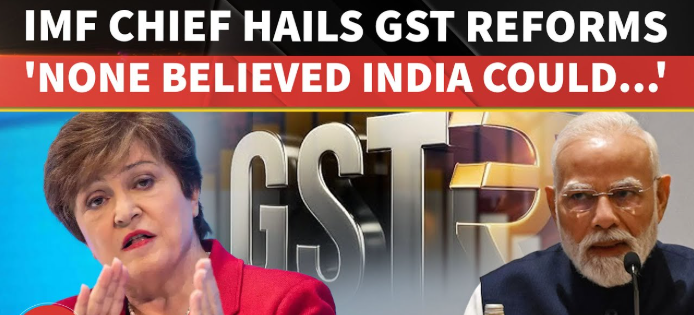
New Delhi: India’s economy is estimated to grow at 6.6 percent in the current financial year (2025-26) and the recent Goods and Services Tax (GST) reforms are likely to help cushion the country from the adverse impact of the 50 percent tariffs imposed by the US, the International Monetary Fund (IMF) said on Thursday.
“India’s economy has continued to perform well. Following the economic growth of 6.5 percent in fiscal year 2024/25, real GDP expanded by 7.8 percent in the first quarter of fiscal year 2025/26,” the global lender said in a statement after its Executive Board completed an annual assessment for India.
The IMF said that, looking ahead, India’s ambition to become an advanced economy can be supported by advancing comprehensive structural reforms that enable higher potential growth, according to media reports on Thursday.
Despite external headwinds, growth is expected to remain robust, supported by favourable domestic conditions, it added.
“Under the baseline assumption of prolonged 50 percent US tariffs, real GDP is projected to grow at 6.6 percent in FY2025/26 before moderating to 6.2 percent in FY2026/27,” the IMF said.
The GST reform and the resulting reduction in the effective rate are expected to help cushion the adverse impact of US-imposed tariffs of 50 percent on India, including 25 percent for its purchases of Russian energy.
The IMF, however, noted there are significant near-term risks to the economic outlook. On the upside, the conclusion of new trade agreements and faster implementation of structural reform domestically could boost exports, private investment, and employment.
On the downside, further deepening of geoeconomic fragmentation could lead to tighter financial conditions, higher input costs, and lower trade, FDI, and economic growth. Unpredictable weather shocks could affect crop yields, adversely impact rural consumption and reignite inflationary pressures, it added.
Headline inflation is projected to remain well contained, reflecting the one-off effect of the GST reform and continued benign food prices. “Headline inflation has declined markedly, driven by subdued food prices,” the lender said.
Financial and corporate sectors have remained resilient, supported by adequate capital buffers and multi-year low non-performing assets. Fiscal consolidation has advanced, and the current account deficit has been contained, supported by resilient service exports.
The IMF’s Executive Directors commended India’s strong economic performance and resilience, which has benefited from sound macroeconomic policies and reforms. Amid high uncertainty, they called for continued sound policies and noted that accelerated implementation of structural reforms will be critical to maintain stability and support India’s ambition of becoming an advanced economy.
They concurred with the authorities’ plans for continued fiscal consolidation this year, while noting that achievement of the fiscal deficit target will require strong spending discipline. Welcoming the recent simplification of the GST, they called for careful monitoring of fiscal impact of the reduction in GST and personal income tax rates.
The directors also recommended that tariff relief measures should be targeted, transparent, and time-bound, and the pace of fiscal consolidation in FY2026/27 should be conditional on the impact of tariffs on the output gap.
For the medium term, they stressed that fiscal buffers should be replenished by focusing on domestic revenue mobilisation, while also raising the efficiency of expenditure, including through a more targeted social safety net. Enhancing fiscal sustainability at the state level, as well as carefully monitoring contingent liabilities, would also be important.
They felt that, if tariffs persist at current levels, there would likely be scope for further monetary easing amid benign inflation dynamics. They broadly recommended continued efforts to enhance monetary transmission, as well as greater exchange rate flexibility to help the Indian economy absorb external shocks, with interventions aimed at addressing disorderly market conditions consistent with the integrated policy framework.
The IMF underscored that comprehensive structural reforms are critical to support India’s economic development.
The directors also welcomed the recent labour market reforms and encouraged the authorities to enhance human capital and female labour force participation, continue with the public investment push, and strengthen the business environment.
They stressed that the deepening of trade integration can bolster India’s competitiveness and attract FDI. Investment in R&D and fostering innovation will also help support productivity-driven development. Advancing the green transition supported by greater access to concessional financing will also be important for promoting sustainable and resilient growth.
The IMF highlighted that India’s financial system has been sound, supported by strong capital and liquidity positions. They encouraged the authorities to mitigate vulnerabilities among nonbank financial institutions and cautiously monitor risks from concentration and rising financial sector interconnectedness. They also encouraged authorities to make further progress on financial structural reforms.