




Virendra Pandit
New Delhi: Britain set the ball rolling for the establishment of Israel in 1917 when its Foreign Secretary Arthur Balfour declared support for a “national home for the Jewish people” in the Muslim-dominated Palestine, and to protect the rights of the existing non-Jewish communities, which proved difficult to implement and contributed to relentless conflict.
Israel came into existence in 1948 after the Second World War.
Now, British Prime Minister Keir Starmer has announced the UK’s recognition of a Palestinian state as well, in what represents a significant change in government policy, the media reported on Monday.
In a video statement on X, he said: “In the face of the growing horror in the Middle East we are acting to keep alive the possibility of peace and a two-state solution.”
Australia, Canada and Portugal have also formally recognized the state of Palestine, with France expected to follow.
But the UK’s Deputy Prime Minister David Lammy acknowledged that recognition would not necessarily change reality on the ground, and said “now is the time to stand up for a two-state solution.”
He told BBC One’s Sunday with Laura Kuenssberg programme: “Will this feed children? No, it won’t. That’s down to humanitarian aid. Will it free hostages? That must be down to a ceasefire.”
Supporting Israel, the United States has termed the recognition of Palestinian state by key allies like Britain, Australia and Canada a “performative gesture.” It also cleared its stance on the Middle East crisis listing Israel’s security as one of its priorities, along with the release of Israeli hostages still in Hamas captivity.
The British decision has drawn fierce criticism from the Israeli government, families of hostages held in Gaza and some Conservatives. Responding on Sunday, Israeli Prime Minister Benjamin Netanyahu said a Palestinian state “will not happen.”
Saying he had “a clear message” to the leaders who had declared recognition, he added: “You are giving a huge reward to terrorism.”
Both the Israeli and US governments say recognition is a diplomatic gift for Hamas following its attack in southern Israel on October 7, 2023, in which 1,200 people were killed and 251 taken hostage. In the Gaza War sparked by Israel’s retaliatory attack, over 65,000 Palestinians have since died.
Sir Keir insisted the decision “is not a reward for Hamas” because it means Hamas can have “no future, no role in government, no role in security.”
“Our call for a genuine two-state solution is the exact opposite of (Hamas’) hateful vision,” he said.
The move is a “pledge to the Palestinian and Israeli people that there can be a better future,” he continued, adding the “starvation and devastation (in Gaza) are utterly intolerable” and the “death and destruction horrifies all of us.”
Palestinian Authority President Mahmoud Abbas welcomed the decision, saying it would help pave the way for the “state of Palestine to live side by side with the state of Israel in security, peace and good neighbourliness.”
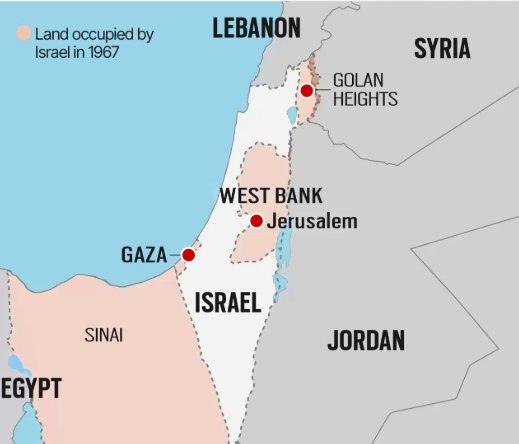
The two-state solution refers to the creation of a Palestinian state in the West Bank and Gaza Strip, with East Jerusalem as its capital, broadly along the lines that existed prior to the 1967 Arab-Israeli war.
A state of Palestine is currently recognised by around 75 percent of the United Nation’s 193 member states, but has no internationally agreed boundaries, capital or army – making recognition largely symbolic.
Because of Israel’s military occupation in the West Bank, the Palestinian Authority, set up in the wake of peace agreements in the 1990s, is not in full control of its land or people. In Gaza, where Israel is also the occupying power, Hamas has been the sole ruler since 2007.
Canadian Prime Minister Mark Carney offered “partnership in building the promise of a peaceful future” for both Palestine and Israel, while Australia’s Anthony Albanese said it was “part of a co-ordinated effort to build new momentum for a two-state solution.”
Portugal’s Foreign Minister Paulo Rangel called the two-state solution “the only path to a just and lasting peace.”
Israel’s latest ongoing ground operation in Gaza City, described by a UN official as “cataclysmic,” has forced hundreds of thousands of people to flee.
It is the latest Israeli offensive in the nearly two-year war which has seen much of the Palestinian territory’s population displaced, its infrastructure destroyed, and at least 65,208 people killed, according to the Gaza health ministry.
Earlier this week, a UN Commission of Inquiry concluded Israel had committed genocide against Palestinians in Gaza, which Tel Aviv denounced as “distorted and false.”
UK ministers have also highlighted the continued expansion of Israeli settlements in the occupied West Bank, which are illegal under international law, as a key factor in the decision to recognise Palestinian statehood.
Reacting to UK’s recognition, Conservative leader Kemi Badenoch called the move “absolutely disastrous,” adding: “Rewarding terrorism with no conditions whatsoever put in place for Hamas.”
Shadow foreign secretary Dame Priti Patel accused the UK PM of “capitulating to the hard-left factions of his party.”
But Liberal Democrat leader Sir Ed Davey welcomed the decision, which he said was “long overdue.”
Mandy Damari, mother of former UK-Israeli hostage Emily Damari, said Sir Keir was “under a two-state delusion.” Recognition rewarded Hamas while hostages were still in Gaza and the group still in power, she said.
The Hostages and Missing Families Forum UK, which represents relatives of captives with British ties, condemned the decision, calling it a “betrayal of humanity and a move that rewards Hamas while 48 hostages remain in captivity.” Of the hostages still being held, around 20 are still thought to be alive.
“Instead of confronting Hamas, Britain has emboldened it,” the group said in a statement.
Hamas on Sunday welcomed the recognition as an “important step in affirming the right of our Palestinian people to their land and holy sites” but said it must be accompanied by “practical measures” that would lead to an “immediate end” to the war.