Trade deal: EU to pay 15% tariff to the US, buy energy worth $750 bn, and invest $600 bn







Virendra Pandit
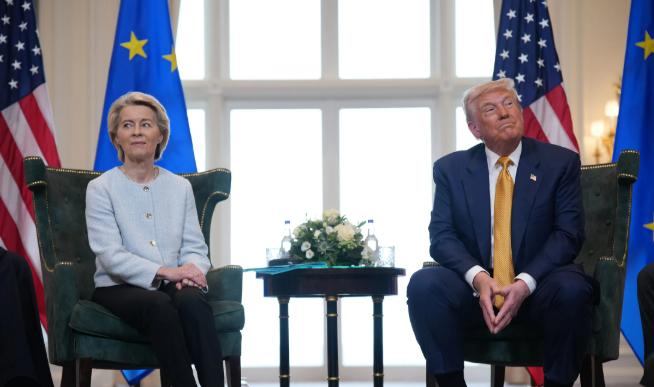
New Delhi: After a high-stakes meeting between Donald Trump and European Commission President Ursula von der Leyen in Scotland, the US and EU on Sunday clinched what the US President described as the “biggest-ever” deal to resolve a transatlantic tariff stand-off that threatened to explode into a full-blown trade war after August 1.
As part of the deal, Trump said the 27-nation EU bloc had agreed to purchase “USD 750 billion worth of energy” from the United States, as well as make USD 600 billion in additional investments.
Emerging from the meeting at his golf resort in Scotland, Trump announced that a baseline tariff of 15 percent would be levied on EU exports to the US.
The deal, which the leaders struck in an hour, came as the clock ticked down on an August 1 deadline to avoid an across-the-board US levy of 30 percent on European goods.
“We’ve reached a deal. It’s a good deal for everybody. This is probably the biggest deal ever reached in any capacity,” said Trump, according to the media reports on Monday.
He said the 15-percent baseline tariff would apply across the board, including for Europe’s crucial automobile sector, pharmaceuticals, and semiconductors.
Von der Leyen said the “significant” purchases of US liquefied natural gas (LNG), oil, and nuclear fuels would come over three years, as part of the bloc’s bid to diversify away from Russian sources.
Negotiating on behalf of the EU’s 27 countries, she was pushing hard to salvage a trading relationship worth an annual USD 1.9 trillion in goods and services.
“It’s a good deal,” the EU chief told reporters.
“It will bring stability, and predictability. That’s very important for our businesses on both sides of the Atlantic,” she said.
She said bilateral tariff exemptions had been agreed on a number of “strategic products,” notably aircraft, certain chemicals, some agricultural products and critical raw materials.
Von der Leyen said the EU still hoped to secure further so-called “zero-for-zero” agreements, notably for alcohol, which she hoped to be “sorted out” in coming days.
Trump also said EU member-countries — which recently pledged to ramp up their defence spending within NATO — would purchase “hundreds of billions of US dollars worth of military equipment.”
The EU had to surrender as it has been hit by multiple waves of tariffs since Trump reclaimed the White House on January 20, 2025.
It is currently subject to a 25-percent levy on cars, 50 percent on steel and aluminium, and an across-the-board tariff of 10 percent, which Washington threatened to hike to 30 percent in a no-deal scenario.
The bloc had been pushing hard for tariff carve-outs for critical industries from aircraft to spirits, and its auto industry, crucial for France and Germany, is already reeling from the levies imposed so far.
“Fifteen percent is not to be underestimated, but it is the best we could get,” acknowledged von der Leyen.
Any deal will need to be approved by EU member-states — whose ambassadors, on a visit to Greenland, were updated by the commission on Sunday morning. They were set to meet again after the deal struck in Scotland.
German Chancellor Friedrich Merz quickly hailed the deal, saying it avoided “needless escalation in transatlantic trade relations.”
But German exporters were less enthusiastic. The powerful BDI federation of industrial groups said the deal would have “considerable negative repercussions” while the country’s VCI chemical trade association said the accord left rates “too high.”
The EU had pushed for a compromise on steel that could allow a certain quota into the US before tariffs would apply.
Trump appeared to rule that out, saying steel was “staying the way it is,” but the EU chief insisted later that “tariffs will be cut and a quota system will be put in place” for steel.
While 15 percent baseline is much higher than pre-existing US tariffs on European goods, which average around 4.8 percent, it mirrors the status quo, with companies currently facing an additional flat rate of 10 percent.
Had the talks failed, EU states had greenlit counter tariffs on USD 109 billion (93 billion euros) of US goods including aircraft and cars, to take effect in stages from August 7.
President Trump has embarked on a campaign to reshape US trade with the world, and has vowed to hit dozens of countries with punitive tariffs if they do not reach a pact with Washington by August 1.
Asked what the next deal would be, Trump replied: “This was the big one. This is the biggest of them all.”