



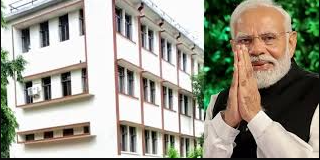

NEW DELHI, May 2: The Maharaja Sayajirao University, Baroda, the only English-medium university in Gujarat, has added in its sociology syllabus a module on the Prime Minister Narendra Modi’s “leadership philosophy” in its BA and MA programmes.
The MSU, one of India’s oldest public universities, will teach the module “Modi Tattva,” as part of a paper on the “Sociology of Patriotism” alongside contents on the Rashtriya Swayamsevak Sangh (RSS) and historical figures and former kings like Chhatrapati Shivaji Maharaj and Maharaja Sayajirao Gaekwad III, the visionary Maratha ruler of the then Baroda empire, who had established the university.
Sayajirao Gaekwad III was also a crucial patron of B.R. Ambedkar, funding his higher education at Columbia University and providing him employment, enabling his rise as a social reformer, as well as Shri Aurobindo Ghosh, the revolutionary-turned-spiritual leader of Bengal, who later set up an Ashram in Pondicherry, now Puducherry.
Sociology department head Virendra Singh said the inclusion of ‘Modi Tattva’ reflects the need to examine the Prime Minister’s leadership within established sociological frameworks. He said the module draws on Max Weber’s theory of charismatic authority, previously applied to figures such as Mahatma Gandhi and Martin Luther King Jr.
“Whether you like it or not, you will have to discuss PM Modi in a political field and a leadership role. He is someone who will remain there for a long time,” Dr Singh said. The paper will be offered to students in the fourth year of their BA programme and at the MA level, carrying four credits across four units. The units will cover themes including geo-nationalism and cultural nationalism, and the course will involve 60 hours of teaching.
Dr Singh said the syllabus would examine ‘Modi Tattva’ in relation to the Prime Minister’s public acceptance and continued electoral presence. It would also analyse specific policy measures, including demonetisation, digital initiatives, FASTag, and the creation of the Jal Shakti Ministry, linking them to the public response and governance outcomes.
The course design, he said, was shaped in part by fieldwork conducted by postgraduate students during surveys linked to a NITI Aayog project in rural areas. During those surveys, students observed the role of RSS-affiliated individuals in the implementation of public programmes, an observation that led to the organisation’s inclusion as a subject of study.
(Manas Dasgupta)