“Water bomb:” Arunachal CM Khandu warns against China’s huge dam in Tibet








Virendra Pandit
New Delhi: The world’s largest dam project being developed by China is a ‘water bomb’ for India, Arunachal Pradesh Chief Minister Pema Khandu has warned.
The project, which China named as the Yarlung Tsangpo dam, was announced after Chinese Premier Li Keqiang visited the border region in 2021, the media reported on Wednesday.
Because of this, after discussions with the Government of India, the Arunachal Pradesh government has conceived a project called the Siang Upper Multipurpose Project, which will serve as a defence mechanism and ensure water security, he was quoted as saying by a news outlet.
China’s mega dam being built near the Arunachal Pradesh border will be a ticking “water bomb,” an existential threat and a bigger issue than anything else apart from the military threat, Khandu said.
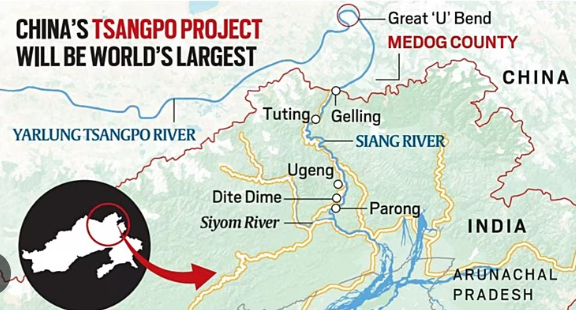
The world’s largest dam project on the Yarlung Tsangpo river, the Tibetan name for Brahmaputra, is a matter of grave concern as China is not a signatory to the international water treaty that could have forced it to abide by international norms.
“The issue is that China cannot be trusted. No one knows what it might do,” said Khandu.
“Setting aside the military threat from China, it seems to me that this is a far bigger issue than anything else. It is going to cause an existential threat to our tribes and our livelihoods. It is quite serious because China could even use this as a sort of ‘water bomb’,” he said.
According to reports, China approved the construction of the USD 137 billion, five-year project in 2024. It is projected to produce 60,000 MW of power, making it the world’s largest hydropower dam.
This dam is to be built at a huge gorge in the Himalayan reaches where the river makes a sharp U-turn to flow into Arunachal Pradesh.
Had China signed the international water treaty, Khandu said, there would have been no problem because it would have been mandatory for it to release a certain amount of water downstream for the basin, for aquatic and marine life.
In fact, if China were a signatory to international water-sharing agreements, this project could have been a blessing for India, he said.
For one, it would have prevented the summer flooding of Arunachal Pradesh, Assam and Bangladesh where the Brahmaputra flows.
“But China is not a signatory, and that is the problem… Suppose the dam is built and they suddenly release water, our entire Siang belt would be destroyed. In particular, the Adi tribe and similar groups… would see all their property, land, and especially human life, suffer devastating effects,” he said.
“I believe China is either about to start or has already started work on their side. But they do not share any information. In the long run, if the dam is completed, our Siang and Brahmaputra rivers could dry up considerably,” he said.
For India’s water security, he said, if the government can complete its project as planned, it will be able to meet the water requirements from its own dam.
In the future, if China releases water, there will definitely be flooding, but it can be controlled, he said.
For this reason, Khandu said, the state government is holding discussions with the local Adi tribes and others in the area.
“I am going to arrange a meeting very soon to raise further awareness about this issue,” he said.
Asked what the government can do against the Chinese move, the chief minister said the government just cannot simply protest and sit idle.
“Who will make China understand? Since we cannot make China see reason, it is better that we focus on our own defence mechanisms and preparations. That is what we are fully engaged in at the moment,” he said.