Upping the ante: Now, the US drops 2,200-kg bunker buster bombs on Iran’s missile site










Virendra Pandit
New Delhi: Attempting to conclude the expensive war at the earliest, the United States on Wednesday dropped 2,200-kg bunker buster bombs on Iran’s key missile site near the crucial Strait of Hormuz, the chokehold behind the global price rise of crude oil and gas, the media reported.
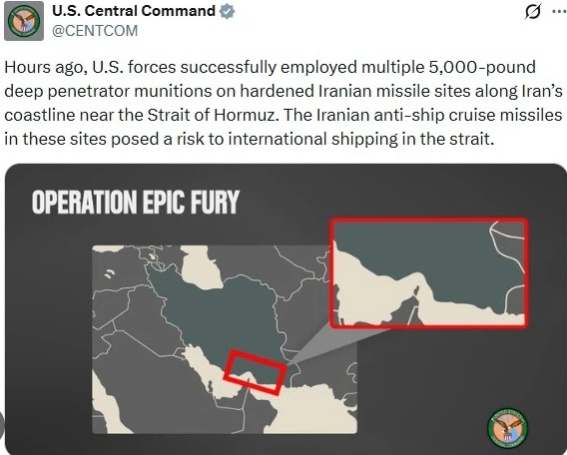
The US military claimed that the strikes targeted ‘Iranian anti-ship cruise missiles’ that posed a direct risk to vessels moving through the Strait of Hormuz.
According to reports, the US forces carried out strikes on Iranian missile sites along the country’s southern coastline near the Strait of Hormuz, using multiple 5,000-pound (2,200-kg) bunker-buster bombs.
“Hours ago, US forces successfully employed multiple 5,000-pound deep penetrator munitions on hardened Iranian missile sites along Iran’s coastline near the Strait of Hormuz,” the military command said in a tweet early Wednesday.
It claimed that the strikes targeted Iranian anti-ship cruise missiles, which “posed a risk to international shipping in the strait.”
The Central Command announced the bombings hours after US President Donald Trump lamented that most North Atlantic Treaty Organisation (Nato) allies said that they did not want to get involved with the American military’s campaign in Iran.
While he did describe the move as a “very foolish mistake,” he gave no indication that he plans to punish the alliance’s fellow members for their stances.
Trump said Nato countries were supportive of the joint US-Israeli war, which has now entered its third week, even as they did not want to get involved.
“Everyone agrees with us, but they don’t want to help. And we, you know, we as the United States have to remember that because we think it’s pretty shocking,” he told reporters.
His remarks came just days after the US President publicly called in nations to send warships to enable container vessels to pass through the Iran-controlled Strait of Hormuz unharmed.
Several countries, however, including close US allies, almost rejected Trump’s pleas, leaving him high and dry.
French President Emmanuel Macron said his country would “never” do so until the situation was calmer.
The Strait of Hormuz, which has been effectively closed since the first week of March in the wake of the ongoing war between Iran and the joint front of Israel and the US, is a vital choke point through which about 20 percent of the world’s oil and gas passes.
The disruption to movement of cargo ships through the strategic waterway has sent fuel prices soaring across the world.