




Manas Dasgupta
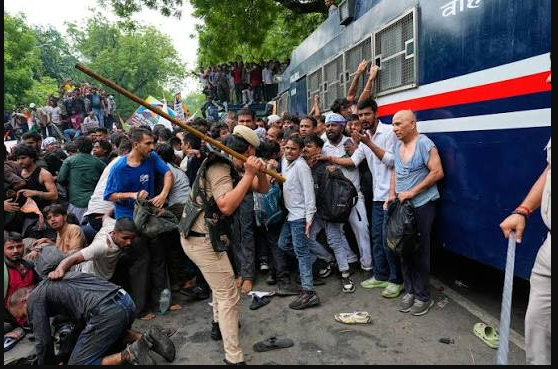
NEW DELHI, Oct 10: In an unprecedented situation that many opposition leaders termed as an “undeclared emergency,” more than 4,000 people, mostly students and youths, and leaders of several opposition leaders and former chief ministers were detained across Delhi on Saturday to scuttle the Cockroach Janta Party (CJP) call protest at Jantar Mantar to press the demand for the ouster of the Chief Election Commissioner (CEC Gyanesh Kumar and the rollback of the “Special Intensive Revision” (SIR) of the electoral rolls.
Delhi has been turned into a fortress, with more than 40,000 Delhi Police and Central Armed Police Forces (CAPFs) personnel deployed, and barricades and spike strips installed ahead of the planned protest at Jantar Mantar.
Several INDIA bloc leaders, including former chief ministers Arvind Kejriwal of Delhi, Mamata Banerjee of West Bengal, Pinarayi Vijayan of Kerala and Manik Sarkar of Tripura were detained by Delhi Police on Saturday as they attempted to join the protest at Jantar Mantar. AISA’s Neha Bora was also among those who were detained in the national capital on Saturday. There were also reports of journalists being detained around Jantar Mantar. Posts and videos on social media showed the detained journalists flashing their press cards from the buses.
Bollywood actor Imran Khan has been detained in Mumbai where he was participating in the protest against the alleged discrepancies in the Special Intensive Revision (SIR) by the Election Commission of India (ECI). Before his detention, Khan said he was attending the protest to see why freedom of movement was being restricted and why people’s voices were being suppressed. “I am not in a position to make demands of anyone. Nor am I part of any organization. I am just here as a representative,” he said.
After CJP’s Abhijeet Dipke, Saurav Das and Ashutosh Ranka were detained upon landing at Delhi airport ahead of their planned protest at Jantar Mantar against CEC Gyanesh Kumar, more student leaders and youths were picked up from different places across Delhi and in some other parts of the country to thwart their attempt to reach Jantar Mantar.
Amid heavy barricading and troop deployment around Jantar Mantar, the CJP urged people to march towards the protest venue. “If Delhi Police tries to stop you, wherever they stop you will become your Jantar Mantar,” CJP’s Ajinkya Shinde, who is leading the anti-CEC stir after Dipke’s detention, said in a video shared on X.
Activist Sonam Wangchuk on Saturday warned of going on another hunger strike if the leaders detained during Saturday’s crackdown on anti-CEC protest were not released by Sunday. In a video message released on his social media handles, the activist claimed that the country was in a state of “undeclared emergency.”
“Yesterday when I posted a message appealing for unity and peace in today’s protest, I had never imagined that the biggest democracy in the world would be under an undeclared EMERGENCY,” he wrote. Wangchuk, who extended his support to the anti-CEC protest, was unable to physically take part in the agitation in Delhi. “I was happy there were so many leaders to lead the movement, but I now learn that they have all been arrested,” he said.
Ahead of the protest, security was tightened around Jantar Mantar and the roads leading to the site. Barricades were put up, with security personnel deployed at key points. Loudspeakers at three major entry and exit points issued warnings in Hindi and English against gatherings, processions, road blockades and other activities prohibited under Section 163 of the Bharatiya Nagarik Suraksha Sanhita (BNSS).
The Delhi Police said more than 15,000 personnel had been deployed to manage the anticipated turnout on Saturday, while the number of central force personnel in the city was expected to be around 26,000.
Security measures also affected public transport. The Delhi Metro Rail Corporation (DMRC) initially announced that entry and exit would be suspended at 57 stations from 9 pm on Friday until Saturday. It later revised the list to 45 stations following the intervention by the Supreme Court which cautioned the Centre against totally paralysing the public transport system merely on threat perception.
The Railways cancelled mail and express trains at their originating stations if they were scheduled to arrive at New Delhi or Hazrat Nizamuddin railway stations between 4 am and 2 pm on Saturday, October 10. The decision was taken amid concerns over heavy road traffic around the stations due to a planned protest in central Delhi.
Movement across Delhi has been affected by train cancellations, restrictions at Metro stations, the closure of retail liquor shops and tighter police security ahead of the planned protest. These measures have raised concerns over travel and access to several parts of the national capital.
The CJP leaders including founder president Abhijeet Dipke, and spokespersons Saurav Das and Ashutosh Ranka were detained by Delhi Police from inside an aircraft shortly after their flight landed in the national capital on Saturday. The three leaders had travelled from Mumbai to Delhi to participate in the party’s proposed protest at Jantar Mantar. In a video shared by the CJP, Dipke is heard telling police personnel who entered the aircraft, “We are here to be arrested. Come and arrest us.”
Before detaining the leaders, police personnel informed them that they did not have permission to stage a protest at Jantar Mantar. The CJP described the action as a violation of freedom of movement and demanded the immediate and unconditional release of the three leaders.
The CJP had called for the demonstration at Jantar Mantar to protest against the CEC over alleged voter-list manipulation during the Special Intensive Revision (SIR) of electoral rolls and changes related to Form 6, which is used for voter registration.
Police continued to detain activists after informing them that permission had not been granted for the proposed demonstration. The preventive action was aimed at ensuring that people with criminal backgrounds do not disrupt law and order during the proposed demonstration, police sources said.
Police are also closely monitoring the movements of individuals suspected of mobilising crowds or encouraging others to participate in the protest. Surveillance has been intensified outside the residences of such individuals as part of the security measures, the sources added.
Police personnel have been deployed at strategic locations across the national capital, particularly along routes leading to Jantar Mantar and other sensitive areas, to prevent any untoward incident. Security arrangements include heightened surveillance, monitoring the movement of individuals suspected of attempting to disturb public order, and keeping a close watch on possible mobilisation efforts ahead of the proposed demonstration. The planned protest has prompted increased security across Delhi, with police maintaining a strict vigil to prevent any breach of peace.
Several daily-wage labourers lost a day’s earnings, as they were turned away at security barricades by the Delhi Police on Saturday morning, while they were on their way to workplaces in Central Delhi. As Delhi turned into a fortress ahead of the protest at Jantar Mantar, security forces set up multiple layers of barricades on roads leading to central Delhi. At the barricades, only people with government ID cards were allowed to proceed towards Central Delhi.
Around 9:30 a.m., Ram Kishan Mandal, 36, was among a group of daily-wage workers employed at a construction site in central Delhi, who were stopped by Delhi Police personnel at a barricade leading to India Gate in Central Delhi. “Police are saying that we don’t have a permit to go ahead. We tried calling our employer, who asked us to walk to the site, but they are not allowing us,” he said.
Mr Mandal, who hails from Katihar district of Bihar, said his house was destroyed in the recent flood in the State, and his wife and children were living in a makeshift house with a tarpaulin roof. “If we earn something, then only I will be able to rebuild my house,” he said. “If we don’t work, we will lose out on today’s wage. What will we eat for two days?”
At another such barricade near Nizamuddin, another group of daily-wage workers was turned away by the police. “We are working at a construction site just across the flyover, but the police are not allowing us to go,” one of the workers said, pointing to a flyover about 50 metres away.
Mukesh Chauhan, 47, who works as an electrician at a work site in central Delhi, was also stopped at the Nizamuddin barricade while he was going to work on his motorbike. “If I don’t go, then I won’t get paid for the day. But they (police) are not allowing me to go. I earn only about ₹9,000 a month. People like us should be allowed to go. If I don’t work today, I will also lose the ₹100 I have spent on petrol for travelling,” he said.
Devender Chauhan, 41, on a scooter along with his wife was stopped at the barricade. “She works at a cafe in central Delhi. Look at her uniform; the company’s name is written here, but they are not allowing us to go,” he said. “The advertising company in Khan Market, where I work, is asking me to go and open the shop. The main key is with me. They are now saying, don’t work today. I have checked other roads also, everything is closed,” Mr Chauhan said. After multiple requests, Mr Chauhan’s wife finally got permission from one of the police officers to walk to her work place about 2 km away.
“Last time also, when Dharmendra Pradhan resigned, Khan Market was barricaded on all sides, and we were not allowed to even leave. We had to wait for about two hours,” he added, referring to the June-July protest in Jantar Mantar by CJP and other students’ unions.
CITU (Delhi) secretary, P.V. Aniyan, said daily wage and gig workers in Central Delhi and nearby areas were the worst affected by the government’s clampdown. “Their one day’s earnings have been completely affected. Before enforcing such a blockade in Delhi, the government should think about its effects,” he said.
The CJP has been demanding that CEC Gyanesh Kumar resign over alleged irregularities in the SIR of electoral rolls. The group has continued to raise the issue through protests and public statements, including a demonstration in Mumbai on October 2.
The latest protest has been planned at Jantar Mantar in Delhi; however, the Delhi Police said the organisers did not have the required permission to hold the demonstration and rejected their request, citing public interest.
Mr Dipke alleged that around 13 crore voters had been removed from electoral rolls since 2024. He also linked the alleged deletions to the narrow vote-share gap between the National Democratic Alliance (NDA) and the Opposition INDIA bloc in the 2024 Lok Sabha elections, arguing that large-scale changes to voter lists could influence election results.
The Election Commission has rejected the allegations, maintaining that major decisions, including the SIR of electoral rolls, had been taken unanimously by the full commission.