Trade deals: With the US, expected in Dec; talks on with 50 nations






Virendra Pandit
New Delhi: With most of the issues resolved, India expects to secure a trade deal with the US by the end of December 2025, the media quoted Trade Secretary Rajesh Agrawal as saying on Friday.
The US imposed tariffs of up to 50 percent on imports from India starting in late August, even as negotiations between the two countries continued.
Earlier this month, US President Donald Trump said that talks with Prime Minister Narendra Modi had been going well. Trump’s administration has pressured India to reduce oil purchases from Russia and to bring down tariffs, including across sensitive sectors like agriculture.
“What needs to come first is the framework trade deal, which can address the reciprocal tariffs,” Agrawal told industry leaders at an event of the Federation of Indian Chambers of Commerce and Industry (FICCI).
“I think all I can say is that we are close, we have tried to iron out most of the issues,” he said, adding that any remaining issues can be addressed at a “political level.”
“We are very optimistic and very hopeful that we should find a solution within this calendar year,” he said.
India’s trade deficit widened to a record high of USD 41.68 billion in October, driven by higher imports of gold and a decline in exports to the US.
Agrawal said the deficit was not in “worrying zone.”
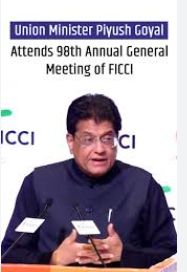
Meanwhile, Union Commerce and Industry Minister Piyush Goyal on Friday said that India is at present negotiating free trade agreements (FTAs) with a number of trading partners, including the US and European Union.
India is working with its ‘trusted’ trading partners through these agreements to boost economic ties, he said.
“We have all seen trade being weaponised. We have all seen the importance of having trusted partners around the world,” he said, adding that, at this moment, India is in talks with individual countries and groups of nations totalling about 50.
The remarks come at a time when a steep hike in tariffs by the US has disrupted global trade. The Trump administration has imposed a 50 percent import duty on Indian goods entering American markets since August 27.
The Gulf Cooperation Council (GCC) too is interested in trade pact talks, he said. The GCC is a union of six countries in the Gulf region– Saudi Arabia, UAE, Qatar, Kuwait, Oman and Bahrain.
New Delhi has already implemented a comprehensive trade agreement with the UAE. Talks with Oman are on nearing completion. Bahrain and Qatar want to enter into negotiations with India, he said.
“The whole six-nation group would like to engage with us. We are talking to New Zealand…We are in active discussions with the US and with 27-nation EU,” the minister said at the FICCI’s 98th Annual General Meeting.
India and the US are negotiating a bilateral trade agreement (BTA). So far, six rounds of negotiations have been completed.
New Delhi is also reviewing its trade pacts with the 10-nation ASEAN bloc and with South Korea to bring more balance to it. The ASEAN members include Brunei, Cambodia, Indonesia, Laos, Malaysia, Myanmar, the Philippines, Singapore, Thailand, and Vietnam.
“We are working with Eurasia (EAEU), which has started negotiations this week. We are equally engaged to start negotiations very quickly with Israel. Canada and India are looking at CEPA (Comprehensive Economic Partnership Agreement). Next week, they are going to start a conversation around that,” he added.
The five-member South African Customs Union (SACU) and Mercosur group also want to negotiate, he said. SACU nations include South Africa, Namibia, Botswana, Lesotho and Eswatini, and it is the world’s oldest customs union, over a century old.
Mercosur is a trading bloc in Latin America, comprising Brazil, Argentina, Uruguay and Paraguay.
India and the five-nation grouping, the Eurasian Economic Union (EAEU), on August 20, inked the terms of reference for the agreement. Russia, Armenia, Belarus, Kazakhstan, and Kyrgyzstan are the five member countries of EAEU.
India and Canada have agreed to resume negotiations for the CEPA with an aim to increase the two-way trade to USD 50 billion by 2030.
New Delhi has so far implemented such agreements with a number of nations, including Singapore, Japan, Korea, Malaysia and Australia.