Tariff: The US gets $550 bn Japan investments, imposes 15% import duty








Virendra Pandit
New Delhi: After much dilly-dallying, the US has imposed a 15 percent tax on imports from Japan, which will invest USD 550 billion in return!
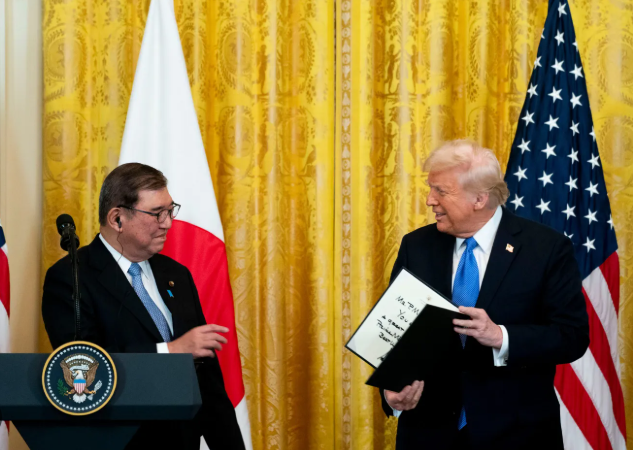
President Donald Trump announced a trade framework with Japan on Tuesday, imposing a 15 percent tax on goods imported from the Asian nation, according to media reports on Wednesday.
“This Deal will create Hundreds of Thousands of Jobs — There has never been anything like it,” Trump boasted on Truth Social, adding that the United States “will continue always to have a great relationship with the Country of Japan.”
He said Japan would invest “at my direction” USD 550 billion into the US and “open” its economy to American autos and rice. The 15 percent tax on imported Japanese goods is a meaningful drop from the 25 percent rate that Trump, in a recent letter to Japanese Prime Minister Shigeru Ishiba, said would be levied from August 1.
After he re-entered the White House on January 20, the US had claimed it would sign “90 trade deals in 90 days.” However, less than a dozen countries, including the UK and Vietnam, have done so far, despite Trump boasting multiple times that he has been a dealmaker all his life!
With this announcement, he is seeking to tout his ability as a dealmaker — even as his tariffs when initially announced in early April led to a market panic and fears of slower growth that for the moment appear to have subsided. Key details remained unclear from his post, such as whether Japanese-built autos would face a higher 25 percent tariff that Trump imposed on the sector.
But the framework fits a growing pattern for Trump, who is eager to portray the tariffs as win for the US. The White House says the revenues will help reduce the budget deficit and more factories will relocate to America to avoid the import taxes and cause trade imbalances to disappear.
The wave of tariffs, however, remains a source of uncertainty about whether it could lead to higher prices for consumers and businesses if companies simply pass along the costs. The problem was seen sharply on Tuesday after General Motors reported a 35 percent drop in its net income during the second quarter as it warned that tariffs would hit its business in the months ahead, causing its stock to tumble.
As the August 1 deadline for the tariff rates in his letters to world leaders is approaching, Trump also announced a trade framework with the Philippines that would impose a tariff of 19 percent on its goods while American-made products would face no import taxes. Trump also reaffirmed his 19 percent tariffs on Indonesia.
The US ran a USD 69.4 billion trade imbalance on goods with Japan in 2024, according to the Census Bureau.
America had a trade imbalance of USD 17.9 billion with Indonesia and USD 4.9 billion with the Philippines. Both island nations are less affluent than the US and an imbalance means America imports more from those countries than it exports to them.
The US President is set to impose the broad tariffs listed in his recent letters to other world leaders on August 1, raising questions of whether there will be any breakthrough in talks with the European Union. At a Tuesday dinner, Trump said the EU would be in Washington on Wednesday for trade talks.
The Trump administration has a separate negotiating period with China that is currently set to run through August 12 as goods from that nation are taxed at an additional 30 percent baseline.
Treasury Secretary Scott Bessent said he would be in the Swedish capital of Stockholm next Monday and Tuesday to meet with his Chinese counterparts. He said his goal is to shift the American economy away from consumption and to enable more consumer spending in the manufacturing-heavy Chinese economy.
“President Trump is remaking the US into a manufacturing economy,” Bessent said on the Fox Business Network show “Mornings with Maria.” “If we could do that together, we do more manufacturing, they do more consumption. That would be a home run for the global economy.”