Space: In Shubhanshu Shukla, India gets its second astronaut and a new hero!

Virendra Pandit
New Delhi: With the return of Shubhanshu Shukla on Earth on Tuesday, India has a new hero, 41 years after the country’s first astronaut, Rakesh Sharma, made the country proud.
It has been a giant leap for the Indian Space Research Organization (ISRO), which has funded Rs. 550 crore for the US-led joint mission and is now focusing on its human spaceflight dreams.
Shukla became the first Indian astronaut to visit the ISS. After his return on Tuesday, he will undergo an intensive ‘rehabilitation’ programme before his likely return to India in the coming weeks.
A decorated Indian Air Force (IAF) test pilot, Shukla, 39, carried out seven India-led experiments in microgravity, including plant growth, algae research, and stem cell regeneration during his 18-day stay at the International Space Station (ISS).
As the Dragon spacecraft carrying Shukla and three other astronauts returned to Earth after an 18-day stay aboard the ISS on Tuesday, it carried with it more than just scientific data and seed samples. It brought home a story of grit, dreams, and India’s growing space ambitions, the media reported.
Group Captain Shubhanshu Shukla completed his maiden space voyage as part of the Axiom-4 (Ax-4) mission, a commercial spaceflight supported by ISRO and NASA, and operated by Axiom Space, a private US-based space entrepreneur.
The journey marked a milestone for India: Shukla is the first Indian to step aboard the ISS and only the second Indian to go into space, after Rakesh Sharma’s iconic flight in 1984 as part of the then Soviet Union’s space mission.
Born on October 10, 1985—just a year after Sharma’s spaceflight—Shukla grew up in Lucknow in a middle-class family with no direct links to aviation or space. But a childhood visit to an airshow lit a spark in the budding astronaut.
“As a child, he had once been to an air show and was fascinated by the speed and sound of the aircraft. That’s when he first spoke about flying,” his elder sister Suchi Shukla said. “But of course, there was no telling at the time how quickly he would embrace his dream.”
Educated at City Montessori School (CMS), Shukla’s journey to the stars was anything but scripted. In a stroke of destiny, a classmate applying to the National Defence Academy (NDA) realised he was overage and passed on the form to Shukla, who was selected.
He was commissioned into the IAF in 2006 and became a decorated test pilot with over 2,000 hours of flying time on advanced fighter aircraft such as the Su-30 MKI, MiG-29, Jaguar, and Dornier-228. He later earned an M. Tech. in Aerospace Engineering from the Indian Institute of Science, Bengaluru.
Last year, he was selected as one of four astronauts in India’s ambitious Gaganyaan programme, alongside Prasanth Balkrishnan Nair, Angad Pratap, and Ajit Krishnan.
The quartet underwent intensive training in Russia’s Gagarin Cosmonaut Training Centre and ISRO’s Astronaut Training Facility in Bengaluru. But before Gaganyaan’s scheduled launch in 2027, Shukla got the opportunity to fly as part of the Ax-4 crew, becoming the second Indian to be part of a human spaceflight mission after 41 years.
After several postponements, the Shukla-piloted mission finally launched from the Kennedy Space Center on June 25, aboard the SpaceX Falcon 9 rocket. Ten minutes into the mission, the Dragon capsule entered orbit, prompting him to declare in Hindi, Kamaal ki ride thi! (What a wonderful ride it was!) and shared his sense of national pride: “I have the Indian tricolour embossed on my shoulders that tells me I am with all of you.”
Nicknamed “Shux” and known for his composed demeanour, Shukla carried Indian delicacies to space, including gajar ka halwa, aamras, and moong dal ka halwa, so his international crewmates could get a taste of India.
When he congratulated Shukla, Prime Minister Narendra Modi mentioned these delicacies and whether his crewmates relished them.
His launch-day song Yun Hi Chala Chal from the Shah Rukh Khan film Swades turned out to be a fitting choice for an astronaut on a mission about discovery, identity, and the journey back home.
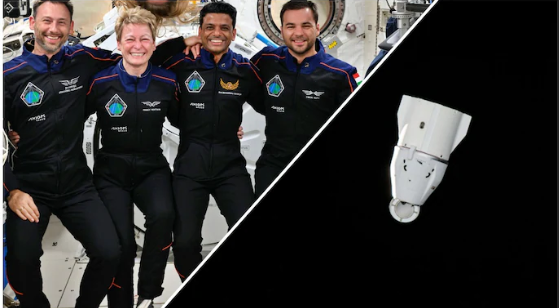
On board the ISS, Shukla piloted the Axiom-4 mission, alongside commander Peggy Whitson and mission specialists Slawosz Uznanski-Wisniewski of Poland and Tibor Kapu of Hungary. Together, they not only conducted science experiments but also engaged in outreach to students and space communities across the globe.
Shukla conducted seven India-led microgravity experiments across diverse domains of life sciences, agriculture, space biotechnology, and cognitive research.
“I am so proud that ISRO has collaborated with national institutions and come up with some fantastic research, which I am doing here on the station,” Shukla said during an interaction with Axiom’s chief scientist Lucie Low.
A highlight was the plant germination experiment led by scientists Ravikumar Hosamani (University of Agricultural Sciences, Dharwad) and Sudheer Siddapureddy (IIT, Dharwad). Shukla planted moong and methi seeds in petri dishes and captured their sprouting progress, inserting them into cold storage for later analysis back on Earth.
The goal was to study how microgravity influences plant growth, microbial interactions, and genetic expression, which are key insights for long-term space farming.
In another project, he worked with cyanobacteria and microalgae, which are organisms being explored for their ability to produce food, oxygen, and biofuels in space. These tiny life forms may hold the key to sustainable life-support systems during deep space missions, the media reported.
He also participated in stem cell research, exploring whether supplements can aid in injury repair and tissue regeneration in space. “It’s been great to work in the Glove Box doing this research. I feel proud to be a bridge between scientists on Earth and the USS,” Shukla said.
One of his lighter experiments was a zero-gravity demonstration involving water.
Shukla created a floating water bubble and joked, “I’ve become a water bender here on the station,” as his commander used a plastic bag to show how surface tension manipulates light in space like a lens.
As the mission neared completion, Shukla and his Ax-4 crewmates joined astronauts of Expedition 73, a long-duration mission, for a farewell ceremony on July 13. He thanked the ISS crew and ISRO for its support in developing a research portfolio and an outreach programme for students and STEM communities in India.
He also interacted with Prime Minister Narendra Modi, school students, and connected with ISRO centres using amateur radio. “It’s not just my journey, it’s India’s,” he said.
“From a curious young learner in our classrooms to a pioneering astronaut, Shux’s story beautifully encapsulates our mission of ‘Education for World Unity and Peace’,” said Geeta Gandhi Kingdon, a student at CMS, Lucknow, during the watch party the school had organised for the launch of the mission.
Shukla’s mission concluded with the Dragon Grace spacecraft’s splash down near the California coast on Tuesday but his story will continue.
With Gaganyaan on the horizon and new avenues in space research opening up, his experience is expected to be instrumental in shaping India’s human spaceflight programme.
In Shukla’s own words from the station: “I want each one of you to be part of this journey. Let us embark on India’s human space programme together.”