




Manas Dasgupta
NEW DELHI, Oct 12: The Supreme Court on Monday clarified that it had “neither approved nor disapproved” the alleged controversial alterations made to Form 6, an application form used by eligible individuals to seek inclusion in the electoral roll, stating that the issue was not adjudicated upon during the hearing on the Special Intensive Revision (SIR) of electoral rolls in Bihar.
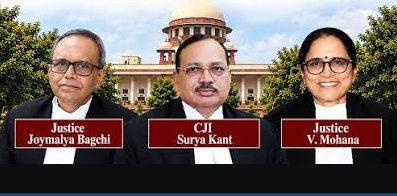
The clarification came from a bench comprising Chief Justice of India Surya Kant and Justices Joymalya Bagchi and V Mohana while hearing a petition related to the SIR exercise. The bench said its May 27 judgement was entirely about the legality of the pilot SIR process in Bihar.
The Court said the May 27 ruling pre-dated the changes made to Form 6. The changes and modified declarations, which required applicants to provide ancestry details or linkage to previous SIR rolls on the ECINet portal, were introduced subsequently in July. “When the Bihar SIR issue was heard and decided, the new Form 6 was not there. The new Form 6 was neither approved nor disapproved by us. But we will examine it now,” Justice Bagchi observed orally.
The remarks came in response to a petition filed by Priya Mishra against the Union government challenging the alterations made to Form 6 to register new voters during the SIR exercises undertaken across multiple States.
During the hearing, counsel for the petitioner submitted that the Election Commission had claimed the apex court approved the new Form 6.
He said the apex court had on October 5 observed that it had not approved any modifications to Form 6, which was being used by the Election Commission during the SIR of electoral rolls in various states.
“There is no adjudication on the new Form 6. That is all we have said,” Justice Bagchi observed, adding that when the matter relating to the SIR in Bihar was heard by it, the issue of new Form 6 was not there.
“What the Chief Justice said was that when the Bihar SIR matter was heard by us, the new Form 6 was not there,” Justice Bagchi said, adding that this did not mean it was either approved or disapproved by the top court. The Chief Justice cautioned lawyers against reading too much into the court’s observations, saying, “Don’t pick up words like this …”
The bench said the plea would be heard along with similar pending petitions relating to SIR, which were slated to come up for hearing on October 27. While hearing a separate plea on October 5, the apex court said it had not approved any modifications to Form 6.
The revised declaration in Form 6 has sparked controversy amid allegations that changes were introduced to the voter registration process without following the prescribed legal procedure.
Under the revised form, applicants seeking registration as new voters must declare whether they or their parents were included in the previous Special Intensive Revision (SIR). The earlier version of Form 6, used during electoral roll revisions in other states, did not require such a declaration.
The Election Commission, in a press release issued on September 26, suggested that the Supreme Court had upheld the Form 6 declaration in its May 2026 judgment concerning the Bihar SIR.
A key issue raised in the petition is the alteration of Form 6, which is used to apply for voter registration. The plea alleges that the requirement to provide ancestral details and establish a link with the previous SIR was introduced through the poll panel’s software without the statutory amendment required under the electoral rules.
The counsel for the petitioner recounted the CJI’s oral remark on October 5. The lawyer said that the CJI had commented that alterations in Form 6 were “not approved by us.” He said despite the CJI’s remarks, the Election Commission has continued to justify the changes to Form 6, claiming the court has approved them.
The May 27 judgment on the Bihar SIR had observed that Form 6 was a guide to the SIR verification process. The apex court said the Form 6 used in Bihar SIR “set out a framework of documentation.” “It is neither practicable nor desirable for the verification process to be left entirely unguided or subjective. It is true that Form 6, as prescribed under the Registration of Electors Rules, 1960, sets out a framework of documentation; however, the same is tailored to the process of revision contemplated under Section 21(2) of the Representation of the People Act,” the May 27 judgment authored by Chief Justice Kant had observed.
On October 5, during the hearing of petitions challenging the SIR process, the CJI had sharply reacted to submissions about the July alterations in the Form 6. “We are making it clear, any modifications to Form 6 have not been made by us,” the Chief Justice had said. Form 6 is a statutory document provided in the Schedule of the Registration of Electors Rules, 1960. Modifications to Form 6 should be done through the proper law-making process, and not by unilateral administrative actions.
The alterations in Form 6 included a supplementary declaration form on additional linkage requirements for voter registration. New applicants have to declare whether they, their parents, or their grandparents were registered in the previous SIR electoral rolls. Further, a response to these mapping and linkage questions was made a strict prerequisite for submitting Form 6 applications.