Roving Periscope: “Mother of All Deals,” India, EU may sign the FTA on Jan. 27


Virendra Pandit
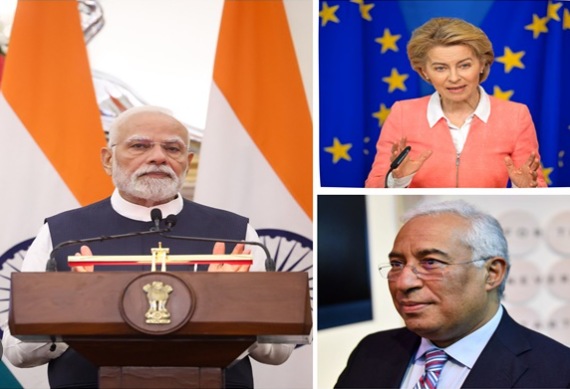
New Delhi: “The Mother of All Deals,” the long-pending free trade agreement (FTA) between India and the European Union (EU) is expected to be signed on January 27, a day after the President of the European Council, Antonio Costa, and President of the European Commission, Ursula von der Leyen, grace the Republic Day Parade in New Delhi as this year’s chief guests.
Union Minister for Commerce and Industry Piyush Goyal had hinted at this possibility recently. Now, at the ongoing World Economic Forum (WEF) Annual Summit in Davos, Switzerland, von der Leyen also signalled progress on Tuesday, stating the EU is close to agreeing, but acknowledged that additional work remains.
“It will be the mother of all deals,” she said on Tuesday, adding that the historic India trade pact was within reach.
Bilateral trade between India and the EU totalled USD 136.5 billion in the 2024-25 fiscal year ending March 2026, making the 27-nation bloc one of India’s biggest trading partners, the media reported on Friday.
The EU is India’s largest trading partner. India’s bilateral trade in goods with the EU stood at USD 136.53 billion in FY25, with exports worth USD 75.85 billion and imports of USD 60.68 billion.
India and the EU are expected to announce the conclusion of protracted negotiations for the FTA on January 27, opening the way for reduced tariffs on European cars and wine and expanded market for Indian electronics, textiles and chemicals.
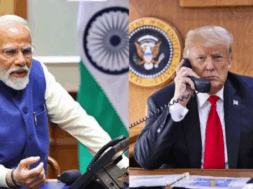
The formal announcement could come after Prime Minister Narendra Modi’s meeting with EC President Antonio Costa and European Commission President Ursula von der Leyen, who will co-chair the 16th India-EU summit during their visit to India from January 25 to 28 with PM Modi, the reports, quoting officials, said.
If finalised and ratified by the European Parliament, a process that could take at least a year, the trade pact would boost Indian exports such as textiles and jewellery. Negotiations were relaunched in 2022 after a nine-year pause, gaining traction last year amid rising trade tensions, and US President Donald Trump’s tariff-happiness.
In August, he doubled tariffs on Indian imports to as much as 50 percent, among the highest in the world.
The agreement comes days after the EU signed a pivotal pact with the South American bloc Mercosur, following deals last year with Indonesia, Mexico and Switzerland.
During the same period, New Delhi finalised pacts with Britain, New Zealand and Oman.
The spate of deals underscores global efforts to hedge against the United States as Trump’s bid to take over Greenland and tariff threats on European nations test longstanding alliances among Western nations.
“Negotiators are still trying to bridge differences on several sensitive issues, including India’s reluctance to sharply cut tariffs on auto imports,” an EU official said.
Non-tariff Barriers
A key concern for New Delhi is a range of non-tariff barriers such as the newly introduced carbon levies on imports of goods including steel, aluminium, cement, with industry experts saying there was little scope for relaxation.
Duty-free access to the EU could help offset losses for Indian textile and jewellery exporters in the US, Ajay Srivastava, founder of the New Delhi-based think tank Global Trade Research Initiative, said, while noting regulatory hurdles remain.
“An India-EU FTA would cut tariffs on textiles, garments and leather, letting Indian exporters compete more evenly with Bangladesh and Vietnam,” he added.
The EU imports nearly USD 125 billion worth of textiles annually, where India holds a 5-6 percent share versus China’s 30 percent, highlighting the potential gains from an FTA amid rising U.S. tariffs.
India’s autos, electronics, textiles, pharmaceuticals and chemicals are likely to emerge as key beneficiaries of a potential India-EU FTA.
Some sensitive agricultural items have been excluded from negotiations, an Indian trade ministry official said.
Recently, Goyal said there would be no compromise on India’s interests and that all sensitive issues, such as the Carbon Border Adjustment Mechanism and dairy, would be addressed to India’s satisfaction.
On January 8 and 9, he visited Brussels, in a decisive step forward in the India–EU FTA negotiations and in resolving pending issues.
The proposed FTA, Goyal said, would be the “mother of all deals”. His remarks came a day after Commerce Secretary Rajesh Agrawal hinted that both sides were likely to announce a conclusion of trade talks on January 27.
“I have done seven deals so far, all with developed countries. This one will be the mother of all deals. The good thing about the deal will be that there is no competition between the EU and India. It’s a win-win for both sides,” the minister said on the sidelines of the Startup India event.
For New Delhi, the trade deal with the 27-nation European bloc is crucial. Its trade negotiations with the US have dragged, and it is exploring new export markets, as that country has imposed a 50 percent additional tariff on its exports.
The agreement will cover all aspects, but only “sensitive” agriculture issues on “both sides” are off the table, a senior government official said on Thursday.
“In earlier times, when governments were negotiating, they were negotiating from a position of weakness. Therefore, they were doing deals with Asean and such economies. They were trying to join RCEP (Regional Comprehensive Economic Partnership), which would have meant an FTA with China. It would have been a death knell for ‘Make in India’, small-scale industries and farmers. All the FTAs by Prime Minister Narendra Modi are with developed countries and not even one with competing economies,” Goyal said.
Additionally, he said exports in the first 14 days of January 2026 were “highly positive”, following 1.8 percent growth in shipments in December 2025.
His meetings with Eu officials focused on stocktaking the progress achieved across various negotiating tracks to “narrow divergences” and ensure clarity on outstanding issues, the Department of Commerce said.
Apart from the economic benefits of the trade agreement, the EU, especially its biggest members like Germany and France, is keen to wean India off Russian influence. Both New Delhi and the European bloc are hopeful that their deal will help cut their mutual dependence on China.