Roving Periscope: Markets down after Trump’s 500% tariff threat to Russian oil buyers




Virendra Pandit
New Delhi: With US President Donald Trump ‘greenlighting’ the bipartisan Russia Sanctions Bill, stock markets in some countries sank on Thursday, with India’s Sensex and Nifty50 shedding 780 and 263 points, respectively.
The proposed bill, if passed, could be used to penalise Russia’s trading partners, including India, China and Brazil, over their purchase of Russian oil, said Republican Senator Lindsey Graham, a prominent defence hawk, the media reported.
In Mumbai’s Dalal Street, benchmark indices extended losses for a fourth consecutive session on Thursday, with the BSE Sensex dropping 780 points to close at 84,180 and the NSE falling 263 points to close at 25,877.
Trade experts warned that the proposed tariffs under the Sanctioning of Russia Act of 2025 would effectively function as a trade ban, making Indian goods prohibitively expensive for American consumers and threatening key export sectors including pharmaceuticals, textiles, information technology and leather.
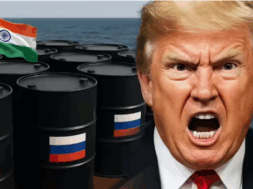
The Graham-Blumenthal sanctions bill proposes to authorize the US President to levy up to 500 percent tariffs on nations that knowingly purchase Russian oil or uranium and “fuel Russian President Vladimir Putin’s war machine.” The hard-hitting sanctions package is meant to economically cripple Moscow as the Trump administration continues to negotiate a likely peace deal to end the ongoing war that began with Russia’s invasion of Ukraine in February 2022.
Graham said he met with Trump at the White House on Wednesday, during which the President extended his support to the bill that has been in the works for months. The development was also confirmed by a White House official, the media reported.
“This will be well-timed, as Ukraine is making concessions for peace and Putin is all talk, continuing to kill the innocent,” Graham said in a statement.
He said there could be a vote on the bill next week, although it’s unclear how likely that will be. The US Senate is set to take up a scaled-back government funding package next week if the House of Representatives, currently considering, passes it. The following week is a Senate recess timed to Martin Luther King Jr Day.
The Russia Sanctions Bill
The bill, drafted mainly by Republican lawmaker Lindsey Graham and Democratic Senator Richard Blumenthal, allows the administration to impose tariffs and secondary sanctions up to 500 percent on countries buying Russia’s oil, gas, uranium and other exports. Doing so is meant to cut off the source of financing for much of Russia’s military actions.
The White House had insisted on some revisions and flexibility for Trump in the sanctions package, but it is not clear whether any changes were secured.
The legislation has dozens of co-sponsors in the Senate, as well as a companion bill in the House, drafted by Republican Representative Brian Fitzpatrick.
The Trump administration is currently trying to finalise a peace deal to end the war in Ukraine, now nearly four years old, with special envoy Steve Witkoff and Jared Kushner, Trump’s son-in-law, as the US President’s chief negotiators.
According to the US Congress website, the legislation, titled the “Sanctioning of Russia Act 2025”, proposes wide-ranging penalties on individuals and entities connected to Russia. One major provision includes increasing duties on all goods and services imported from Russia into the US to at least 500 percent of their value.
Another provision calls for a 500 percent duty on goods and services imported from countries that “knowingly engage in the exchange of Russian-origin uranium and petroleum products.”
India’s Russian oil imports
Since Russia’s invasion of Ukraine in 2022, India increased its purchases of Russian crude oil due to steep discounts offered by Moscow in view of Western sanctions. Russia became India’s largest crude supplier, with Russian oil at times accounting for about 35-40 percent of India’s total crude imports, up from roughly 0.2 percent before the war.
Following Trump’s return to the White House in January 2025, Washington intensified pressure on countries continuing to buy Russian oil. In August 2025, the Trump administration imposed an additional 25 percent tariff on Indian exports for purchasing Russian crude, taking the overall tariff burden to 50 percent.
After tougher sanctions on Russian oil majors like Rosneft and Lukoil came into effect in November 2025, India’s imports of Russian crude fell sharply, from about 1.8 million barrels per day in November to around 1.0 million barrels per day in December.
In January 2026, Reliance Industries Limited, India’s largest buyer of Russian oil, said it had not received any Russian deliveries for weeks and did not expect any in January, signalling a further decline in imports.
On January 4, a day after the US forces invaded Venezuela and kidnapped its President Nicolas Maduro, Trump said America could raise tariffs further if India did not stop buying Russian oil.
“They (India) wanted to make me happy, basically. (Prime Minister Narendra) Modi is a very good man; he is a good guy. He knew I was not happy, and it was important to make me happy. They do trade and we can raise tariffs on them very quickly. It would be very bad for them,” Trump told reporters aboard Air Force One, referring to India’s recent reduction in purchases of Russian crude oil.
Earlier, India rejected Trump’s claim that PM Modi had assured him that New Delhi would stop buying Russian oil. The government said no such assurance was given nor conversation had taken place. New Delhi has repeatedly stated that its energy purchases are based on national interest and affordability, especially at a time of global fuel price uncertainty.