Roving Periscope: Is western media ‘embedded’ in the West’s geopolitical propaganda?







Virendra Pandit
New Delhi: A section of the ‘embedded’ American media appears to be justifying US President Donald Trump’s blatant invasion of oil-rich Venezuela, in violation of all international laws, by counting the alleged sins of its kidnapped President Nicolas Maduro who, along with his wife, is being “brought to justice” by parading him handcuffed and blindfolded in full public view in New York.
This biased media is almost prodding Washington to fix Mexico, Panama, Colombia, and Cuba as well, re-establish the “Donroe Doctrine” in the Western Hemisphere, and Make America Great Again (MAGA).
Another section of the media, in Europe, is selective or even mutely covering the Venezuela adventure: it has carefully been ‘factual’, aping their government press releases, lest the unpredictable Trump now invade even Greenland, Iceland, and more.
That apart, some media outlets are out to plant stories against ‘enemies’ of the West, led by America, to make out a case for Trump’s next targets.
One such report surfaced from Bloomberg on January 2, claiming that at least three tankers carrying Russian crude were heading towards Jamnagar, for Reliance Industries Ltd (RIL)’s plant on India’s west coast as their next destination, after the refiner restarted some purchases for domestic production. The vessels, Bloomberg claimed, are laden with nearly 2.2 million barrels of Urals and are expected to deliver their cargoes early this month, quoting data analytics firm Kpler, which monitors ship movements and projected destinations.
The report implied that Reliance might have resumed Russian crude imports after scaling back deliveries amid US sanctions. Bloomberg even ignored an RIL clarification issued the same day.
RIL’s share prices fell 4.39 percent to close at Rs. 1508.90 on Tuesday, amid additional reports that Trump could clamp fresh tariffs on India on the Russian crude issue.
A Reliance spokesman denied that the cargoes had been purchased by the company, adding that it didn’t have any committed shipments of Russian crude for delivery in January, and that it had received no Russian crude in three weeks either.
The blue-chip company described the Bloomberg report as “blatantly untrue” and expressed concern over the publication of an article that it said damaged its reputation.
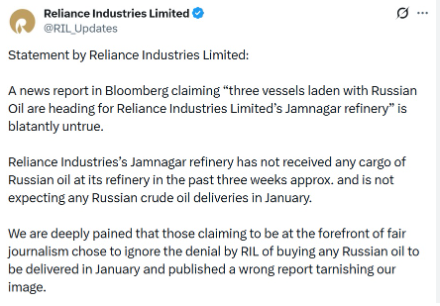
In an official statement posted on X, RIL clarified that:
“A news report in Bloomberg claiming “three vessels laden with Russian Oil are heading for Reliance Industries Limited’s Jamnagar refinery” is blatantly untrue. Reliance Industries’ Jamnagar refinery has not received any cargo of Russian oil at its refinery in the past three weeks approx. and is not expecting any Russian crude oil deliveries in January. We are deeply pained that those claiming to be at the forefront of fair journalism chose to ignore the denial by RIL of buying any Russian oil to be delivered in January and published a wrong report tarnishing our image.”
The company said that vessel tracking signals indicate potential destinations but do not confirm purchases or deliveries.
The Bloomberg report came amid tighter US and European Union sanctions on Russian oil, including restrictions on shipping, insurance and financial transactions.
In August 2025, Trump imposed an additional 25 percent tariff on India for importing Russian crude, raising the total US levies to 50 percent.
Ever since, he has been threatening to hike tariffs, his latest threat coming on Monday, as he tried to arm-twist India to sign on the dotted line on the US-India bilateral trade deal, on the pretext of continued import of the Russian crude.
Indian refiners, including RIL, have been adjusting their procurement strategies in response, seeking to balance discontinued Russian crude with alternative supplies from West Asia, Africa and other regions, including the USA, to maintain refinery operations.
India became the biggest buyer of discounted Russian seaborne crude after the start of the Ukraine war in February 2022. The purchases have fuelled a backlash from Western nations, which targeted Russia’s energy sector with sanctions, arguing that oil revenues help fund Moscow’s war effort—even as a hypocritical Europe itself continued to buy Russian energy, especially natural gas to run its own industries.
With Reliance halting Russian crude purchases, India’s oil imports from Russia are set to fall further in January; Beijing will remain the only major outlet for Moscow.
New Delhi has reportedly asked refiners for weekly disclosures of Russian and US oil purchases. India expects Russian crude imports to dip below 1 million barrels per day as New Delhi seeks to clinch a trade deal with Washington.
Stricter US and European Union sanctions have already slowed Russian oil flows to India, which fell to a three-year low of about 1.2 million barrels per day (bpd) in December 2025, marking a roughly 40 percent drop from a June peak of around 2 million bpd, according to a media report.
Russian oil deliveries to Reliance’s Jamnagar refinery complex made up more than 40 percent of the plant’s imports in the January to November period last year.
Besides Reliance, other Russian oil importers were state-owned Indian Oil Corp. and Bharat Petroleum Corp. which also picked up cargoes from non-sanctioned sellers.