Roving Periscope: In the US, Jaishankar sets the tone for Goyal’s trade talks






Virendra Pandit
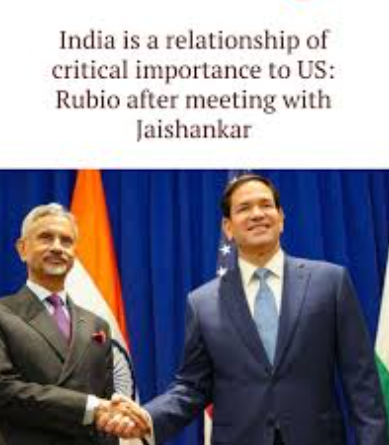
New Delhi: External Affairs Minister S. Jaishankar on Monday met his US counterpart Secretary of State Marco Rubio on the sidelines of the 80th Summit of the United Nations General Assembly (UNGA) in New York, in what is seen as setting the tone for resumed bilateral trade and tariffs negotiations being led by India’s Commerce and Industry Minister Piyush Goyal, who is also in the US.
Dr. Jaishankar’s meeting with Rubio was their first face-to-face interaction after President Donald Trump imposed an additional 25 percent tariff in August for New Delhi’s purchases of Russian oil, taking the total levies imposed on India to 50 percent. They had last met in July in Washington DC for the Quad Foreign Ministers’ Meeting.
Goyal is leading an Indian delegation for resumed trade talks. “The delegation plans to take forward the discussions with a view to achieving early conclusion of a mutually beneficial Trade Agreement,” the Ministry of Commerce and Industry said in a statement.
During the last visit of officials from the office of the US Trade Representative to India on September 16, ‘positive’ discussions were held on various aspects of the trade deal, and it was decided to intensify efforts, it noted.
Dr. Jaishankar is set to hold a series of bilateral and multilateral meetings on the sidelines of the UN session and will deliver the national statement at the General Debate on September 27 from the UNGA podium, the media reported on Tuesday.
He also met with European Union Foreign Ministers, at a special meeting hosted by EU High Representative for Foreign Affairs and Security Policy Kaja Kallas, on the sidelines of the UNGA. The meeting also included ministers from Brazil and Mexico and focused on critical global issues, including multilateralism, the India-EU partnership, the Ukraine conflict, the Gaza situation, energy, and trade.
Dr. Jaishankar, in a post on X, stated “Pleased to meet EU Foreign Ministers at their informal meeting today in New York. Thank EU HRVP Kaja Kallas for hosting me. An opportunity to have open exchange of views on multilateralism, India-EU partnership, Ukraine conflict, Gaza, energy and trade.”
Dr. Jaishankar and Goyal held separate key meetings in New York emphasising the importance of the bilateral relationship. Both nations aim to overcome recent tensions and unlock trade potential.
“Secretary Rubio, reiterating that India is a relationship of critical importance to the United States, expressed his appreciation for the Indian government’s continued engagement on a number of issues including trade, defense, energy, pharmaceuticals, critical minerals, and other items related to the bilateral relationship,” Rubio was quoted as saying in a statement by the US Department of State.
“Secretary Rubio and External Affairs Minister Jaishankar agreed the United States and India will continue working together to promote a free and open Indo-Pacific region, including through the Quad.”
Goyal met with US Trade Representative Jamieson Greer to accelerate trade talks between the two countries. In May, he held deliberations with US Commerce Secretary Howard Lutnick in Washington.
After March and May, this was their third meeting this year. The two leaders were keen to build on the momentum established by the recent positive interactions between US President Donald Trump and Prime Minister Narendra Modi.
The talks, halted for some time, resumed after Trump announced that his team was continuing trade negotiations with India.
Earlier this month, he said he was optimistic about concluding a trade agreement with India. In response, PM Modi said the trade negotiations would pave the way for “unlocking the limitless potential of the India-US partnership.”
The visit by the ministers comes after the daylong discussions in New Delhi between US Chief Negotiator Brenden Lynch and his Indian counterpart Rajesh Agrawal, Secretary, on the proposed BTA on September 16, when President Trump spoke with PM Modi on phone to wish him on his 75th birthday that fell the next day. PM Modi responded by saying he was “fully committed” to taking the Indo-US partnership to “new heights.”
In February, the two leaders directed officials to negotiate a proposed BTA.
It was planned to conclude the first tranche of the pact by the fall (October-November, 2025). So far, five rounds of negotiations were held. The pact is aimed at more than doubling the bilateral trade to USD 500 billion by 2030.
India’s Chief Economic Adviser (CEA) V. Anantha Nageswaran on September 18 said he expected a resolution to the tariff stand-off with the US in the next few weeks, even as he projected steady momentum in India’s domestic economy.
The US remained India’s largest trading partner for the fourth consecutive year in 2024-25, with bilateral trade valued at USD 131.84 billion (including USD 86.5 billion worth of exports). The US accounts for about 18 percent of India’s total goods exports, 6.22 percent in imports, and 10.73 percent in the country’s total merchandise trade.
On the H-1B visa fee issue, former US Ambassador to New Delhi Tim Roemer admitted that the measure “causes a hiccup in the relationship” of the two countries. “Hopefully once we get through these trade negotiations, which are going to be maybe promising… then this H-1B visa issue can be revisited,” he said.
India has already concluded trade deals with the UK, Israel, and Australia, referring to which Roemer suggested that the US too could reach such an agreement given its wide-ranging interests in trade, technology, chip manufacturing, and clean energy. In that case, the US President might reconsider the H-1B visa issue.
If he does not, either the courts may say that the President overextended on H-1B visa, or the US Congress could weigh in and say, this was its purview.
The White House on Monday said the doctors could qualify for exemptions from the new USD 100,000 visa fee for high-skilled H-1B visa applications. The clarification came after some medical bodies expressed concerns over the risk to rural America, where there is already a dearth of health service providers. Data shows that over 76 million Americans live in places where the government has designated a shortage of primary care doctors.