Roving Periscope: In a 1971 Dhaka repeat, Taliban hang Pak soldiers’ pants in Afghanistan!





Virendra Pandit
New Delhi: In 1971, when nearly 93,000 Pakistani soldiers surrendered before the Indian Army in Dhaka, many of them were photographed squatting without their trousers, and some Bangladesh Mukti Bahini members hung their pants publicly.
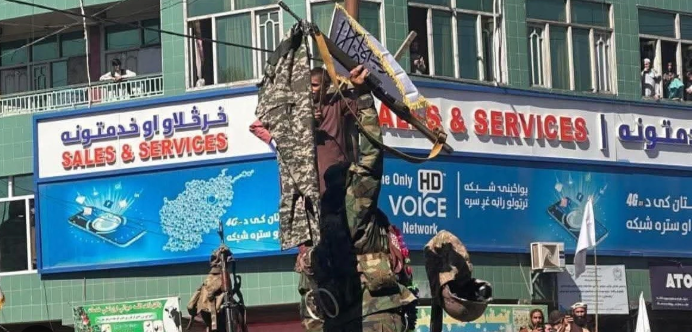
Cut to 2025. As Pakistan claimed on Wednesday that it agreed to a 48-hour ceasefire as ‘requested’ by Afghanistan, the Taliban publicly showcased and rode through Kabul on the battle tanks and other arms and ammunition they seized from the fleeing or surrendering Pakistani soldiers. They even hung pants of the disrobed enemy soldiers, the media reported on Thursday.
The way a panicked Pakistan requested India to halt Operation Sindoor in May, it also beseeched Afghanistan to stop the increasing hostilities this week. Islamabad put up a brave face and claimed victory against New Delhi—even elevating Army chief Asim Munir as “Field Marshal!” What will it do now?
Pakistan had signed a ‘mutual defence’ pact with Saudi Arabia in September. When it requested Riyadh and Doha (Qatar) to mediate with the Taliban this week, the Arabs merely asked both countries to keep the peace!
Afghanistan’s Tolo News reported that Pakistan had reached out to Saudi Arabia and Qatar for mediation.
“For God’s Sake, stop Afghans from fighting,” Pakistani officials told the two Arab countries, according to the report.
Angry with Islamabad’s double-speak, Kabul even refused entry of Pakistan Defence Minister Khawaja Abbas, the ISI chief, and other senior officers who wanted to initiate a dialogue.
In their brief but deadly war since Friday last, the two sides are reported to have lost over a hundred soldiers/militiamen, wounded hundreds of others. No official figures about casualties have been shared so far.
Pakistan even used fighter jets and drones against Afghanistan, while Taliban fighters overran border outposts and captured some two dozen of them. But who called for a ceasefire first amid images of bombing, seizure of arms and blown-off border gates?
“The fighting stopped because the Mujahideen inflicted a heavy defeat on them (Pakistani forces),” Ali Mohammad Haqmal, who heads information and culture in Spin Boldak district of Afghanistan, was quoted as saying by Tolo News.
“The Mujahideen carried out effective attacks against the Pakistani forces, putting them in a state of emergency and worsening their situation. That’s why they requested to stop the fighting,” he said, highlighting that the calls for a ceasefire came from the Pakistani side.
To prove his point, the Taliban fighters publicly displayed battle tanks, weapons, and even trousers of the surrendered Pakistani soldiers. Some of these pants were retrieved from the posts the fleeing soldiers abandoned.
Taliban spokesman Zabihullah Mujahid said the ceasefire was “at the request and insistence of the Pakistani side.” He wrote on X that the truce would be open-ended unless violated, and that Afghan forces were instructed to observe it strictly.
Curiously, Qatar-based Al Jazeera also echoed Mujahid’s claim of Pakistani request for ceasefire.
“Pakistan’s Foreign Office said the ceasefire, implemented at the Taliban’s ‘request’ and with ‘mutual consent,’ took effect at 6 pm local time (Wednesday) and would last for 48 hours, reported the Karachi-based Dawn newspaper.
The Taliban requested a ceasefire after facing a “powerful response” from Pakistani forces, the media outlet quoted an unnamed senior Pakistani military official as saying.
The two versions didn’t just differ on who called for a ceasefire, but also on the duration of the truce. While Afghanistan said it was “open-ended” until Pakistan violated it, the Pakistanis said it was for a 48-hour period.
CNN noted the 48-hour ceasefire followed deadly clashes, with Pakistan’s Foreign Ministry pushing for dialogue while the Taliban conditioned it on no further aggression.
This ceasefire was unlike the one between India and Pakistan after the four-day war in May. After fierce fighting during the Operation Sindoor, Pakistan’s panicked Director-General of Military Operations (DGMO) called up his Indian counterpart seeking a ceasefire. While that was bilateral, the one between Afghanistan and Pakistan needed mediation.
Although neither Afghanistan nor Pakistan spoke about an external mediator, the Dawn claimed, quoting diplomatic sources, that “Qatar helped facilitate the understanding.”
According to the report, soon after the announcement of the truce, Pakistan’s Foreign Office said Deputy Prime Minister and Foreign Minister Ishaq Dar received a message from Qatar’s Minister of State for Foreign Affairs Abdulaziz Al-Khulaifi. It “commended Pakistan’s ‘constructive engagement’ in promoting regional peace.”
Dar thanked Qatar for its “consistent support and positive role.”
The chances of the 48-hour ceasefire continuing remain remote as there is no mechanism in place for talks between the Islamic Emirate of Afghanistan and the Islamic Republic of Pakistan.
“I have my doubts that the ceasefire will hold, because the Taliban are being sponsored by Delhi,” Pakistani Defence Minister Khawaja Asif told Geo News. “Right now, Kabul is fighting a proxy war for Delhi,” he added, in an attempt at blame-shifting.
Pakistan has repeatedly accused the Taliban-led Afghan government of harbouring terrorists from the Tehreek-e-Taliban Pakistan (TTP), whom Islamabad dubs as Fitna al-Khawarij. These groups, Pakistan claims, use Afghan soil as a launchpad for attacks inside its territory. But Kabul rejects these allegations, countering that Pakistan shelters IS-linked fighters and violates Afghan sovereignty with airstrikes.
The fresh hostilities broke out on October 9 when Afghanistan accused Pakistan of bombing sites in Kabul, Khost, Jalalabad, and Paktika. Pakistan neither confirmed nor denied the claims.
Two days later, on October 11, in coordinated Taliban attacks on Pakistani border posts in the Chaman sector, 23 Pakistani soldiers died. Islamabad resorted to retaliatory strikes that reportedly claimed up to 200 Afghan lives. Other reports claimed higher death tolls on both sides.
Afghan officials said Pakistani shelling, targeting civilian areas, killed 15 non-combatants, including women and children, and wounded over 100. Pakistan’s Inter-Services Public Relations (ISPR) countered, saying that its forces killed 20–30 Taliban fighters, destroying posts and tanks.