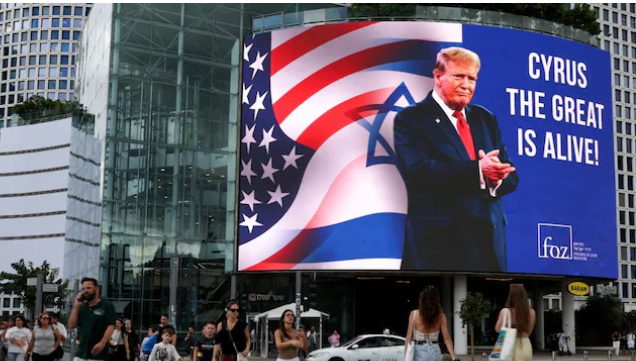
Roving Periscope: Hamas releases 20 surviving hostages; Israelis liken Trump with Cyrus the Great!








Virendra Pandit
New Delhi: With all the 20 remaining Israeli surviving hostages in Gaza being freed from Hamas captivity and returned to Israel on Monday after two years of the ongoing war, the visiting US President Donald Trump received a standing ovation in the Knesset, the Israeli Parliament, with some comparing him with Persia’s legendary Emperor Cyrus the Great, and others favouring the Republican leader for the Nobel Peace Prize in 2026, which he missed in 2025.
The bodies of 28 deceased Israeli hostages are expected to be returned by Hamas under the terms of the US-brokered 20-point ceasefire deal, the media reported.
President Trump also indicated that ending the ongoing war between Russia and Ukraine would be his next focus.
As part of the agreement, the release of 250 Palestinian prisoners serving long and life sentences is now underway, as is the release of more than 1,700 Palestinian detainees from Gaza held by Israel without charge since the Hamas-led invasion of Southern Israel on October 7, 2023. Retaliating against it, Israel went to war against Hamas-controlled Gaza, where over 67,000 people have died so far, besides the ruination of much of the Palestinian enclave.
Israeli Prime Minister Benjamin Netanyahu described President Trump as the “greatest friend” Israel has ever had in the White House.
Addressing the Knesset, amid some commotion, Trump told cheering Israeli lawmakers that “the long and painful nightmare is finally over.” He reiterated, once again, that he also brought peace between India and Pakistan!
During the first such address by a US president since 2008, he said the day would mark “the moment that everything began to change, and change very much for the better” in the Middle East.
During a whirlwind trip to the region, Trump will also attend a peace summit in Sharm El-Sheikh, Egypt, alongside Egyptian President Abdel Fattah al-Sisi and other leaders from 20-odd countries, including India.
After hearing politicians’ chants of “Trump, Trump, Trump” in the Knesset, a beaming US President suggested the region was experiencing “the historic dawn of a new Middle East.” It echoed the words he used when Israel signed landmark deals with several Arab states during his first presidency (2017-21).
“At last, not only for Israelis but also for Palestinians, the long and painful nightmare is finally over,” Trump added.
The ceasefire that he helped to broker was “the most challenging breakthrough of them all, the most challenging breakthrough maybe ever,” he said as he gave an insight into some of his recent conversations with Israeli Prime Minister Benjamin Netanyahu, saying he felt the Israeli military campaign in Gaza was becoming “bad” and “heated.”
Trump’s speech was briefly interrupted as an opposition lawmaker held up a piece of paper that said “Recognise Palestine.” At least one person was escorted out of the room.
The US President was introduced to parliament by Netanyahu, who saluted Trump’s various acts of solidarity with Israel.
“Everything changed” in the American attitude to Israel’s military campaign in Gaza when Trump was re-elected as US President last year, Netanyahu added.
The Israeli PM thanked Trump for his “unremitting help” in securing the return of the remaining hostages – part of a group of 251 people seized during the October 7, 2023, attacks in southern Israel by Hamas.
Trump also praised Netanyahu, saying: “He’s not the easiest guy to deal with, but that’s what makes him great.”
The ceasefire in Gaza took effect on Friday morning last week after Israel and Hamas agreed to the first phase of Trump’s 20-point peace plan. The next phases are still to be negotiated.
The US President said the ceasefire will hold, and that a “board of peace” he is due to head would quickly be set up to administer the Palestinian territory.
Netanyahu said he was “committed to this peace.”
Also welcomed to the Knesset alongside Trump were other key US officials, including Secretary of State Marco Rubio and Defence Secretary Pete Hegseth.
The names of Special Envoy Steve Witkoff and Trump’s son-in-law and adviser Jared Kushner received particularly loud cheers from Israeli MPs, for their own roles in brokering the ceasefire. Kushner was accompanied by his wife Ivanka Trump.
Members of Trump’s audience wore red caps. Instead of Trump’s signature slogan “Make America Great Again,” they read “Trump the Peace President.”
He was told by the parliamentary speaker that there was “no-one” more deserving of next year’s Nobel Peace Prize.
But some Israeli lawmakers, who want the war in Gaza to continue, did not attend.
Amid these developments, banners in Israel emerged, calling Trump ‘Cyrus the Great’ as Gaza peace plan started, linking him to the Persian monarch who had famously liberated Jewish hostages from Babylonian Captivity in the sixth century BC.
The peace plan in Gaza began on Monday with Hamas releasing all 20 surviving Israeli hostages to the Red Cross, marking the first release under a ceasefire during the ongoing conflict. President Trump is being widely credited for brokering the ceasefire, especially in Israel and the US.
Cyrus the Great had founded Persia’s Achaemenid Empire (550 BC to 330 BC). Under his leadership and that of his successors, the realm expanded across a vast region, including modern-day Iran, Iraq, Turkey, Syria, Egypt and Central Asia.
A key moment in his rule was the capture of Babylon in 539 BC. Babylon’s king, Nabonidus, faced internal dissatisfaction because of unpopular religious reforms and his long absences from the city. Cyrus’ conquest marked the beginning of a new approach to governance in the region, The Conversation reported.
One of Cyrus’ most famous acts was the release of Babylonian captives, including Jews who had been exiled from Israel decades earlier. In 587 BC, King Nebuchadnezzar II of Babylon destroyed Jerusalem and took thousands of Jews as hostages. Nearly 50 years later, Cyrus allowed many of them to return to Judah.
The biblical Book of Ezra records this decree, hailing Cyrus as chosen by God to rebuild the Jewish Temple in Jerusalem. The Old Testament Book of Isaiah praised him as the liberator of the Jewish people. Although not a Jew himself– he likely followed Zoroastrianism–Cyrus earned a lasting place in Jewish history.
The “Cyrus Cylinder”, an ancient clay tablet from Babylon, describes his takeover of the city as peaceful and mentions the return of exiles. Today, a replica of the tablet is displayed at the UN headquarters in New York, and it is often cited as an early example of human rights advocacy, The Conversation reported.
Greek historian Xenophon also described Cyrus as a ruler who cared deeply for his subjects, likening him to a father figure. His reputation for fairness was recognised both during his lifetime and in later centuries.