Roving Periscope: Chinese youth shun pregnancy; birth rate hits record low










Virendra Pandit
New Delhi: In 2022, China was the world’s most populous country with a headcount of more than 1.4 billion people, boasting of a ‘demographic dividend.’ No longer.
Media reports on Monday, quoting official numbers, suggested that births in China fell to a record low in 2025 despite subsidies and policy shifts, as young Chinese routinely delay marriage and parenthood amid high costs, job uncertainty and long working hours.
China’s population fell for the fourth consecutive year in 2025, extending a demographic decline that has gathered pace despite repeated policy shifts and incentives aimed at boosting births.
The Asian giant’s population declined by 3.39 million people last year, taking the total to about 1.4 billion. The fall was steeper than in 2024 and extends an annual decline that began in 2022, indicating a record collapse in births and a steady rise in deaths.
According to the data released by the National Bureau of Statistics, China recorded 7.92 million births in 2025, down sharply from 9.54 million in 2024, a year-on-year decline of 1.62 million births, or 17 percent.
The birth rate fell to 5.63 births per 1,000 people, the lowest level recorded since 1949, when the People’s Republic of China (PRC) was founded. This means that China has now reported more deaths than births for four years in a row, a milestone that marks a structural shift rather than a temporary dip.
Its fertility rate, or the average number of children a woman has over her lifetime, stands at around one, far below the replacement level of 2.1.
While births fell rapidly, deaths have continued to rise. China recorded 11.31 million deaths in 2025, pushing the death rate to 8.04 per 1,000 people, the highest since 1968.
The combination of falling births and rising deaths resulted in a net population decline of 2.41 per 1,000 people last year.
Experts said the speed of the shift reflects the long-term impact of decades of low fertility, now colliding with a rapidly ageing population.
China has in recent years been trying to reverse the population shrinking trend with policies aimed at incentivising births. It scrapped its one-child policy in 2016, replacing it with a two-child limit. But when births failed to rebound, the government raised the cap to three children per couple in 2021.
Recently, Beijing rolled out a nationwide childcare subsidy, effective January 1, 2026, offering parents 3,600 yuan (about USD 500) per annum for each child under the age of three. Public kindergarten fees were waived last year, and some provinces have added extra payouts, subsidised housing, and longer maternity leave.
Besides, China has imposed a 13 percent value-added tax on contraceptives, including condoms and birth control pills, after removing earlier exemptions. While not formally labelled a pro-natalist policy, the move was widely interpreted as an attempt to push childbirth.
President Xi Jinping has called for a “new culture of marriage and childbearing”, urging officials to shape attitudes towards love, marriage and fertility. Local governments have also responded with increasingly intrusive measures, even including tracking menstrual cycles and discouraging abortions deemed not medically necessary.
Despite these efforts, birth rates are falling. According to a 2024 report by the YuWa Population Research Institute, China is among the most expensive countries in the world to raise a child, as costly housing, education, and childcare costs remain a major deterrent.
Financial hardships have only heightened tension. Youth unemployment among those aged 16 to 24 reached 18.9 percent in August 2025, and many young people work long hours under the so-called “996” culture, 9 am to 9 pm, six days a week. That leaves little time or appetite for procreation, sexual activity, pregnancy, or child rearing.
Marriage rates are also at record lows as many couples born during the one-child era now face the dual burden of raising children while caring for two sets of ageing parents. Therefore, public reaction to government incentives has been muted, with some young people saying higher condom prices are still far cheaper than the cost of raising a child.
A shrinking population carries significant economic and social implications because, as China’s working-age population falls, it will weaken the labour supply and consumer demand. While the economy grew 5 percent in 2025, meeting the official target, economists say growth was driven largely by exports, masking sluggish domestic consumption.
Simultaneously, ageing population challenge is accelerating as the number of people aged 60 and above is expected to reach 400 million by 2035, and the state pension system is already under strain, with the Chinese Academy of Social Sciences warning that funds are running low.
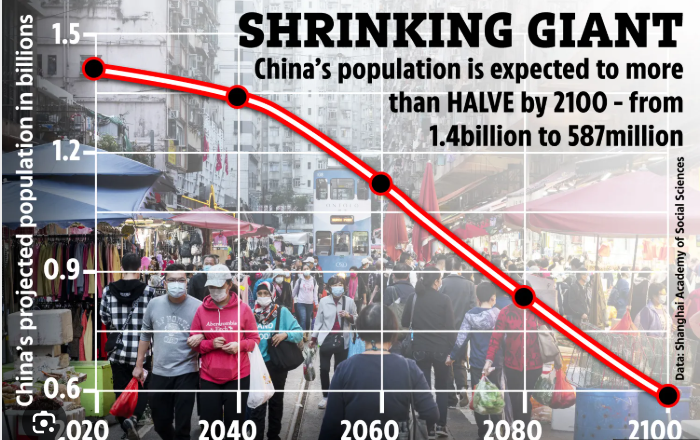
The United Nations’ projections suggest China’s population could fall from around 1.4 billion today to about 800 million by 2100, with some estimates pointing to a loss of more than half its population by the end of the century.
For now, the data suggests that China’s demographic decline is a crisis which is deepening, and the policy tool options to reverse it are running out.