Roving Periscope: After Hormuz, Iran threatens to shut Bab-al-Mandeb Strait as well









Virendra Pandit
New Delhi: As the inconclusive and intensifying US-Israeli war on Iran entered the 38th day, with attempts to reopen the Strait of Hormuz failing, Tehran has threatened to shut another key waterway, Bab al-Mandeb, the media reported.
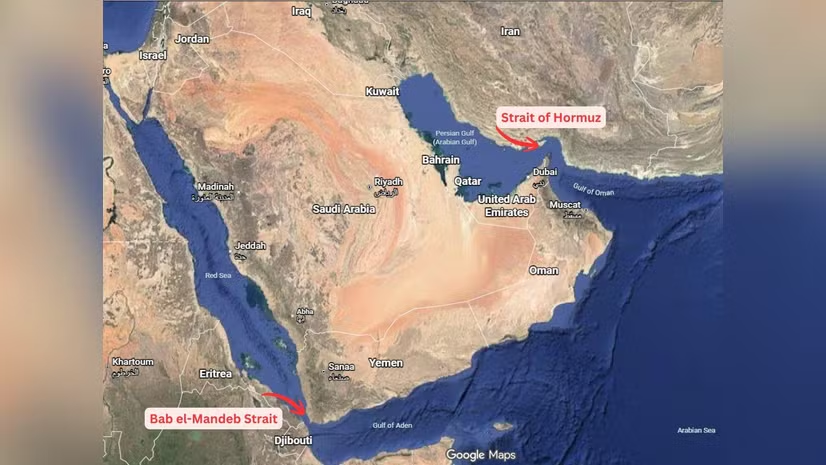
The Strait of Bab-el-Mandeb is a major global chokepoint between Yemen on the Arabian Peninsula and Djibouti and Eritrea in the Horn of Africa, connecting the Red Sea to the Gulf of Aden, and by extension to the Indian Ocean.
As global supply chains remain severely affected by disruptions around the Strait of Hormuz, former Iranian Foreign Minister Ali Akbar Velayati has warned that Tehran’s allies could shut the Bab al-Mandeb, another key global shipping route, if pressure on Iran is mounted further.
Velayati, who is now a senior adviser to Iran’s new Supreme Leader, Mojtaba Khameini, issued the warning on social media. “The unified command of the Resistance Front views Bab al-Mandeb as it does Hormuz,” he wrote on X. “If the White House dares to repeat its foolish mistakes, it will soon realise that the flow of global energy and trade can be disrupted with a single move.”
His remarks followed US President Donald Trump’s threat to strike Iran’s power plants and bridges if Tehran failed to reopen the Strait of Hormuz, through which about 20 percent of the world’s oil and gas passes.
While Iran said Hormuz remains open to ships from ‘friendly’ countries negotiating safe passage, it has warned the US and Israel that they will not be allowed through.
If the Bab al-Mandeb Strait is also disrupted, the impact could go far beyond the current conflict, potentially affecting global trade and energy supplies very severely.
The Strait of Bab al-Mandeb
It lies between Yemen on the Arabian Peninsula and Djibouti and Eritrea in the Horn of Africa. At its narrowest point, the strait is about 29 km wide, allowing ships to pass through two narrow channels for inbound and outbound traffic.
The waterway is strategically important because it links shipping routes between Asia, Europe, and West Asia.
The region around the strait is also influenced by Iran’s Shia proxy, Yemen-based Houthi rebels, which Tehran calls part of its “Axis of Resistance.” It is a network of Iran-allied groups across the region that also includes Lebanon-based Hezbollah and Gaza-based Hamas.
The Bab al-Mandeb is among the world’s most critical shipping routes, a key pathway for oil shipments from West Asia to Europe and Asia through the Red Sea and the Suez Canal. In 2024, around 4.1 billion barrels of crude oil and refined petroleum products passed through the strait — roughly 5 percent of global supply.
The route is also used by Gulf crude producers to send oil to Europe via Egypt’s Suez Canal or the Suez-Mediterranean pipeline.
With the Strait of Hormuz facing disruption, the Bab al-Mandeb route has become even more important. Saudi Arabia, for instance, has increasingly relied on its Red Sea port of Yanbu to ship crude through this route.
To move oil there, the kingdom uses the East-West Pipeline — a 1,200-km pipeline linking the Abqaiq processing centre near the Gulf to Yanbu on the Red Sea.
According to Al Jazeera, citing data from energy intelligence firm Kpler, the pipeline carried an average of 770,000 barrels per day in January and February 2026. After the closure of the Strait of Hormuz, flows increased sharply and reached the pipeline’s capacity of about 7 million barrels per day by the end of March.
Other Trade
The strait carries far more than oil. Around 10 percent of global trade passes through the Bab al-Mandeb, including container shipments travelling from China, India and other Asian economies to Europe.
If both the Straits of Hormuz and Bab al-Mandeb were blocked, nearly a quarter of the world’s oil and gas supply could be disrupted.
Such a scenario would likely push up energy prices further and affect supply chains worldwide — from manufacturing to household fuel costs.
The Houthis
Iran-aligned groups, such as Houthis, have already demonstrated their ability to disrupt shipping in the region.
During Israel’s war in Gaza, beginning October 2023, Yemen’s Houthi rebels targeted vessels that it said were linked to Israel or the United States. The attacks led to rising insurance costs and reduced traffic through the Red Sea shipping lane.
In May 2025, the US and the Houthis reached a ceasefire agreement, after which shipping activity resumed. However, recent events suggest disruptions could happen again.
Since late March, the Houthis have relaunched missiles and drones at Israel, signalling their involvement in the broader regional conflict that began with the US-Israeli attacks on Israel on February 28.
Impact
A closure of this second strait as well would create a major disruption in global trade.
According to Elisabeth Kendall, a West Asia specialist, simultaneous disruptions in both the Straits of Hormuz and Bab al-Mandeb would be particularly damaging.
“Because if you have restrictions on the Strait of Hormuz at the same time as restrictions are escalating in the Bab al-Mandeb, then you really will disrupt, if not cripple, trade toward Europe,” she told Al Jazeera.
However, she also suggested that the Houthis may be cautious about triggering a wider conflict. While controlling the strait could give them strategic leverage, such a move might provoke a strong response from Saudi Arabia, which has already been at war with them, or other regional power.