



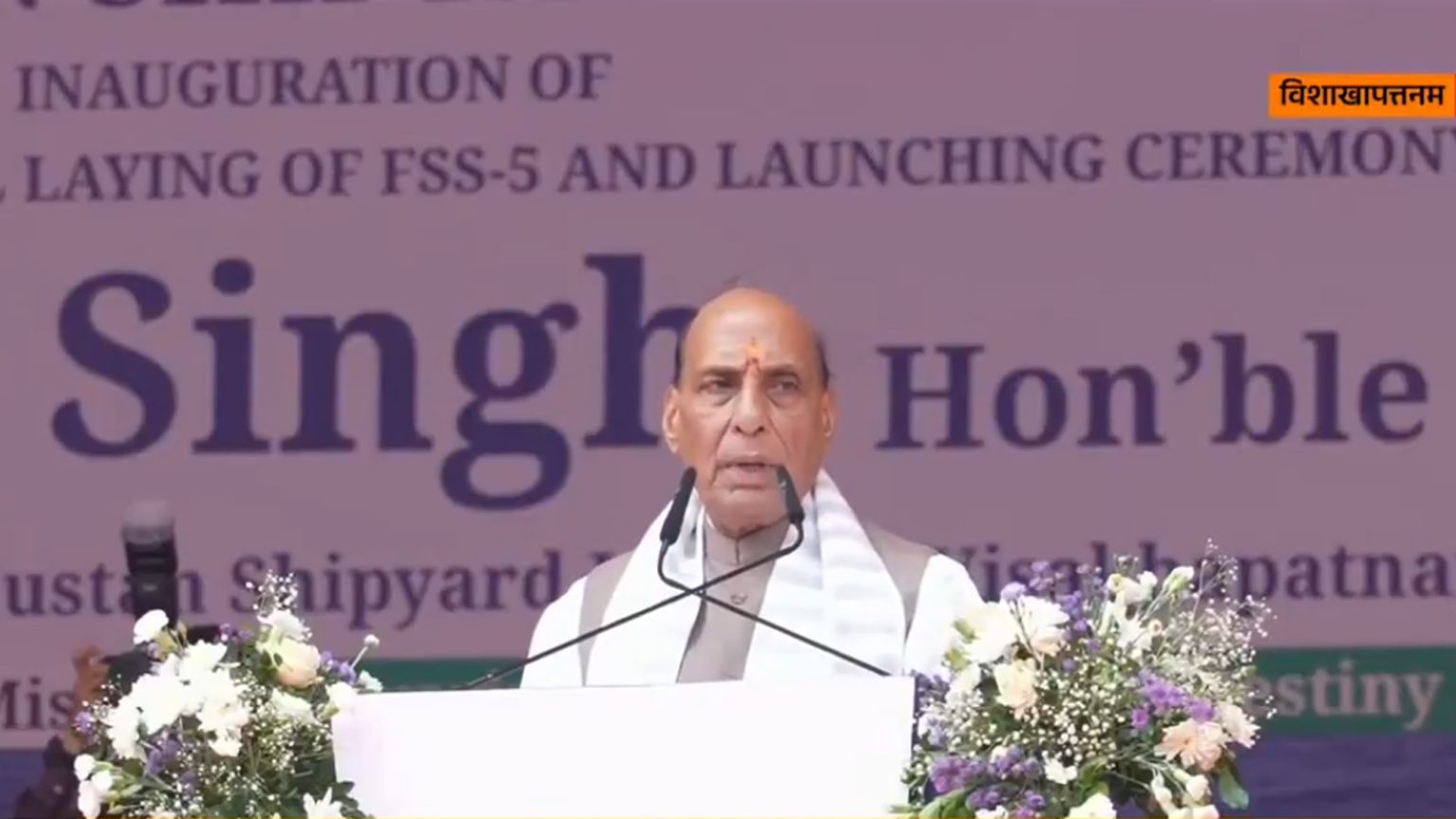

Amaravati [Andhra Pradesh]: Defence Minister Rajnath Singh on Tuesday launched the first indigenously designed and built Fleet Support Ship, ‘Surya’, at Hindustan Shipyard Limited (HSL) in Visakhapatnam, marking a milestone in strengthening the Indian Navy’s operational reach and endurance.
Singh also laid the keel of the fifth Fleet Support Ship, FSS-5, and inaugurated the upgraded Slipway-4 and a 300-tonne Goliath Crane, expanding the shipyard’s capacity to build larger and more complex vessels.
“The launch of FSS1 is a symbol of achievement, keel laying of FSS5 is a symbol of resolve and the new Slipway is a symbol of our growing capability,” he said, adding that HSL was strengthening both its shipbuilding capacity and the foundation of India’s maritime power.
FSS-1, named ‘Surya’, entered the waters of the Bay of Bengal following traditional honours performed by Laila Swaminathan, president of the Navy Wives Wellness Association.
Designed and built indigenously by HSL, the Fleet Support Ships will provide at-sea replenishment and sustained support to naval operations. They will feature enhanced cargo and fluid capacity, onboard first-line maintenance workshops, a helicopter deck for multi-role helicopter operations and self-defence systems.
Singh said sustained operations in distant maritime areas required logistics, maintenance and support capabilities alongside warships. The vessels would strengthen the Navy’s reach, endurance and operational effectiveness in the Indian Ocean Region, he said.
The upgraded Slipway-4 has been extended and strengthened to enable HSL to build and launch ships of up to 45,000 deadweight tonnes (DWT).
The 300-tonne Goliath Crane, spanning Slipways 3 and 4, was designed and manufactured by L&T Geostructure with Konecranes under Make in India. Equipped with programmable logic controller controls, variable frequency drives, tandem lifting, remote diagnostics and condition monitoring, it will enable faster and more precise handling of heavier blocks used in modern ship construction.
Recalling the launch of ‘Jala Usha’, the first ship built in independent India, at Visakhapatnam in 1948, Singh highlighted the country’s longstanding maritime heritage. He described HSL as a custodian of national maritime capability and praised its contribution to maritime and defence requirements for more than eight decades.
He also cited HSL’s attainment of Miniratna Category-I status in 2025 as an important milestone reflecting its transformation and sustained efforts after coming under the Ministry of Defence.
Calling for Indian shipyards to compete with leading global facilities, Singh said, “Self-reliance is an important milestone, but global competitiveness is the next big leap.”
He stressed that competitiveness would depend on quality, cost, technology, delivery and reliability, and called for HSL to become a benchmark for quality, productivity and timely delivery.
The minister urged closer integration between HSL and Andhra Pradesh’s industrial ecosystem. State MSMEs could become suppliers, universities could support research and skill development, technology companies could contribute to digital shipbuilding, and startups could develop maritime technologies, he said.
The objective should be a complete shipbuilding ecosystem around HSL, supported by logistics, port infrastructure, research, technology and skilled manpower.
Singh said the presence of the Eastern Naval Command, Naval Dockyard, HSL and Visakhapatnam Port gave the city a strong foundation for an integrated maritime ecosystem. He called for Visakhapatnam to be developed as a major maritime industrial hub, bringing together naval expertise, shipbuilding capability, engineering talent, port infrastructure and skilled workers.
He also advocated an integrated national maritime ecosystem involving the Navy, HSL, the Defence Research and Development Organisation, academia, industry, MSMEs and startups.
“India’s maritime strength cannot be built by the Navy or shipyards alone,” he said.
“Our goal should be simple and clear – design better, build faster, deliver on time, operate efficiently and do maintenance effectively,” Singh added.
He said India’s defence manufacturing ecosystem had undergone significant changes over the past decade, with greater emphasis on domestic design and production of sophisticated systems and platforms.
Timely delivery, productivity, indigenous design capability, supply chain resilience, skilled manpower, capacity and cost competitiveness would determine whether India could convert its shipbuilding potential into global competitiveness, he said.
Outlining priorities for HSL, Singh called for timely delivery to become part of its organisational culture, greater learning from leading global shipyards, stronger indigenous design capabilities, partnerships with MSMEs and startups, and lifecycle capabilities. He also emphasised closer coordination between the Navy and shipyards.
Indian shipyards should aspire to serve friendly countries and international markets, he said, and develop a global presence in maritime technology, ship repair and maintenance services, and engineering expertise.
The events were attended by Chief of the Naval Staff Admiral Krishna Swaminathan; Andhra Pradesh Minister for Roads, Buildings, Infrastructure and Development Janardhan Reddy; Visakhapatnam MP Sribharat Mathukumilli; Secretary (Defence Production) Sanjeev Kumar; Eastern Naval Command chief Vice Admiral Sanjay Bhalla; Coast Guard Commander, Eastern Seaboard, Additional Director General Donny Michael; HSL Chairman and Managing Director Rear Admiral C. Raghuram (Retd); and senior Navy and Defence Ministry officials.
[DD News]