




Manas Dasgupta
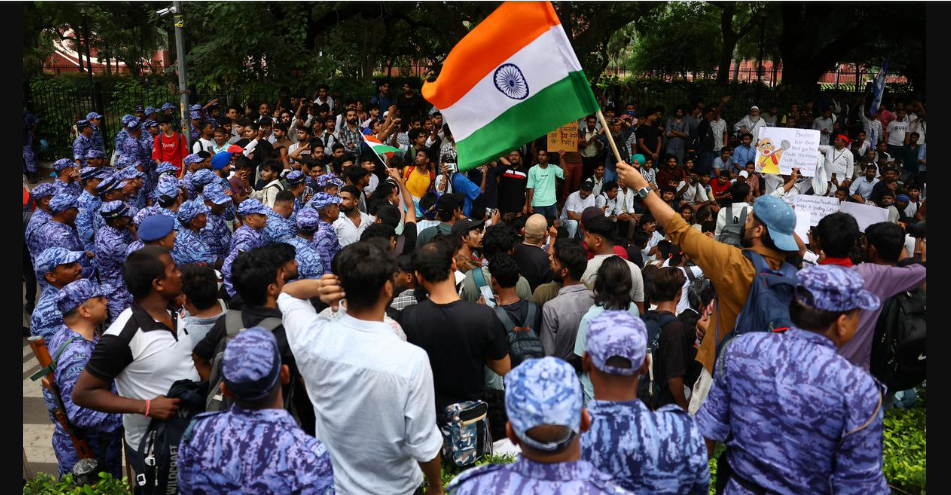
NEW DELHI, July 20: Monsoon session of Parliament began on Monday in a stormy note with both Houses being adjourned several times and ended the opening day without transacting any business amidst opposition sloganeering as the student protesters the Cockroach Janta Party (CJP) outside marched towards the Parliament House to press their demands, including immediate resignation of the union education minister Dharmendra Pradhan.
The opposition leaders criticised the government over handling the matter, with Leader of Opposition in Lok Sabha, Rahul Gandhi, dubbing Prime Minister Narendra Modi as the “most anti-youth” PM in the country’s history. “He’s so ‘anti-youth’ that he can’t even take the resignation of a failed Education Minister Dharmendra Pradhan,” Gandhi said in a video on X. Several other opposition leaders were seen supporting the CJP protesters, calling for sacking of Pradhan.
Leader of the Opposition in the Tamil Nadu Assembly Udhayanidhi Stalin took to X to condemn the “high-handedness of the police against CJP youth.” “For more than a decade now, DMK has been advocating abolition of NEET. Today, Tamil Nadu’s voice against NEET is resonating across the nation, including from the national capital,” Mr Stalin said. “Instead of addressing their concerns, the government is responding with its police force. This is unacceptable in a democracy,” he added.
Visuals from Mumbai showed police authorities cracking down against supporters of CJP, activist Sonam Wangchuk gathered near Chaityabhoomi.
In the Delhi High Court, hearing a petition claiming surveillance of protesters at the CJP-led sit-in at Jantar Mantar, a bench of Chief Justice DK Upadhyaya and Justice Tejas Karia asked the police whether Supreme Court guidelines on the issue were being followed.
In a landmark 2017 judgment, the Supreme Court had unanimously declared privacy an intrinsic part of the Right to Life and Personal Liberty under Article 21. This ruling set the foundation for the “proportionality test”, stating that any state surveillance must be lawful, necessary, and proportionate to the objective.
The petition in the high court, filed by former Jawaharlal Nehru University Students’ Union president Aishe Ghosh, contended that since the commencement of the protest by the CJP at Jantar Mantar on June 20, protesters have been subjected to continuous photography, videography and round-the-clock monitoring through a permanent surveillance tower.
It also alleged that the monitoring goes beyond documenting the protest itself and captures routine personal activities, including eating, resting, seeking medical assistance, and other aspects of daily life. Ghosh claimed women protesters were photographed and videographed even during rain, when their clothes were drenched.
During the hearing, the bench asked the Delhi Police whether it had seen Supreme Court directions on surveillance. “Did the Delhi Police follow those directions?” the bench asked Solicitor General Tushar Mehta. Mehta responded that there has been no surveillance. “At Jantar Mantar, every protest is always recorded. In this protest, a hundred people are seen making videos and reels. This is only for the purpose of law and order. There is no surveillance,” he argued. The bench then posted the matter for hearing on Tuesday.
The Delhi High Court on Monday also asked the Safdarjung Hospital to file Sonam Wangchuk’s, pathological reports and health bulletins and said it would take a call on Tuesday on the plea by the fasting activist’s wife Gitanjali Angmo to shift him to a private facility. The bench was hearing an appeal by Ms Angmo against a Sunday order of the high court refusing to interfere with his ongoing treatment at the central government hospital.
“The report should include today’s sample analysis,” said the bench of Chief Justice D.K. Upadhyaya and Justice Tejas Karia It said it would take a call on Tuesday on whether to allow Angmo’s plea to shift Mr Wangchuk to a private facility. Ms Angmo has challenged a single judge’s Sunday order which refused to interfere with the activist’s ongoing treatment at Safdarjung Hospital.
The bench asked the In-charge director of AIIMS as well as the AIIMS emergency doctor treating Mr Wangchuk to be present at the hearing, and also sought the presence of the doctor who was treating him earlier.
It also asked Ms Angmo to file the reports of Mr Wangchuk’s blood analysis, which were stated to have been undertaken at her behest at a private lab. The bench, earlier, agreed to hear the matter on an urgent basis after Angmo’s senior counsel mentioned it.
In her appeal, Ms Angmo contended that the single judge’s Sunday order illegally confines Mr Wangchuk to Safdarjung Hospital without any arrest and effectively directs that neither the activist nor his wife has decisive authority in determining his medical treatment. The appeal said the order does not address “informed consent” or one’s right to accept or reject any medical treatment.
In a special Sunday hearing, Justice Mini Pushkarna had refused to interfere with Mr Wangchuk’s treatment at Safdarjung Hospital stating that the government’s removal of the fasting activist from Jantar Mantar to a government hospital cannot be called arbitrary. The single Judge had opined that no interim order to immediately transfer the activist was required at this stage. The order said Safdarjung doctors were closely monitoring the activist, and it could not be said that any force was being used against him in violation of his bodily integrity.
Taking note of the high court’s July 16 order directing the authorities to monitor Mr Wangchuk’s health and medically intervene if necessary, Justice Pushkarna observed that since Mr Wangchuk did not check himself into any hospital facility, the government was “within its right” to take him to Safdarjung in view of his medical condition.
Mr Wangchuk has been on a hunger strike since June 28 at the CJP protest site at Jantar Mantar over alleged irregularities in competitive examinations and the deaths of several students linked to the NEET paper cancellation earlier.
The Delhi Police on Monday said it has taken cognisance of a viral drone video purportedly showing protesters gathered at Parliament Street and has launched an investigation into the alleged unauthorised drone operation. “The authenticity of the footage and the circumstances surrounding the drone operation are being verified. For this violation of applicable laws and drone regulations, appropriate legal action will be taken,” Delhi Police said in a statement.
A police source said the probe was initiated after the drone footage surfaced on social media. The source added that the New Delhi district is a highly sensitive area where prior permission is mandatory for flying drones, and any violation of the prescribed rules attracts legal action.