Media: Finally, the BBC apologizes to Trump, but refuses to pay compensation




Virendra Pandit
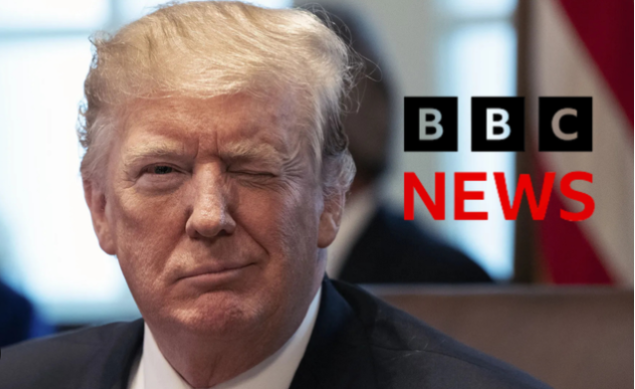
New Delhi: Continuing its hallowed ‘tradition’ of rushing to sensationalize reporting, and then apologizing, the British Broadcasting Corporation (BBC) apologized on Thursday to US President Donald Trump over its misleading editorial, but asserted there was no basis for his defamation claim.
If the case went to trial, however, legal experts said the BBC could show that Trump was not harmed because he was ultimately elected president in 2024!
It also said there are no plans to rebroadcast the documentary, which had spliced together parts of his speech that came almost an hour apart.
Its apology came over a misleading edit of the Republican leader’s speech on January 6, 2021, but said it had not defamed him, rejecting the basis for his USD 1 billion lawsuit threat, the media reported.
The BBC said its Chair Samir Shah sent a personal letter to the White House saying that he and the corporation were sorry for the edit of the speech Trump gave before some of his supporters stormed the US Capitol as Congress was poised to certify the results of President-elect Joe Biden’s victory in the 2020 election.
“We accept that our edit unintentionally created the impression that we were showing a single continuous section of the speech, rather than excerpts from different points in the speech, and that this gave the mistaken impression that President Trump had made a direct call for violent action,” the BBC wrote in a retraction.
The BBC received the letter from Trump’s lawyers on Sunday, demanding a “full and fair retraction” of the documentary, an apology, and that the BBC “appropriately compensate President Trump for the harm caused.”
The letter, that set a deadline of November 14, 2025, for the BBC to respond, also demanded retraction of other “false, defamatory, disparaging, misleading or inflammatory statements” about Trump.
It said the President should be “appropriately” compensated for “overwhelming financial and reputational harm.” Legal experts said that Trump would face challenges taking the case to court, but could use the mistake to try leverage a payout.
The dispute was sparked by an edition of the BBC’s flagship current affairs series Panorama, titled “Trump: A Second Chance?” broadcast days before the November 2024 US presidential election.
The third-party production company that made the film spliced together three quotes from two sections of the 2021 speech, delivered almost an hour apart, into what appeared to be one quote in which Trump urged supporters to march with him and “fight like hell.”
Among the parts cut out was a section where Trump said he wanted supporters to demonstrate peacefully.
Amid the raging controversy, BBC’s Director-General Tim Davie, along with news chief Deborah Turness, quit on Sunday (November 9), saying the scandal was damaging the BBC and “as the CEO of BBC News and Current Affairs, the buck stops with me.”
Deadlines to bring the case in English courts, where defamation damages rarely exceed 100,000 pounds (USD 132,000) expired more than a year ago. Because the documentary was not shown in the US, it would be hard to show that Americans thought less of him because of a program they could not watch.
The BBC’s apology came hours after a second similarly edited clip, broadcast on Newsnight in 2022, was revealed by the Daily Telegraph.
In the Corrections and Clarifications section, published on Thursday evening, the BBC said the Panorama programme had been reviewed after criticism of how Trump’s speech had been edited.
Lawyers for the BBC wrote to President Trump’s legal team in response to a letter received on Sunday, a BBC spokesperson said.
“While the BBC sincerely regrets the manner in which the video clip was edited, we strongly disagree there is a basis for a defamation claim.”
In his speech, Trump had said: “We’re going to walk down to the Capitol, and we’re going to cheer on our brave senators and congressmen and women.”
More than 50 minutes later in the speech, he said: “And we fight. We fight like hell.”
In the Panorama programme the clip shows him as saying: “We’re going to walk down to the Capitol… and I’ll be there with you. And we fight. We fight like hell.”
Speaking to Fox News, Trump said his speech had been “butchered” and the way it was presented had “defrauded” viewers.
In its letter to Trump’s legal team, the BBC sets out five main arguments for why it does not think it has a case to answer.
First, it said the BBC did not have the rights to, and did not, distribute the Panorama episode on its US channels. When the documentary was available on BBC iPlayer, it was restricted to viewers in the UK.
Secondly, the documentary did not cause Trump harm, as he was re-elected shortly after.
Thirdly, the clip was not designed to mislead, but just to shorten a long speech, and that the edit was not done with malice.
Fourthly, the clip was never meant to be considered in isolation. Rather, it was 12 seconds within an hour-long programme, which also contained lots of voices in support of Trump.
Finally, an opinion on a matter of public concern and political speech is heavily protected under defamation laws in the US.
A BBC insider said that internally, there is a strong belief in the case the corporation has put forward, and in its defence.
Concerns over the Trump Panorama documentary emerged when a leaked internal memo, written by a former independent external adviser to the corporation’s editorial standards committee, was published by the Daily Telegraph newspaper. Among other things, the document also criticised the BBC’s reporting of trans issues, and BBC Arabic’s coverage of the Israel-Gaza war.
In the past, the BBC has apologised on multiple occasions for various incidents, including misreporting and editorial errors. In February 2025, it apologized for a Gaza documentary; in March 2024 for a Russel Brand report; in January 2020 for the Kobe Bryant footage; in October 2008 for the Jonathan Ross and Russel Brand scandal; and in 2004 for the Hutton Inquiry and Iraq invasion.