Markets: Sensex, Nifty lose over 2% as West Asian war continues; Rupee also falls









Virendra Pandit
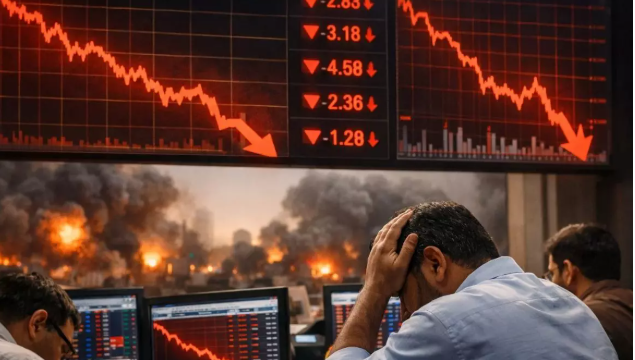
New Delhi: With no signs of an early end to the raging war in West Asia and the US sending more troops for a likely ground assault on Iran, Global as well as domestic benchmark indices Sensex and Nifty 50 closed deep in the red on Monday.
As the ongoing conflict entered its fifth week, with no signs of easing, Sensex plunged 2.22 percent (1635.67 points) to close at 71947.55 while Nifty50 was down 2.14 percent (488.20 points) ending at 22331.40.
The BSE Sensex made an intraday low of 71,774.13, down 1,809 points, or 2.46 percent, while the Nifty index dipped 535 points, or 2.34 percent, to hit a low of 22,283.85.
The Indian rupee on Monday breached the 95/USD-mark in intra-day trade on and settled at 94.78 (provisional) against the American currency after Iran war escalation jolted global markets, fuelling rupee volatility and risk-off sentiment.
The rupee (INR) depreciated nearly 10 percent against the US dollar in the current fiscal year (2025-26).
Meanwhile, Finance Minister Nirmala Sitharaman on Monday said the country’s economic fundamentals are strong, and compared to other emerging market economies, the Indian rupee is “absolutely going fine” against the US dollar.
In the share market, selling was broad-based, with all sectoral indices finishing in the red. From the Nifty 50 pack, only 6 stocks gained, while the rest traded in the red. Bajaj Finance, Kotak Mahindra Bank, SBI, IndiGo, Shriram Finance, Bajaj Finserv, Jio Financial Services dropped in the range of 3 to 5 percent.
India VIX, the fear gauge index, spiked 4 percent to 27.89, reflecting heightened market nervousness and suggesting that traders should prepare for sharp price swings.
Rising oil prices are weighing heavily on risk appetite. Brent crude rose over 3 percent to USD 116.12 per barrel, while US West Texas Intermediate was quoted at USD 102.96 per barrel.
Monday was also the monthly expiry for Nifty (March series). Additionally, it marked the last trading session of the current financial year (FY2026). An expiry session is typically marked by high volatility due to traders rolling over their futures and options (F&O) positions. Markets will remain closed on March 31 (Tuesday) on account of Mahavir Jayanti.
Asian markets
Monday’s decline in Indian headline indices was in line with the fall in Asian markets. Japan’s benchmark Nikkei 225 slipped 4.5 percent in morning trading to 50,979.54. Australia’s S&P/ASX 200 lost 1.2 percent to 8,417.00. South Korea’s Kospi dropped 3.2 percent to 5,264.32. Hong Kong’s Hang Seng fell 1.7 percent to 24,519.63, while the Shanghai Composite shed 0.7 percent to 3,884.57.
The drops in Asia follow deep declines on Wall Street last Friday, marking a fifth straight losing week—its longest such streak in nearly four years.
Broader Asian markets also remained under pressure, reflecting global risk aversion. Brent crude surged above USD 115 per barrel, intensifying macroeconomic concerns.
For FY26, the Sensex dropped 7% and the Nifty fell 5%, amid heavy FII outflows and persistent global uncertainties.
On Monday, financial stocks led losses; Bajaj Finance, SBI, Axis Bank, and Kotak Bank were among top laggards. FIIs sold Rs. 4,367 crores; March outflows hit Rs.1.14 lakh crore, worst in months.
Indian Rupee
The rupee on Monday breached the 95/USD-mark in intra-day trade on Monday and settled at 94.78 (provisional) against the American currency after Iran war escalation jolted global markets, fuelling rupee volatility and risk-off sentiment, the media reported.
Forex traders said the USD/INR pair witnessed high volatility and swung 165 paise during intra-day trade as the West Asian crisis entered the 31st day keeping energy markets nervous.
At the interbank foreign exchange, the rupee opened at 93.62 and then gained further ground to 93.57 against the US dollar, registering a gain of 128 paise from its previous close, after the Reserve Bank of India (RBI) brought down the net open position that banks can keep overnight at USD 100 million.
Through its circular dated March 27, 2026, the RBI capped the Net Open Position (NOP-INR) for banks at USD 100 million, with compliance required by April 10.
However, it failed to sustain the momentum and fell to an all-time intra-day low of 95.22 in intra-day trade against the American currency.
At the end of Monday’s trading session, the rupee was quoted at 94.78 (provisional), 7 paise higher from its previous close of 94.85 against the greenback.
On Friday, the rupee slumped by a massive 89 paise to close at a historic low of 94.85 against the US dollar.
Forex traders said the USD/INR pair is facing pressure from the elevated dollar index and crude oil prices. Safe-haven demand is keeping the dollar index firm above the 100-mark, limiting any meaningful recovery in the rupee.
Also, rising geopolitical tensions quickly reflected in oil prices, and Brent crude surged as fears of supply disruptions increased, they added.
The dollar index, which gauges the greenback’s strength against a basket of six currencies, was trading 0.15 percent lower at 100.30.
Since the commencement of the West Asia conflict on February 28, 2026, the rupee has depreciated by 4.1 percent to close at Rs 94.82 per USD on March 27, 2026.
Replying to the question, Minister of State for Finance Pankaj Chaudhary said the value of the rupee is market-determined and is influenced by various factors.
“The government and the RBI are keeping a close watch on the value of the rupee,” he said.