



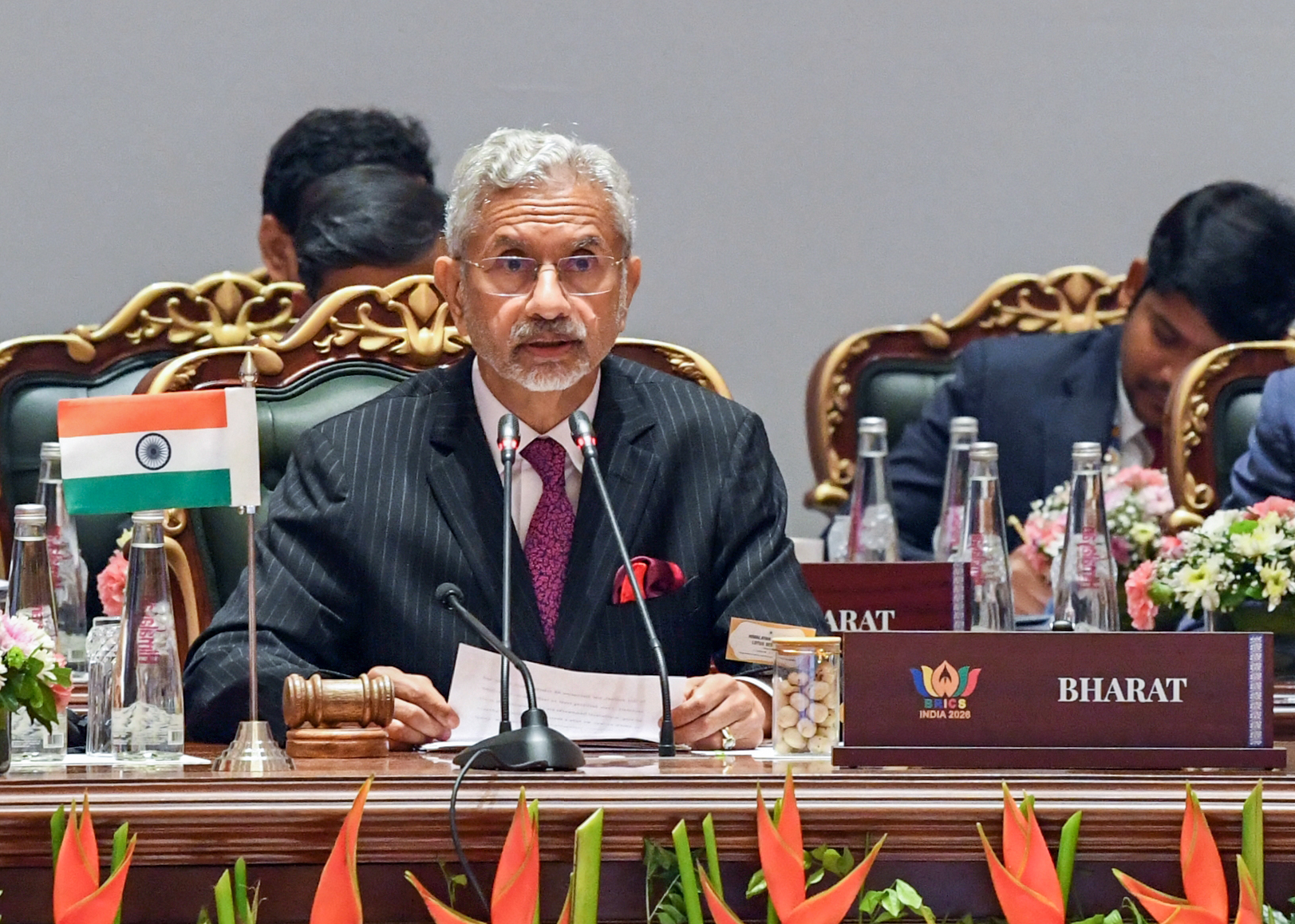

New Delhi: External Affairs Minister S. Jaishankar on Friday called for urgent reforms in global governance institutions, saying the existing multilateral framework had failed to keep pace with the realities of an interconnected, complex and multipolar world.
Addressing the BRICS session on “Reforms of Global Governance and the Multilateral System”, Jaishankar said the credibility and effectiveness of multilateral institutions were increasingly coming under scrutiny amid declining trust and inefficiencies in decision-making.
“The structures that underpin global governance have not kept pace with these changes,” he said, adding that reform was “not a matter of choice, but of necessity”.
Emphasising India’s long-standing position on “reformed multilateralism”, Jaishankar said global institutions must reflect contemporary realities and respond to the aspirations of emerging markets and developing countries.
Calling the reform of the United Nations central to this effort, he said the organisation’s key structures, particularly the Security Council, continued to reflect “an earlier era” despite the significant expansion in U.N. membership and responsibilities.
“Without meaningful reform, including expansion in both permanent and non-permanent categories, the effectiveness and credibility of the U.N. will remain constrained,” he said, while stressing the need for greater representation for Asia, Africa and Latin America.
Jaishankar also referred to ongoing discussions under the Inter-Governmental Negotiations process on Security Council reforms and said the time had come to move towards text-based negotiations.
He noted that BRICS had deliberated extensively on the issue, particularly during the Johannesburg Summit, and said the grouping’s outcome documents reflected a broad consensus on the need for reform.
The Minister also called for changes in the international financial architecture, pointing to vulnerabilities in supply chains, pressures on food and energy security, and unequal access to critical resources.
He said Multilateral Development Banks needed to become “more robust, more responsive, and better equipped” to mobilise resources at scale, while development and climate finance should be made more accessible and aligned with national priorities.
On global trade, Jaishankar said the multilateral trading system must remain rules-based, fair, open and inclusive, with the World Trade Organization at its core. At the same time, he said, the system must address asymmetries and reflect the concerns of developing countries.
“Non-market practices, concentration of supply chains, and uncertain market access have exposed the global economy to new risks,” he said.
Stressing that reforms should go beyond institutional structures, Jaishankar said multilateralism must also become “democratic, representative and effective”.
He reiterated that reformed multilateralism should be grounded in respect for sovereignty and territorial integrity, adherence to international law, and recognition of diverse national circumstances.
In his concluding remarks, Jaishankar said the present global situation underscored the need for cooperation, dialogue and overdue reforms.
“We must work together not only to manage global challenges, but to shape a more democratic, representative and equitable international order,” he said, adding that India remained committed to working with all partners towards advancing effective multilateralism.
(DD News)