




Nidhi Dave
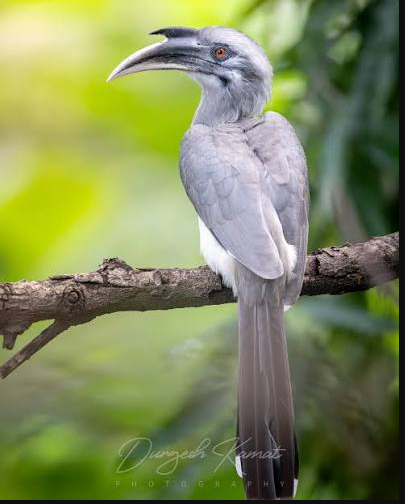
GANDHINAGAR, July 14: Gujarat has achieved another significant milestone in wildlife conservation with the successful reintroduction of the Indian Grey Hornbill to the Gir forests, where the species had been absent for more than six decades.
According to a statement issued by the Chief Minister’s Office (CMO), a recent scientific study has confirmed the success of the Indian Grey Hornbill reintroduction programme in Gir. The study found that the released birds have adapted well to their natural habitat, established stable territories and bred successfully in the wild.
Led by the Gujarat Forest Department in collaboration with conservation partners, the initiative represents a major milestone in restoring the locally extinct species to the Gir landscape and provides the first detailed scientific evaluation of the programme’s outcomes.
Gujarat Forest and Environment Minister Arjun Modhwadia said the successful reintroduction of the Indian Grey Hornbill marked a new chapter in the state’s wildlife conservation efforts, particularly in the recovery of rare and endangered species.
“Wildlife conservation in Gujarat has entered a new phase, with a stronger focus on species recovery and the protection of rare and endangered wildlife. The Indian Grey Hornbills reintroduced into the Gir landscape in 2021 have successfully adapted to their habitat, established territories and produced offspring. This marks a major milestone in restoring a species that disappeared from the region between the 1950s and 1960s. The scientific findings following the re-introduction confirm that the project has been a significant conservation success for Gujarat,” Modhwadia said.
Minister of State for Forests and Environment Pravin Mali said Gujarat’s conservation initiatives demonstrated the importance of protecting natural heritage through species recovery programmes. The findings were published in the peer-reviewed journal Birds in a study titled “Reintroduction of Indian Grey Hornbills in Gir, India: Insights into Ranging, Habitat Use, Nesting and Behavioural Patterns.”
Principal Secretary of Gujarat’s Forests and Environment Department, Vinod Rao, said one pair of hornbills bred successfully in the first year after release, followed by three more breeding pairs in the second year, indicating that the population is establishing naturally.
He added that the Indian Grey Hornbill played a crucial ecological role as a long-distance seed disperser, helping regenerate forests by dispersing the seeds of fruit-bearing trees across large areas.
Under the reintroduction project, 40 Indian Grey Hornbills were released in two phases—28 birds between 2021 and 2022, followed by 12 more in 2023. Eleven male hornbills were fitted with satellite transmitters to track their movement, habitat use and breeding behaviour.
Mohan Ram, Conservator of Forests, Junagadh Circle and co-author of the study, said the birds were translocated from healthy populations in Gujarat’s Aravalli forests after scientific assessments confirmed Gir as a suitable habitat.
Principal Chief Conservator of Forests (Wildlife) and Chief Wildlife Warden Jaipal Singh said the species likely to have disappeared from Gir due to hunting rather than habitat loss. He noted that improved habitat protection over the decades has made the successful return of the hornbill possible.
Satellite tracking revealed that the released hornbills initially ranged over large areas as they explored their new environment before gradually establishing smaller, stable territories. Their average home range decreased from nearly 61 square kilometres during the exploration phase to around 5.7 square kilometres after they had adapted to the Gir landscape.
Their average daily movement also reduced from 4.3 kilometres to 1.4 kilometres once they became established in the habitat, highlighting their successful adaptation to the Gir ecosystem.
The study found that the hornbills preferred Gir’s dry mixed deciduous and teak forests, nesting in mature trees and feeding their chicks on native fruits, insects and other invertebrates. Forest officials said their return is expected to strengthen natural forest regeneration across the Gir landscape.
Jaipal Singh said the birds’ successful breeding, stable habitat use and shrinking home ranges indicate that the reintroduction programme was moving towards establishing a self-sustaining population. He added that the Gir project could become a model for future bird reintroduction programmes in India.