



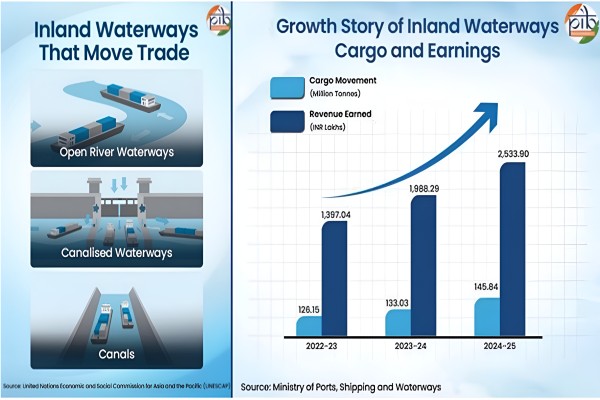

New Delhi: India is steadily transforming its extensive network of rivers, canals, and backwaters into a modern, efficient, and sustainable transport system, positioning inland waterways as a key pillar of its logistics and economic strategy. Backed by policy support and rising investments, the sector is witnessing strong growth in cargo movement, infrastructure, and tourism.
With 111 National Waterways spanning 20,187 kilometres across 23 states and four Union Territories, India has one of the largest inland water transport networks globally. As of March 2026, 32 of these waterways are operational, covering more than 5,100 kilometres, with plans to expand this to 52 in the next five years. The Union Budget 2026–27 has further proposed operationalising 20 additional waterways, signalling a major push for the sector.
This expansion is driven by the cost-effectiveness and environmental benefits of water transport. Global estimates show that inland waterways consume significantly less energy—up to six times lower than road transport— and produce fewer emissions. A single vessel carrying around 2,000 tonnes of cargo can replace around 125 trucks, reducing congestion, fuel use, and logistics costs.
The impact is already visible. Cargo movement on National Waterways reached a record 145.84 million metric tonnes in 2024–25 and rose further to 198 million metric tonnes by February 2026. Passenger traffic has also surged, increasing from 1.61 crore in 2023–24 to 7.6 crore in 2024–25, reflecting the growing role of waterways in both freight and mobility.
The government aims to increase the modal share of inland water transport from 2 per cent to 5 per cent by 2030, and much higher by 2047 under its long-term Maritime Amrit Kaal Vision. Cargo volumes are projected to exceed 200 million metric tonnes by 2030 and reach 500 million metric tonnes by 2047.
Complementing this is a broader strategy to double the combined share of inland waterways and coastal shipping from 6 per cent to 12 per cent by 2047.
A major focus area is infrastructure development. This includes maintaining navigable channels with adequate depth and width, building cargo terminals for loading and offloading , and installing navigation systems for safe vessel movement.
Flagship initiatives like the Jal Marg Vikas Project on National Waterway-1—which spans the Ganga-Bhagirathi-Hooghly river system from Varanasi to Haldia—are improving year-round navigability and boosting economic activity.
The Jal Marg Vikas Project has significantly boosted cargo movement on National Waterway-1, recording growth of over 220 per cent in the past decade. Multimodal terminals at Varanasi, Sahibganj, and Haldia, along with improved intermodal connectivity, are strengthening the logistics network and enabling seamless integration with road and rail systems.
Complementing this, initiatives under the Arth Ganga programme are enhancing livelihoods along riverbanks by linking farmers, artisans, and small producers to markets through water-based transport.
Policy reforms have also played a crucial role. Legal frameworks such as the Inland Waterways Authority of India Act, 1985 and the National Waterways Act, 2016 provide institutional support, while schemes like the Jalvahak Cargo Promotion Scheme incentivise cargo movement. Increased private sector participation is also being encouraged.
Sustainability is central to the strategy. Initiatives such as the Harit Nauka guidelines outline a roadmap for transitioning to green vessels, targeting a 30 per cent reduction in carbon intensity by 2030 and 70 per cent by 2047, aligning the sector with India’s climate goals and reducing the environmental footprint of transport.
Digital tools are enhancing efficiency and safety. Technologies like River Information Services enable real-time tracking, weather updates, and navigation support, while integrated platforms like the PANI portal and vessel tracking applications streamline operations and improve transparency.
Tourism is another emerging opportunity. River cruise activity is growing, with the number of cruise voyages rising from 371 in 2023–24 to 443 in 2024–25. The government’s long-term River Cruise Tourism Roadmap 2047 aims to expand cruise routes across the country. Scenic stretches such as the Varanasi to Haldia stretch on NW-1 and the Brahmaputra in the Northeast are attracting both domestic and international tourists.
The North-East region is becoming a key focus, with investments in river systems like the Brahmaputra and Barak, along with new terminals, navigational aids and connectivity projects, are improving connectivity and boosting trade. Cross-border linkages with Bangladesh are further strengthening regional integration by enhancing access to international markets.
Looking ahead, the government’s approach integrates infrastructure expansion, policy backing, technological advancement, and environmental sustainability to build a future-ready inland water transport system. By reimagining rivers as engines of economic growth rather than merely natural resources, inland waterways are expected to play a key role in lowering logistics costs, enhancing connectivity, creating jobs, and promoting inclusive development.
As India moves towards its long-term economic ambitions, the revival and modernisation of inland waterways signal not just a shift in transport policy, but a wider transformation in how the country leverages its natural assets for sustainable and equitable growth.
(DD News)