


Virendra Pandit
New Delhi: With the likelihood of a US-India bilateral trade-and-tariff deal in the coming weeks, New Delhi has reduced import of Russian crude, which Moscow is now offering on even higher discounts, the media reported on Tuesday.
India’s reduced Russian oil orders came slowly after the US raised tariffs on Indian imports to 50 percent in August and imposed sanctions on Russian oil giants Rosneft and Lukoil in October.
Curtailing Russian oil orders followed a series of US measures that have reshaped global trade flows as well.
For now, India has reduced its purchase of Russian crude oil for December 2025 deliveries, reflecting the growing impact of Western sanctions and ongoing trade negotiations with the US, the reports said.
Five of India’s major refiners have not placed any orders for the import of Russian crude for December deliveries. These deals are routinely finalised by the 10th date of each month.
The West’s recent actions increased scrutiny of India’s energy trade, with Washington accusing New Delhi of indirectly financing Russia’s war in Ukraine through its purchases of Russian oil.
Indian refiners buying less crude include Reliance Industries Ltd, Bharat Petroleum Corp. Ltd, Hindustan Petroleum Corp. Ltd, Mangalore Refinery and Petrochemicals Ltd and HPCL-Mittal Energy Ltd. Together, they accounted for nearly two-thirds of India’s Russian crude imports so far this year.
India’s caution stemmed after US President Donald said earlier this week that the two nations were “pretty close” to finalising a trade-and-tariff deal. As part of the bilateral talks, India has reportedly agreed to increase its crude purchases –shale oil–from the US.
But India is not putting all its eggs in the same basket. Two of its crude importers are still buying Russian oil for December.
Indian Oil Corporation (IOC) and Nayara Energy Ltd have secured Russian crude supplies for December 2025. IOC has already been buying from non-sanctioned suppliers, while Nayara, which is partially owned by the Russian major Rosneft, continues to depend entirely on Russian shipments.
According to reports, traders are offering Russian crude from non-sanctioned sellers at discounts of USD 3 to USD 4 per barrel. Despite this, Indian refiners remain cautious due to complex due-diligence requirements meant to ensure that sanctioned entities are not involved in the supply chain.
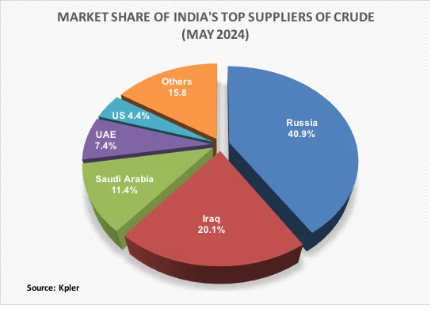
This year, Russia has supplied around 36 percent of India’s crude imports, but refiners are already looking for alternatives as a global oil surplus is expected soon.
IOC recently invited bids to buy up to 24 million barrels from the Americas for delivery between January and March 2026, while Hindustan Petroleum purchased 4 million barrels of US and West Asian grades for January 2026.
Besides, India’s state-owned refiners are returning to traditional suppliers in the Persian Gulf. Executives from Saudi Aramco and Abu Dhabi National Oil Co. (ADNOC) met Indian officials last week on the sidelines of an energy conference in Abu Dhabi, where they assured continued supplies, the reports said.
President Trump on Monday reiterated that India has ‘largely’ stopped importing oil from Russia and indicated that the US may soon lower tariffs on Indian goods.
Asked about progress on a trade deal with India and the possibility of reducing tariffs, Trump said, “Well, right now, the tariffs are very high on India because of the Russian oil, and they’ve stopped doing the Russian oil. It’s been reduced very substantially. Yeah, we’re going to be bringing the tariffs down… At some point, we’re going to be bringing them down…”
In recent weeks, Trump repeatedly praised Prime Minister Narendra Modi who, he said, has promised to scale back crude purchases from Russia. He also sounded positive about the ongoing trade discussions between the two countries.
Last week, the US President said, “They (trade talks with India) are going good, he stopped buying oil from Russia largely. He is a friend of mine, and we speak and he wants me to go there. We will figure that out, I will go…”
Trump is likely to visit India next year.