Energy: China increases Russian oil imports; India cuts down









Virendra Pandit
New Delhi: While India has recently cut down on the import of Russian crude because of reduced discounts, China has increased oil import, the media reported on Wednesday.
China’s oil refineries have placed new orders for Russian crude that will be shipped from ports that typically supply India, as demand from the South Asian country for Moscow’s crude slipped after Russia reduced discounts and US President Trump clamped tariffs on New Delhi.
At least 15 cargoes of Russian oil have been secured by Chinese refineries for October and November delivery.
Meanwhile, Roman Babushkin, Russia’s Deputy Chief of Mission in New Delhi, has termed the US pressure on India for its procurement of Russian crude oil as “unjustified.”
“We are confident that India-Russia energy cooperation will continue notwithstanding the external pressure,” he was quoted as saying.
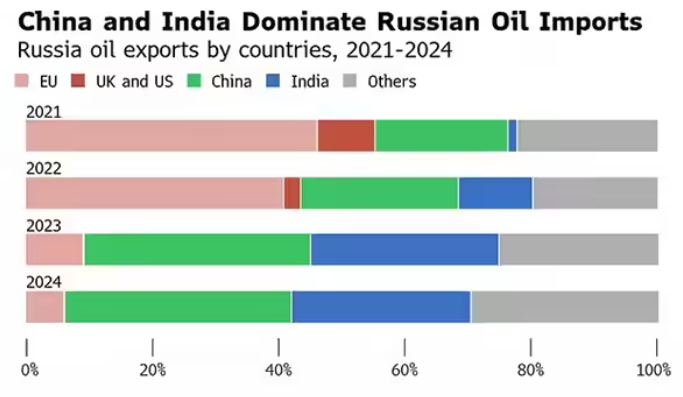
Since the Russian invasion of Ukraine in February 2022, which prompted the West to shun imports from Moscow, China and India emerged as the top two buyers of Russian oil. While Europe continued to buy, indirectly, the Russian crude refined by India, and China also continued to buy, Trump in July threatened to impose secondary tariffs on goods from countries importing Russian oil to pressure Moscow to end the conflict in Ukraine.
Accusing India of ‘funding’ the Russian war, he also announced an additional 25 percent tariff on Indian exports to the US, on top of another 25 percent levy, for its Russian oil and gas imports. This, and the reduced discounts, prompted India to cut down on its purchases. The Russian oil is still USD 3 per barrel cheaper than the Middle Eastern alternatives.
As of last week, China’s state-owned and large private refiners had purchased around 13 cargoes of western Russian crude for October delivery and at least two cargoes for November, the media reported.
The 15 cargoes of oil, each typically ranging from 700,000 to 1 million barrels, will be loaded from Russia’s Arctic and Black Sea ports – supplies that usually go to India instead of China, given its distance.
After his meeting with Russian President Vladimir Putin in Alaska on Friday last week, Trump told Fox News that he was not immediately considering retaliatory tariffs on China over its purchase of Russian oil, but suggested he may do so “in two weeks or three weeks.”
Last year, India imported USD 53 billion worth of petroleum and crude oils from Russia, according to the United Nations data. India’s Russian oil imports increased from a mere 1.7 percent share in total oil imports in 2019-20, to 35.1 percent in 2024-25. Moscow is now the biggest oil supplier to India.
China has also increased imports of discounted Russian oil since 2022. Russia provides 13.5 percent of China’s crude imports. In 2024, it imported USD 62.6 billion worth of Russian petroleum and crude.
However, China is unlikely to make up for the shortfall in India’s purchases of Russian oil, as India buys around 1.7 million barrels per day from Russia, while China purchases only about 1.2 million barrels of seaborne Russian oil daily.
India had turned to purchasing Russian oil sold at heavy discounts after the West imposed sanctions on Moscow.
At a media briefing in New Delhi on Wednesday, Babushkin said it is a “challenging” situation for India. “We have ‘trust’ in our ties with New Delhi.”
In the context of Western punitive measures against Russia, he said the sanctions are also hitting those who are imposing them.
Replying to a question, he said the role of the BRICS group as a stabilising force will increase amid the ongoing global turbulence.
Babushkin’s remarks came against the backdrop of strain in India’s ties with the US following Trump doubling tariffs on Indian goods to 50 percent, including an additional penalty of 25 percent for purchasing Russian oil.
Defending its purchase of Russian crude oil, India has been maintaining that its energy procurement is driven by national interest and market dynamics.