




Manas Dasgupta
NEW DELHI, Oct 28: While questioning why voters already included in the 2026 electoral roll are being required to fill out Form 6—a form intended exclusively for first-time voters, the Supreme Court on Wednesday observed that the Election Commission cannot alter Forms 6, 7, and 8, a complaint raised by the opposition parties.
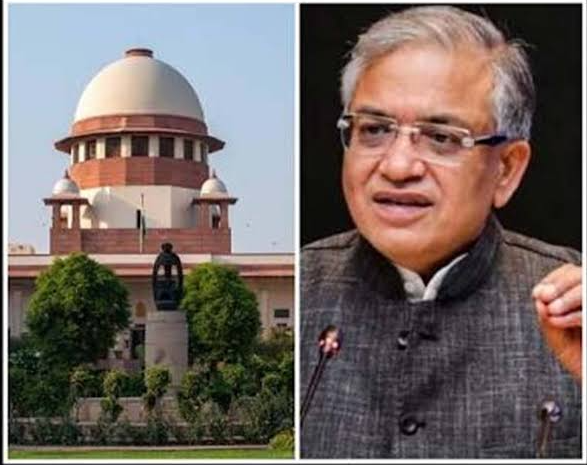
A bench led by Chief Justice of India Surya Kant which also included Justices Joymalya Bagchi and V Mohana was hearing a bunch of petitions on the Special Intensive Revision (SIR) of voters in Delhi. It questioned why individuals who were already on electoral rolls were being asked to fill out Form 6 to have their names re-enrolled. The CJI said Forms 6, 7, and 8 are prescribed formats and cannot be altered.
The bench, also questioned why the Commission is insisting on giving a deadline of October 30 when no election is due in the national capital in the near future. “Do not set a cut-off date for the re-enrolment of names,” the bench said.
The Supreme Court has directed the Commission to file a response within two weeks. Approximately 4.3 million (43 lakh) names have been removed from the draft electoral roll, either because they were missing or because the individuals were relocated elsewhere. The Election Commission has assured the Supreme Court that it will consider accepting forms submitted after the deadline, and that the October 30 cut-off date could be extended if necessary.
The judges have asked the Election Commission to devise a simpler solution for voters who, for various reasons, were unable to submit their enumeration forms. “If an individual previously on the electoral roll is no longer listed, a solution tailored to their specific situation should be found, rather than categorising them as a “new voter,” the bench said.
During the hearing, the Supreme Court stated that Form 6 is intended for first-time voters and the individuals already included in the 2026 electoral roll who have merely changed their address should be permitted to fill out Form 8 and they should not be required to declare that they were never previously registered as voters. Being away for a month or two for work-related reasons should not be interpreted as a permanent change of residence by the voter, the court observed.
The Supreme Court also noted that there may be individuals who have not moved at all but failed to receive the electoral enumeration form; a solution must be provided for such cases. The Court questioned whether an individual’s right to vote would be permanently forfeited simply because they failed to submit the form on time. The Court emphasised that, pending the finalisation of the electoral roll, applications should not be rejected solely on the grounds of late submission.
The Supreme Court pointed out that many labourers, street vendors, and daily-wage workers in Delhi frequently relocate for work. The Election Commission should take the initiative to reach out to them, rather than placing the entire burden on the individuals themselves.
The Supreme Court further directed that the list of individuals removed from the electoral roll should be made public. This information should be provided in simple Hindi and local languages, explaining the reason for the removal and the consequences of failing to respond.
Justice Bagchi remarked that the orders previously issued in the context of Bihar do not resolve all issues pertaining to the ‘SIR’ (Summary Revision/Verification) process. Furthermore, a final decision has yet to be reached regarding the validity of the scrutiny process concerning logical discrepancies in the electoral roll.
Representing the petitioners, senior advocate Prashant Bhushan argued that a large number of voters either did not receive the enrolment forms or were unable to submit them for various reasons. This includes individuals who may have relocated from one part of Delhi to another. Form-8 is intended for address changes, while Form-6 is for the registration of new voters. Consequently, it is unreasonable to compel existing voters to declare – via Form-6 – that they were not previously included in any electoral roll, he said.
The Chief Justice remarked that the Election Commission should not merely wait for voters to submit applications. Instead, it should make efforts to reach out to them directly. The Commission should continue the process of accepting applications via Form 6 and Form 8, urging them to “adopt the simplest solution,” he suggested. The Commission has indicated its willingness to extend the deadline for the submission of applications.
The petitions filed by transparency activists Anjali Bhardwaj and Amrita Johri argued that when the SIR process started in Delhi, the total number of voters was approximately 1.45 crore. Of these, about 9.7 million (97 lakh) individuals submitted their enumeration forms, while forms from approximately 47 lakh people were not received.
Bhushan said according to the Election Commission, approximately 43 lakh voters have been categorised as either ‘permanently shifted’ or ‘absent.’ Within this group, around 31.59 lakh voters are marked as ‘permanently shifted,’ while approximately 11 lakh are classified as ‘missing’ or ‘untraceable’. Additionally, around 2 lakh voters have been marked as deceased.
He argued that a significant number of these individuals might be people who never received an enumeration form, or who were unable to submit one for various reasons.