Earthquake: An 8.8 mega-temblor in Russia triggers tsunami warnings in Japan, the US, etc









Virendra Pandit
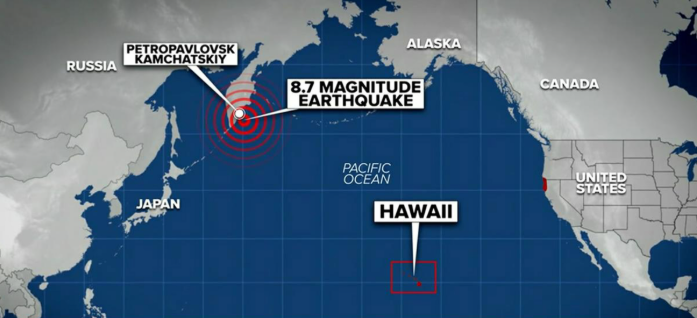
New Delhi: A magnitude 8.8 quake hit Russia’s Kamchatka Peninsula on Wednesday morning, prompting tsunami warnings as far away as Japan, the US West Coast, and other countries, multiple media reports said.
Fearing huge losses, Japan prepared to evacuate around two million people.
Until Wednesday afternoon, tsunami warnings were issued for Russia, Japan, Australia, Taiwan, the Philippines, China, the Hawaii Islands, Guam, Tonga, California, Alaska, Oregon, Washington, British Columbia, Mexico, Peru and Ecuador.
India was safe, the media reported.
Early reports said the tsunami-hit Severo-Kurilsk on Paramushir, one of Russia’s northern Kuril Islands on the Far East coast, and has been described as the deadliest temblor since the 1960 Chile quake. It is also one of the six most devastating earthquakes ever recorded.
Tsunami warnings and advisories have been issued for several countries with Pacific coastlines. Waves generated by the powerful quake in Kamchatka Peninsula struck parts of Russia, Japan and Hawaii on Wednesday. The earthquake and the subsequent tsunami warning triggered evacuations across the Pacific, with Japan asking nearly two million people to evacuate.
Tsunami waves struck parts of Kamchatka, partially flooding the port and a fish processing plant in the town of Severo-Kurilsk and sweeping vessels from their moorings, regional officials and Russia’s emergency ministry said. A tsunami height of 3-4 metres (10 to 13 feet) was recorded in Kamchatka.
The Russian Pacific town of Severo-Kurilsk was hit by waves at least 3 metres (9.8ft) high, and the most powerful was as high as 5 metres (16.4ft), Russia’s Ria Novosti news agency reported, citing emergency services.
The seaport town in the Sakhalin region was flooded, forcing the evacuation of its 2,000 residents, Russia’s Ministry of Emergencies and Disaster Relief said.
“A state of emergency is in effect in Petropavlovsk-Kamchatskiy …,” Mayor Yevgeny Belyaev said in a social media post. Petropavlovsk-Kamchatsky, home to some 165,000 people, is the administrative centre of the Kamchatka Peninsula.
Japan, which was affected by a devastating 2011 tsunami, has been hit by four to five rounds of waves. The Japan Meteorological Agency warned tsunami waves showed no signs of receding. The height of waves continues to grow, from 20cm (0.6ft) earlier today to 1.3 metres (4.2ft) in the northeast of the country, it said.
Tsunami alarms sounded in coastal towns across Japan’s Pacific coast and evacuation orders were issued for tens of thousands of people. Workers evacuated the stricken Fukushima nuclear plant, where a meltdown following the 2011 tsunami caused a radioactive disaster, operator TEPCO said.
Footage on public broadcaster NHK showed scores of people on the northern island of Hokkaido on the roof of a building, sheltering under tents from the beating sun, as fishing boats left harbours to avoid potential damage from incoming waves.
Shortly after 07:30 GMT, the Pacific Tsunami Warning Center said waves of up to 1.7 metres (5.5ft) were affecting the Hawaiian Islands. Hawaii Governor Josh Green said data from Midway Atoll, between Japan and Hawaii, measured waves from peak to trough of 6 feet (1.8 metres). He had earlier said all flights in and out of Maui had been cancelled.
The first tsunami waves were detected in Monterey, California at 12:48am local time (05:48 GMT), according to data from the National Oceanic and Atmospheric Association.
Elsewhere, the US Tsunami Warning Centres said waves as high as 3 metres (9.8ft) could hit Ecuador, while waves of 1 to 3 metres (3.3-9.8ft) were possible in Chile, Peru, Costa Rica, Japan and some Pacific islands.
Chris Elders, a structural geology expert at Curtin University in Australia,said that Wednesday’s earthquake occurred in the Pacific Ring of Fire, an area of significant volcanic and earthquake activity.
“In this particular part, the Pacific Ocean is moving down underneath the eastern side of Russia … and it’s that movement of the tectonic plates that produces these very large earthquakes,” Elders said.
“The earthquake causes the seabed to lift up a little bit, and that displaces the water sideways, producing the tsunami wave, and it’ll spread away from the epicentre,” he said.
New Zealand’s disaster management agency warned that the country’s coastal areas could expect “strong and unusual currents and unpredictable surges at the shore”.
In a national advisory alert, Civil Defence New Zealand said there was no immediate need to evacuate but said citizens should stay away from beaches and shore areas.
And while Australia was added to the advisory list by the Pacific Tsunami Warning Center, the country’s Bureau of Meteorology said there was no threat to the Australian mainland, islands or territories.
The earthquake, which struck at 8:25am Japan time (11:25 GMT), was the strongest in the Russian region since 1952, according to the Russian Academy of Sciences, and struck at a depth of 19.3km (12 miles). The shallow earthquake damaged buildings and injured several people in the remote Russian region.
At a magnitude of 8.8, it is believed to be the sixth strongest earthquake in history. A 2010 earthquake in Chile, the last quake recorded at 8.8, killed 523 people and destroyed more than 370,000 homes.
Meanwhile, the Indian National Centre for Ocean Information Services (INCOIS) — which houses the Indian Tsunami Early Warning Centre (ITEWC) — in Hyderabad recorded two deep sea earthquakes off the East Coast of Kamchatka (8.7 magnitude) and Kuril Islands (6.5 on the Richter Scale) in the Russian Far East region in the early hours. It said there is no threat whatsoever to the Indian coastlines on Wednesday.
The agency under the Ministry of Earth Sciences (MoES) had also stated that the both the quakes had occurred at depths of 10 km each.